Editor’s note: This is the monthly contribution from Boardhawk columnist Dr. Aaron Massey.
A college friend, I think her name was Meghan, looked me square in my eyes and said “we are meeting him today.”
We were in a swing county in a swing state in 2008 when we heard that he was going to be in town. The first hurdle was the Secret Service. What can we say that will convince them to let us in the rally?
We landed on: please.
The next was getting to the front. Meghan, another volunteer, and I locked arms and pushed towards the front of the crowd. And there he was. It was my first time meeting a presidential candidate.
He went on to become the first Black president of the United States. Right after Auntie From Illinois yelled at him about her energy bill, I shook his hand. There was something about that moment that inspired me to at least try to change the world for the better.
We left that moment and went straight to talk to the people about someone who, just minutes ago, changed our lives.
Those neighborhoods we canvassed swung his way, subsequently swinging the state. We did it. We made something happen or at least contributed to it.
For his reelection, I was in graduate school which was about 40 minutes from another swing county in a swing state. So of course I volunteered. With the same fire from four years ago, I joined a group of volunteers to talk to the people again.
Only this time, we were pulled over by six state troopers. We were accused of the very real and not made up at all crime of “rattling doors.” We were then told that we needed to report to the police station, bring all the flyers we had (each of which would have to be individually approved), and consent to a “thorough” background check.
Or we had to leave their state immediately. We called our higher-ups, they said leave, and we were escorted out of the state.
And just like when I shook his hand, being kicked out of a state for talking to people about a candidate’s values, ideas, and policies stuck with me. I was familiar with masked-Midwestern racism. “Bless your heart” migrated from Mississippi, settled in St. Louis, and transformed into “oops, sorry” for segregation.
But I hadn’t yet understood that a community could have different beliefs than the institutions that served them. And that people in power never wanted us to talk because they knew we were more alike than different.
We won that swing county and, subsequently, won that swing state. Unlike the gleeful celebration in 2008 at Denny’s, this win felt dangerous. The winners felt like they’d arrived. Solved racism. All leading to complacency. The losers reified replacement theory discourse into radio stations and television networks. And that’s where we live now.
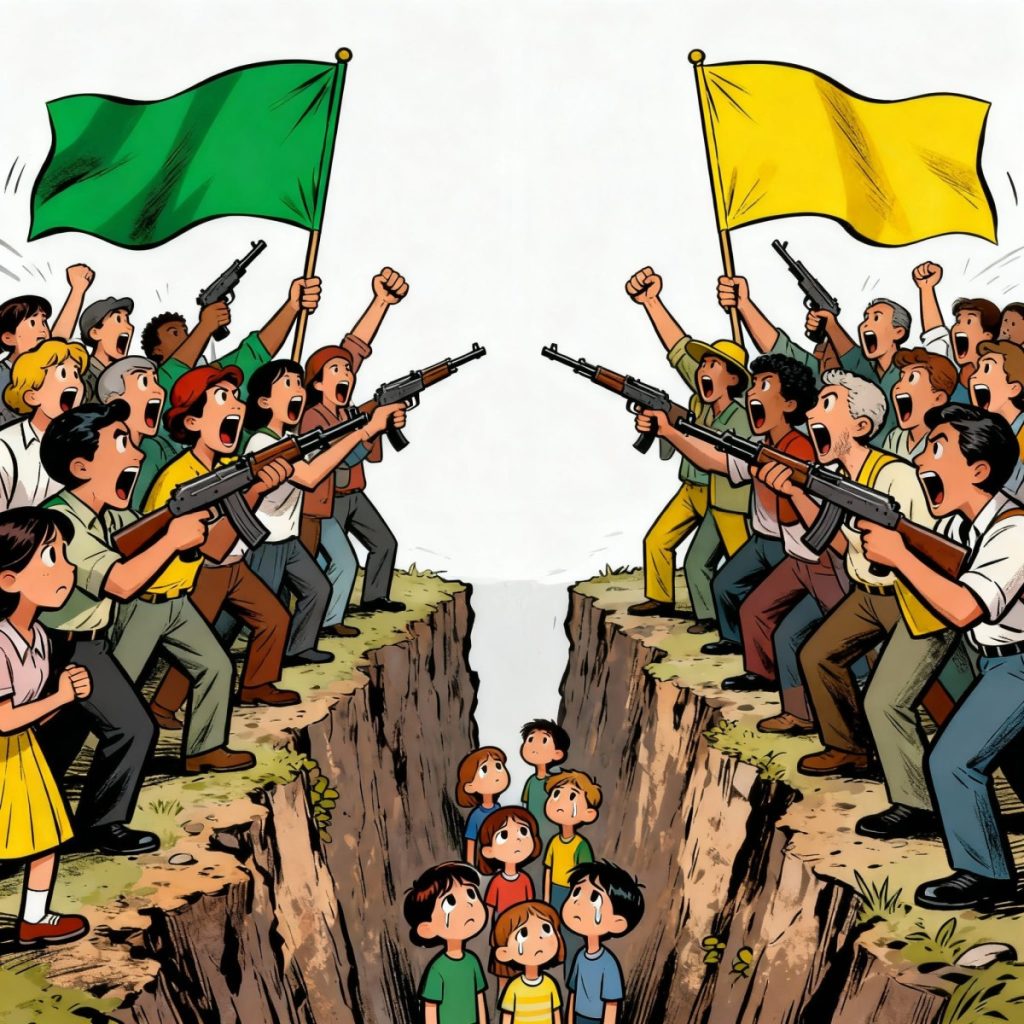
That’s where our children live now.
That’s where our world’s children live now.
If you vote for this political party, you’re woke. And if you vote for this one, you’re based. The belief that you are something because of one action supplants your duty towards civic responsibility. Feeling like you are a part of a social club becomes more important than making steps towards meaningful change in the ways you see fit.
I might not agree with the change you seek. But I do agree that you should be allowed to safely seek it. We aren’t there anymore.
Young people inherited ‘politics over people’ from us.
Why else would it be perceived as political to say that 18,000 children have been murdered in Palestine?
The opposite end of that emptied-middle spectrum is true as well. A young person ended the life of a racist leader instead of debating him. Condemning murder while also condemning racism in the same breath has become political.
The consequence of political fandom and extreme dichotomous rhetoric is a growing number of political cheerleaders and conscientious murderers. And we have ourselves to blame.
These are the consequences of modeling hatred of those who don’t share the same opinion as you while reducing nuance in society. Remember the barely-discussed-now movement to defund the police? Real people felt real pain of police violence in their communities. Real people lost their lives to police shootings.
But because we listened to the loudest voices in the room on both sides, we missed out on an opportunity to do anything. Where were the people in the middle asking for a thoughtful evaluation of funding strategies for police with deadlines and measurement tools? We were in the background watching ya’ll politicize a public health issue. And thus, we never modeled building bridges with people we disagree with for young folks.
Have we modeled civil disagreement lately?
However difficult it is to accept, there are folks in the same political party as you that don’t share all of the same ideologies. There are Republicans who support gun restrictions. There are Democrats who don’t support the trans community.
But because we’ve delved so deeply into cancel culture, the spaces where we would have begun to build understanding of our differences have diminished. We’ve come to believe that we are so different from each other. That poor Black folks and poor White folks are opposites, for example. The only group of people that a vast majority of us are substantially different from are billionaires.
No group of rich, straight, White elitists have moral authority over another. No matter what colors you rep.
There are elected officials that vote against their own ideals to stay in office. If they feel pressure to acquiesce to political norms, surely our children are feeling something. There are corporations that have changed language/roles/departments due to political pressure. Colleges and universities, the very same. We modeled that. Surely new/rising voters feel that tension.
And with a limited understanding of previous political environments, young folks have begun to promote our mistakes and misdirections.
That is the biggest societal failure of our time.
Modeling for young voters how to make humanitarianism political.
People scoffed when President Obama won a Nobel Peace Prize for his campaign built on hope. But that’s just what we need. Hope that our future generations won’t follow our model. Hope that we haven’t impacted them as much as I think we have.
And hope that they will choose to think differently about cancel culture, sound bites, division, and possibility.