Editor’s note: This piece by Peter Huidekoper Jr. strays from the typical focus of Boardhawk pieces. We are publishing it because it gets at a central question that is too seldom asked: For what is education supposed to prepare students, K-12 as well as post-secondary? Is it simply to become cogs in the working world (though certainly being able to support a family is an important outcome), or to become contributing citizens capable of critical thinking, self-reflection, and empathy? It’s well worth a read.
So rather than college-for-all we have moved on to: why college?
Leading to the anemic answer: to get a well-paying job.
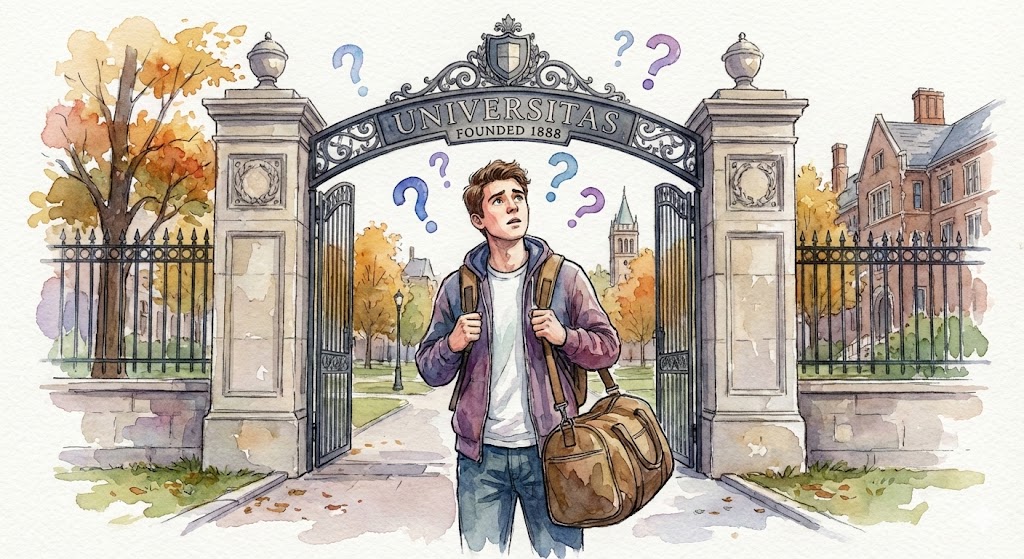
Causing our college freshmen to feel compelled to KNOW where they are headed. KNOW your major ASAP (preferably your double-major, as it will look better on your résumé). KNOW what career you are pursuing ASAP.
None of this “checking out” hundreds of options in that course catalog. TAKE WHAT IS NECESSARY to get you job-ready the day you graduate. And DON’T WAIT TILL SOPHOMORE YEAR to be on track. START NOW!
So much for the freedom of freshman year!
The past two years I have been lucky to know a number of students who graduated high school in May. They are now off to college, in five different states. I hope my questions to them last fall — What do you think you want to study? —did not add to their sense that THE ADULT WORLD WANTS ME TO NAIL THIS DOWN BEFORE I HAVE EVEN FINISHED MY COLLEGE APPLICATION! I was just curious.
They surprised me. Most appeared more certain about their direction than many in my Boomer generation were at 18. They told me of majoring in business, chemistry, criminal law, kinesiology, marine biology, nursing … They have a plan. Three cheers to them!
But I wonder: Have we forced them into KNOWING their direction, even before they step on campus?
I majored … in dropping out. Three times, or four? From two different college campuses. I took eight years to get my degree. A difficult journey, due, in part, to NOT KNOWING where I was headed. Is this still allowed?
In this current zeitgeist, are students afraid of entering college admitting to any doubts about what they hope to do? Have we limited their options before they have even begun to find out what might be possible? Are the costs so high they feel bound to “get with the program”? Have we persuaded them that, even at 18, they should seek guarantees—my family and I will spend (x) and take on a debt of (y) in order that I graduate with a job paying (z)?
Colorado Department of Higher Education and the “Minimum Value Threshold”
This is the bottom-line approach the state of Colorado is marketing. Assure students and their families that a college education is a sound investment. Based on a cost/benefit calculation. It must “pay off.” If not, why bother?
The legislature passed HB22-1349 which, if you can believe this, will allow us to KNOW the value of college. And, amazingly, there is a math formula for this! A working group has developed “the most appropriate empirical model to estimate a Minimum Value Threshold (MVT) of postsecondary credentials”:
| Incremental earnings | –
(subtract) |
Cost specific to attending higher education | =
(equals) |
Colorado Minimum Value Threshold |
This – and All the Data You Could Ever Want – is found in the latest aptly named “2025 Higher Education Return on Investment Report,” courtesy of the Colorado Department of Higher Education (CDHE). The opening letter from Gov. Jared Polis and CDHE Executive Director Angie Paccione acknowledges that choosing college is hard. But today, they write, we can KNOW the benefits:
This report gives Colorado learners, their families, and people who support them the information they need. It shows data about how much people earn and whether their education pays off financially.
(I trust this much is clear: no one is even pretending to measure what students have learned.)
Students, mom, dad: this is a business transaction. ROI in spades. Figures 1-25 (e.g., Median Earnings for Associate Degree Completers 1, 5, and 10 Years After Graduation); Tables 1-24 (e.g., Distribution of Instructional Programs for Completed Credential, by Age Group). All in 58 pages.
No ambiguity. A clear path, safe and secure. And apparently, this is what some students want.
David Brooks: “the most rejected generation”
In a recent piece in The New York Times, “We are the most rejected generation,” David Brooks heard from a college student at Williams College. As a result of the current culture, this young man said, he values “security and stability above all.” He continued:
“… the culture of rejection leads many people to favor earliness and decisiveness above other qualities. You’ve got to specialize in a sport or musical instrument by age 12 if you want to be good enough to be impressive by the time you’re 18… You have to pin yourself down to a single coherent narrative if you’re going to impress an admissions committee. You’ll want to pick a career track early so you won’t be tortured by uncertainty.”
And we thought uncertainty, doubt, and NOT KNOWING (see Socrates) was the beginning of wisdom! Not a bad state of mind, we were once told, to begin one’s college years. Perplexed. Humble. Unsure.
But curious too. And excited. Hoping that college will bring clarity about … who we are and who we want to be.
And therein, for many of us—certainly for me—was its value.
As a college freshman I had it figured out. My strong faith gave me a clear direction—until the middle of junior year when I no longer held those beliefs. My sense of purpose collapsed. To stay and get a degree made little sense. It was more than, why college? At times it was, why life?
I would never recommend my eight years of wandering—physical and spiritual—to any college freshman today. I was often lost. I had disappointed a lot of people.
But I was lucky. Friends and family did not give up on me.
And I was free to ask some bigger questions about my purpose and my future. Returning to college—in various steps—was part of the journey.
Justin Schwartz, Chancellor of the University of Colorado at Boulder
The Chancellor of the University of Colorado at Boulder understands that this is, in part, why college. In August, Justin Schwartz spoke with Jenny Brundin of Colorado Public Radio. Once again, we heard about the connection between college, the student, and the economy. But Schwartz had a different calculation in mind.
How does he think about the value of certain degrees, Brundin asked, “especially as the price of university has risen — more people have this expectation that, ‘oh, a job should be waiting for them at the end of four years.’”
Higher education, he answered, must ask, “what do our students need long-term and what does our society need them to have long-term?” He spoke of creating courses for an unpredictable tech industry: a few years ago, there was a sudden demand for more computer science majors; today, not so much. Determining the Perfect Major leading to that Well-Paying First Job, he suggested, might not be wise, or even possible.
The challenges that our graduates are having now, it’s not because they got the wrong degree; it’s because we have a challenging economy right now. We need to think not just from that perspective of sort of the immediacy of the economic cycles, but really preparing our citizens to be able to think and to be intellectually nimble and agile in a way that they’re going to find different ways to contribute over the course of their careers.
How encouraging it is to hear a Colorado leader reflect on the personal journey each student is taking. To help students succeed, he said, the college will seek:
to remove those barriers … that can get in their way, so that they have an easier time of focusing on why they’re here, which is to learn, to engage, to figure out what they want to do and who they are, so that when they leave here with a degree, they are ready to do what they want to do in life.
“To figure out.” Because they did not arrive KNOWING. Because they are in college above all to learn and grow as human beings. To FIND OUT where they might be headed, not merely to get that ticket punched so they can proceed to the next station.
Not the language of Return on Investment. A different perspective on the value of education.
For the college freshmen I know, I wish them courage and faith in their own journey. I hope they really do feel free to explore. And not just their career path, but their purpose, and how to create a rich life – full of meaning.
Four years (or eight!) is only part of that lifelong journey.