
In 2024 the Colorado Department of Education (CDE) rated Denver’s Abraham Lincoln High School on a Turnaround Plan, the lowest rating in the state accountability system.
In 2025, after initially giving the high school the second lowest rating, on a Priority Improvement Plan, CDE revised and boosted its rating to on Improvement, the second highest rating.
It is hard to see why.
Abraham Lincoln was first placed on Priority Improvement in 2014. There is no evidence that it suddenly made significant improvement last year.
Our most vulnerable students—at Abraham Lincoln this year, over 97% are minority, over 95% are on free and reduced Lunch—deserve a good education. How does CDE’s recent decision serve these students?
Colorado’s approach to accountability seeks to identify and assist our lowest performing schools. Naming schools “on the accountability clock” is perceived by critics as harsh; some even protest it is a kind of punishment.
But the purpose is sound. The public – parents, the school community, and the district – need to know if a school is serving its students well. If its performance the previous year is unsatisfactory, we should know that. Accountability, at its best, triggers a new sense of urgency on the need for change.
Chalkbeat Colorado’s recent story, “Denver’s Lincoln H.S. improves state rating amid immigration enforcement fears, other challenges,” reminded us of the difficult circumstances for the school community.
It noted, too, that the school’s “academic growth … was the highest it’s been since before the pandemic.” This needs some context.
In 2024 the Median Growth Rating percentiles for Abraham Lincoln earned the lowest rating of Did Not Meet Expectations: Reading/Writing (31%); in Math (34%). In low-performing schools, growth must exceed 60% if their students are to catch up with their peers.
In 2025 growth scores climbed to 42% in Reading/Writing, to 44.5% in Math – thus the “double digit increase.” Better. But with such low achievement results in 2024, and still unsatisfactory growth scores in 2025, what are the results?
On the state assessments:
- SAT (11th grade) mean scale score on Reading/Writing – up from 372 in 2024 to 387 in 2025. An increase from 12.8% to 16.7% Meeting Expectations. (State average Meeting Expectations, 61.5%.)
- SAT mean scale score on Math – up from 378 to 401. Which only meant an increase from 5.1% to 7.3% Meeting Expectations. (State average, 32.5%.)
| SAT – 11th grade | Mean scale score
(Maximum score is 800) |
|
| Reading/Writing | Math | |
| State Average | 507 | 479 |
| Meets Expectations | 495 | 466 |
| Approaches Expectations
(Scores below Do Not Meet Expectations) |
448 | 423 |
| Abraham Lincoln High | 387 | 401 |
| R/W score: 120 pts below state average; 83 pts below Minimum Score in Grad. Guidelines.
MATH score: 74 pts below state average; 79 pts below Minimum Score Grad. Guidelines. |
||
PSAT – % Meeting Expectations
READING/WRITING
- Grade 10: slight increase from 2024, 15.9% to 21.7%.
- Grade 9: significant decline from 2024, 30.7% down to 17.3%.
MATH:
- Grade 10: slight increase from 2024, 4.4% to 6.6%.
- Grade 9: slight decline: 7.6% to 7.3%.
Extremely troubling results. Even more revealing (see graph) is that on the state’s Reading/Writing assessment, the majority of students (69%) in grades 9-11 scored – not Meeting, not even Approaching – but at the lowest performance level, Did Not Yet Meet Expectations.
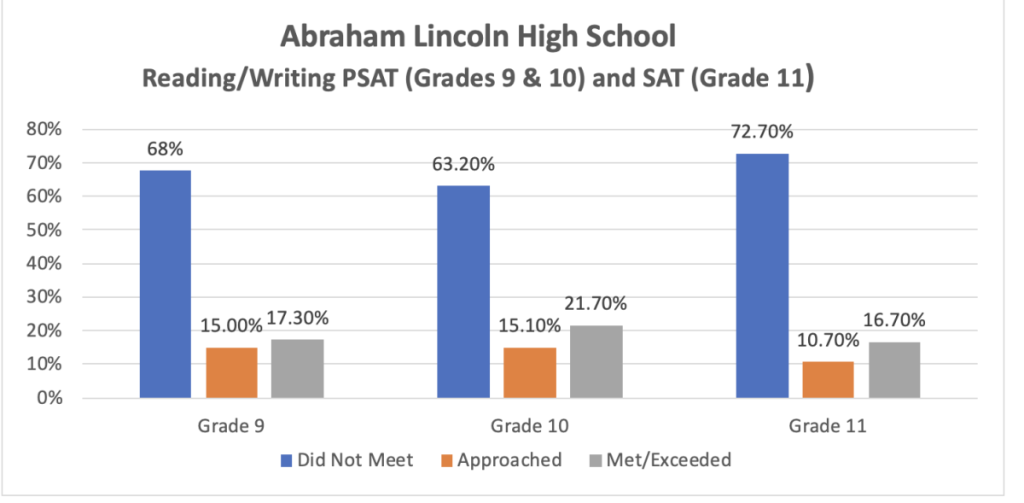
# Students Did Not Meet:
Gr. 9 – 149/220 (68%) Gr. 10 – 134/212 (63.2%) Gr. 11 – 109/150 (72.7%)
To be clear, 109 students out of a junior class of 150 scored Did Not Yet Meet Expectations.
In math, the picture is even more distressing. More thann 82% (480/581) of Abraham Lincoln students in grades 9-11 scored Did Not Yet Meet Expectations.
Any growth worth celebrating?
There is no blaming of students here.
In fact, when we look at the school’s attendance and retention figures, students might be sending us a message.
Last year the rate of chronic absences at Abraham Lincoln increased by 8.3%, from 53.2% to 61.4%. That is 33 percentage-points above the state average. CDE reports this meant 618 out of 1,006 students were chronically absent.
Furthermore, CDE’s 2025 data on truancy reveals a shocking ratio rarely seen in a Colorado high school: more students at Abraham Lincoln (513) were truant (“4 days or more in a month, or more than 10 days in a year”) than those counted not truant (493).
Chalkbeat Colorado’s article shed light on these absences. Principal Néstor Bravo told Chalkbeat of federal Immigration and Customs Enforcement agents parking near the school. It can take courage, he suggested, just for students to show up.
I would never understate how tough this must be for the entire community.
But there is a disturbing pattern at Abraham Lincoln that has been evident for many years. Students leave. Note the large number of 9th graders who do not return for 10th grade.
2020 to 2021 – 344 freshmen – declined to 215 sophomores.
2021 to 2022 – 374 to 227
2022 to 2023 – 421 to 292
2023 to 2024 – 341 to 228
2024 to 2025 – 349 to 243
Last year, the school enrolled 339 freshmen. This year it has 208 sophomores.
Pupil membership in 2025-26 has declined by 14%, from 965 in 2024-25 to 830 students.
No doubt there are several reasons for this decline. Yet one must ask if the school is a place where students feel they belong. If they are able to find teachers who know them well, men and women who will care about them and support them during their high school years.
If not, after attending one year, is it any wonder students might look elsewhere, in order to get a good education?
We want an accountability system that gives us an honest look at results; above all, one that reveals where our most vulnerable students are not getting the education they deserve.
I do not see how lifting the school’s rating to on Improvement achieves this goal.