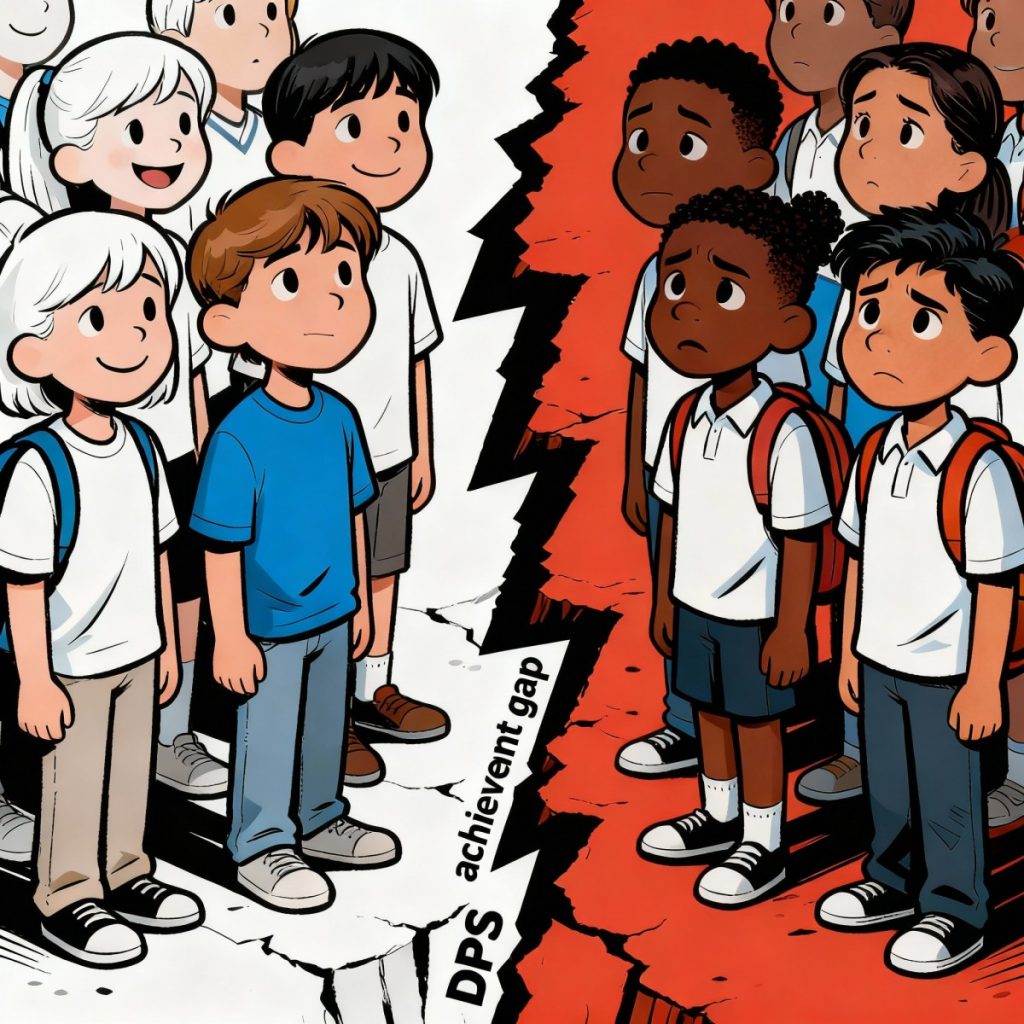
The yawning gaps separating the academic achievement of minority and white students has plagued Denver Public Schools for decades. The election on Nov. 4 could result in four new members for the seven-member board and will help determine how the district will confront that intractable problem.
This year continued the district’s poor performance as measured by the Colorado Measures of Academic Success (CMAS) standardized test. White DPS students scored 74 percent proficient in literacy on state tests while Black and Hispanic students were nearly 50 percentage-points lower. The gap was about the same in math.
Black and Hispanic students make up 66 percent of the district’s nearly 89,000 students; 25 percent are white. That’s a lot of kids destined for the work-a-day world with limited options because of poor academic skills.
Finding remedies is supposed to be a top priority of Superintendent Alex Marrero but the gap is as wide as when he took over four years ago. A top priority of the school board is to ensure that he does better.
The races to represent southwest Denver and an open at-large seat present clear choices of views on the value of standardized tests in measuring the achievement gap. The five candidates for the two sets expressed varying opinions at a Sept. 15 forum sponsored by the Denver Democratic Party.
Southwest Denver (District 2) incumbent Xóchitl Gaytán, who is running for reelection, said that she strongly objects to how test results reflect on students in her district.
“Standardized testing labels our children failures,’’ she said. “The majority of students in southwest Denver are Latino, Mexicana, Chicana students.
“Our children are not failures. They are not these numbers that these standardized tests tell us they are.’’
Gaytán noted that the district was rated green this year by the state Department of Education, one step below the highest rank. Schools in her area contribute to the district’s overall success, she said.
For instance, Kunsmiller Creative Arts Academy, is producing students who are “phenomenal in so many different ways” while students at Lincoln High School are “outpacing and outgrowing” in STEM learning and graphic design, she added.
“Our students are beyond standardized testing.”
Her challenger, Mariana del Hierro, who runs a nonprofit that works on food security and urban agriculture, stressed the value of standardized tests. She has a background in public health and racial equity. She compared state tests to the assessments her doctor uses when he examines her child.
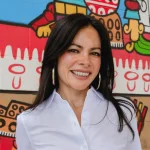
“The doctor uses uniform measurements to assess the health of my child,’’ she said. “The assessments the doctor does are not racist.
“So, when I think of standardized tests, we need that to properly measure where our students are at.’’
The district needs to examine how it functions and addresses factors that contribute to the lower achievement of minority students, she said.
“What are we doing about all the other systems that are developing our children, that are contributing to those gaps? That’s where we need to focus.
“We need those state tests to properly assess what the those changes in the system are that we have to make to support our children of color.’’
The three at-large candidates, Amy Klein Molk, Alex Magaña and Deborah Sims-Fard, who was represented by a proxy at the forum, offered varying degrees of support for standardized tests. They said they want a broader array of assessments to determine the overall abilities of students and more support for teachers.

Klein Molk, a former ed tech entrepreneur and DPS paraprofessional, sees the district’s history of segregation as a continuing detriment to how different racial groups of students are viewed.
“We need to look at how we evaluate students for their full potential,” she said. “We need to be looking at how we evaluate teachers for how they are bringing the well-being of their students holistically to the table.”
There is a critical need to “find a much better way to evaluate the success of our students and our communities,’’ she said. “That goes well beyond test scores because test scores are not an equitable way to look at our communities.’’
She would go to experts and teachers and other stakeholders “to understand the best way to evaluate while also tying in the community that knows their schools better than most.’’
Magaña, a career DPS educator and school leader, said “we need multiple measures. It’s not just one test. . .
“It’s important to have accountability and there’s a standard we must strive for. Highly effective teachers grow our Black and brown and white students across the board.

“So how do we continue to support them and also educate others to do the same?’’
Other factors to consider include chronic absentee and tardy rates, he said. Home life cannot be discounted as a barrier to achievement.
“How about we look at living conditions, what prevents them from excelling and what can the school do about it? Are we giving the resources to the schools so they can provide that?
“Finally, how about the expectations of our educators in our schools,” he said. “There needs to be accountability. If we have high expectations our kids will rise.’’
Sims-Fard, a longtime DPS teacher, comes at achievement from the source — the classroom, said her representative, Joyce Brooks.
“Miss Deb,’’ as she is known, says, “we need to look at learning differently. We’re still educating children like we did in the agricultural age,” Brooks said.
We need to prepa
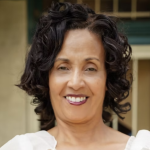
re students for the future that is hard to picture today, Brooks said Sims-Fard believes. “We’re testing them in the way we tested them in the past.’’
The board needs to work with teachers because they often know the best ways to reach kids.
“What do they need and start having that conversation,’’ Brooks said. “They might even do better on standardized tests.’’