Editor’s note: This is the monthly contribution from Boardhawk columnist Dr. Aaron Massey.
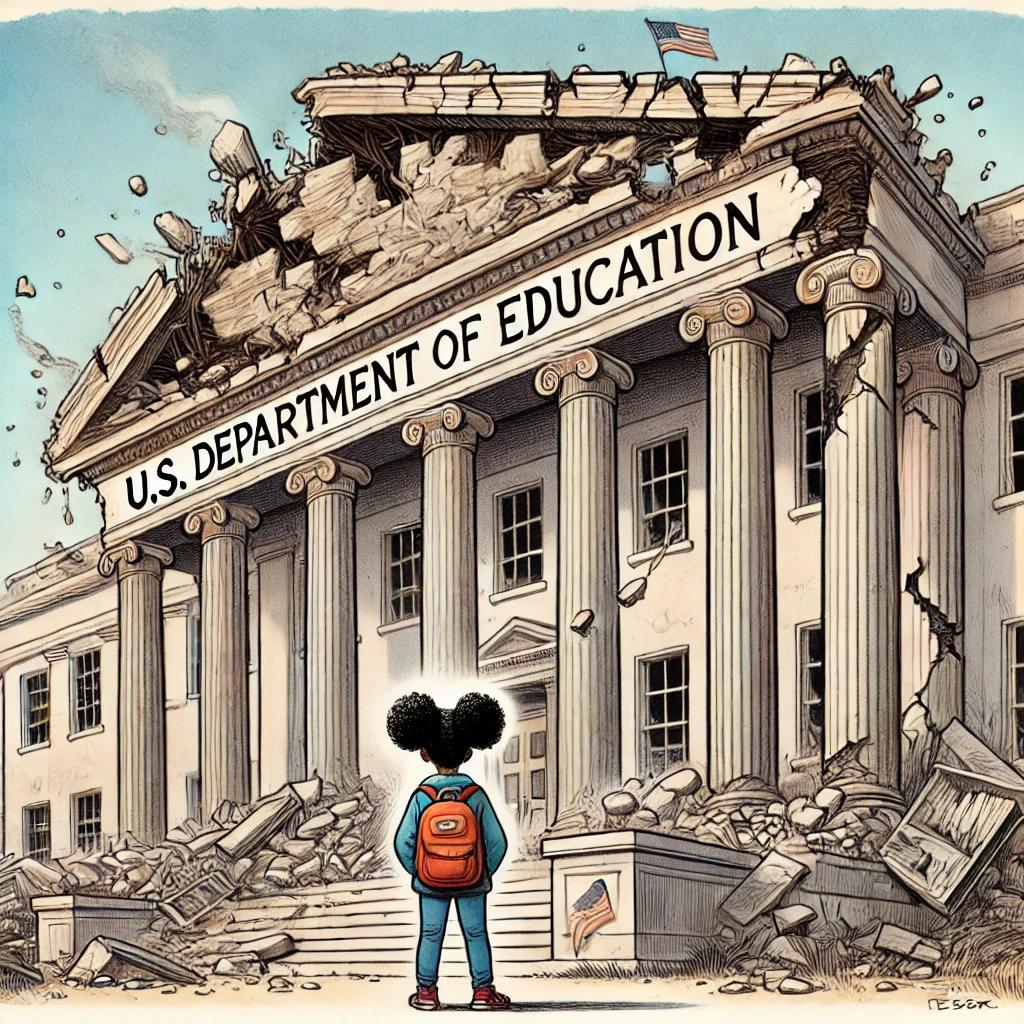
No, we shouldn’t dissolve the U.S. Department of Education.
But it’s not a wholly extreme thought. In fact, many of us had the same question when we heard about its possible closure: “What does the federal Department of Education do?”
At minimum, this question is emblematic of a disconnect between the people and bureaucratic systems like the USDOE. In lieu of chainsawing the entire department or keeping things the same, we should aim for shared understanding and thoughtful action planning.
Here are three reasons why the U. S. Department of Education is on the chopping block, why it makes sense that it’s on the chopping block, but why it should still exist.
Reason 1:
Many of us don’t know what they do. If you’re in the education policy space, you know that the federal DOE gives funding to supplement state and local funding collected mostly by property taxes. Besides that being the most boring sentence I’ve ever written, not seeing the impact of that funding is why it’s on the chopping block.
Your local property taxes – by and large – determine the quality of your education in the United States. This means that if you grow up in a community that does not have access to wealth, your school isn’t likely going to have enough resources to provide an “adequate education.”
Federal funding likely won’t close that gap.
So to some, why have it? Many equity-minded educators like myself often talk about a future where your zip code does not determine your opportunities. But we haven’t achieved that yet. In fact, there is a clear relationship between child poverty rates and district performance.
Not to oversimplify but if your community has a high rate of child poverty, on average, the district’s academic performance is lower. That’s why “school district quality” is a determining factor in buying a home. That’s why housing policies and HOAs kept folks of color out of their neighborhoods.
Moreover, there are somewhere between 9 and 11 million children living in poverty in the United States. Not feeling the impact of the federal supplement is real and needs to be addressed. But that doesn’t mean get rid of it.
Reason 2:
Education ebbs and flows with political cycles. Irrespective of your politics, the constant pendulum swings from one theory to the next disallows the opportunity to see what actually works – which was the original purpose of the U.S. Department of Education.
“The original Department of Education was created in 1867 to collect information on schools and teaching that would help the States establish effective school systems” (U.S. Department of Education, 2025). While that mission sounds nice, it wasn’t until the U.S. wanted to compete with Russia to go to space that we saw an actual focus on the DOE.
It’s like saying you’re fighting to further the mission of Girl Scouts when you buy your Thin Mints and Tagalongs. Yes you’re providing a level of support but that’s not why you bought them.
The same happened with No Child Left Behind. A politician used “higher accountability” as a policy platform to get elected. He got elected. Then he passed it at the federal level. And his home state that he used as an example of the results that are possible when you have higher accountability were exempted from that accountability just years later.
After that, another politician had another idea. And we tried it. Education shouldn’t be at the whim of a politician’s beliefs. There should be a governing body that ensures consistency. Oh wait, the Department of Education. Not providing consistency across administrations is a missed opportunity for the federal DOE. But that doesn’t mean get rid of it.
Reason 3:
Student loans feel like a scam. There exists $1.75 trillion in student loan debt. 92% of that debt is in the form of federal student loans (Forbes, 2025). The institution that mandates attending school for 13 years is the same institution that makes you pay for it in the 14th year. And that just isn’t sitting right with students nowadays.
If you know me personally, you know how much I believe in college and the power it has to change your life. So this isn’t an argument against going to college. It’s an argument against the funding structure of going to college.
Imagine leaving college with student loan debt as a teacher making $45k a year. As a nurse. As a therapist. As a not-rich person wanting to help people. The programs the federal DOE have like loan forgiveness after 10 years of teaching at a public school is a nice thought. That is, until you actually go through the loan forgiveness process that can be cumbersome (and not guaranteed).
The bureaucratic distance between the intent of a DOE program and its actual impact is deeply frustrating. But that doesn’t mean get rid of it.
For these three reasons, I understand how many people would arrive at supporting the dissolution of the federal Department of Education. But we shouldn’t.
The DOE is the strongest band-aid we have for our most vulnerable students. Legal protections for students who are disabled, students who are food-insecure, students who are homeless, etc. depend on the DOE. Students in economically depressed communities and students in rural communities all depend on the federal DOE.
The issue is that they have to depend on the DOE. There are many states that don’t have enough resources to serve their students well. Without that federal funding, they would be in an even worse situation.
Although it is imperfect in many ways, without it, our most vulnerable children will lose needed protections. And that’s enough for me to want to keep it.
So…
Critique it.
Push it to innovate.
Start a movement to make it better.
But don’t dissolve it.