
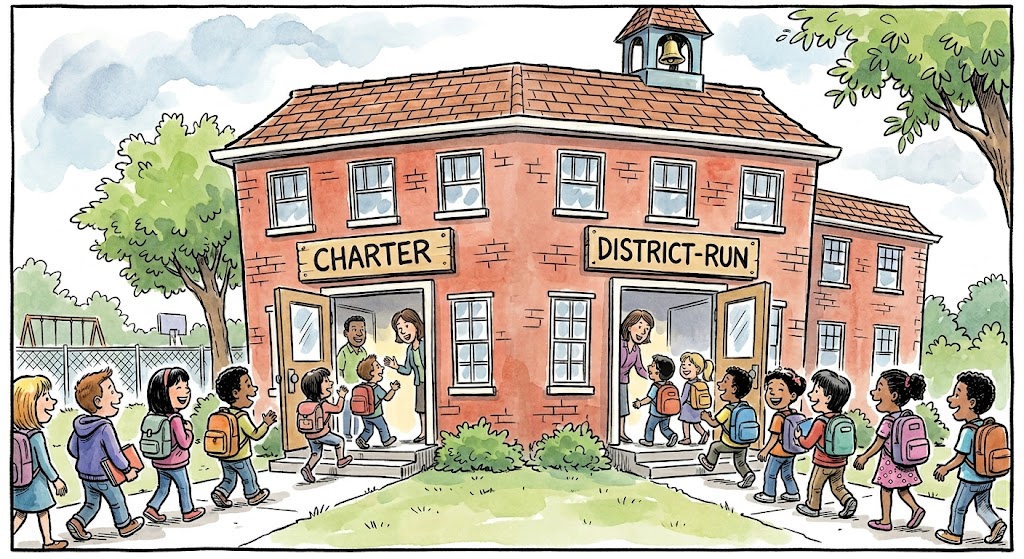
Across Colorado, districts are confronting the same reality: fewer students, underused buildings, and growing pressure to rethink how public school space is used.
For many communities, that conversation immediately raises fears of school closures. Increasingly, however, districts are exploring another option: co-location.
The concept is simple. Multiple schools or programs share a building while maintaining separate leadership, staffing, and educational models. But in practice, co-location quickly becomes about far more than space. It raises difficult questions about identity, trust, community ownership, and who public schools are designed to serve.
Recent debates in both Colorado Springs and Denver show how complicated those conversations can become.
In Colorado Springs District 11, Orton Academy — a charter school serving students with dyslexia — will move into space inside Trailblazer Elementary next school year. In Denver, a charter elementary school’s move next to a long-standing district-run campus reignited concerns about enrollment competition and neighborhood school stability.
At first glance, these appear to be local disputes. In reality, they reflect a broader shift.
The enrollment reality
Districts across the country were built for larger student populations than many now serve. As enrollment declines, maintaining half-full buildings becomes increasingly difficult financially and operationally.
At the same time, families are seeking more specialized educational options. Programs focused on dyslexia intervention, dual-language immersion, or alternative learning models are often difficult to scale as standalone campuses — particularly in districts already facing enrollment-related budget pressure. Co-location offers a practical alternative: expanding access to specialized programming while better utilizing existing public assets.
At its core, the goal is larger than facilities management. All students and families deserve access to a high-quality public education, including programs designed to meet diverse learning needs. In some communities, shared space may be one of the most realistic ways to expand that access without requiring entirely new campuses or additional infrastructure.
But co-location is not a one-size-fits-all solution.
“Co-location is tricky,” said Bill Knous, Senior Director of Quality and Growth at the Colorado League of Charter Schools. “It is not that it cannot work; it is that it is often under-planned, and the level of early alignment needed to make it successful is rarely achieved.”
“One important distinction is co-location within the same building versus co-location on a shared campus,” he said. “Those are very different operating realities. The strongest examples I have seen are campus-based models, where schools share a broader facility footprint but retain enough operational independence to preserve their own culture, schedule, and instructional model.”
Operational logic meets community identity
From a governance perspective, the reasoning behind co-location is straightforward. Under-enrolled buildings still carry the same operational and maintenance costs, making shared space financially preferable to closure in some communities.
But decisions that make sense operationally do not always feel that way to families.
Resistance to co-location is rarely about logistics alone. Families often fear losing the identity, culture, and stability tied to their neighborhood school. Concerns about safety, shared common spaces, and enrollment competition can quickly intensify tensions, particularly when communication feels rushed or incomplete.
That emotional response reflects the role schools play in community life. Schools are not simply public assets on a balance sheet. They are gathering places, traditions, histories, and sources of neighborhood pride.
Community concerns should not be dismissed. But neither can districts avoid the larger realities driving these decisions.
The difference between competition and complement
Not all co-locations feel the same. Some create a sense of direct competition; others feel more complementary. That distinction matters because successful co-location requires more than operational efficiency. It requires trust, structure, and intentional partnership.
Even when the partnership itself is strong, operational complexity does not disappear.
“Leaders have to manage another layer of expectations, protocols, communication, and shared decision-making,” Knous said. “Co-location works best when the schools enter the arrangement with clear agreements, strong relationships, and a shared commitment to serving families well.”
Districts that navigate these transitions well tend to communicate early, involve families before decisions are finalized, and clearly explain how both school communities will be supported moving forward. Co-location decisions imposed on communities often provoke backlash. Communities are far more likely to embrace shared space when they feel included in the process rather than surprised by it.
A different path
For boards and district leaders, the challenge is no longer simply managing facilities. It is balancing financial sustainability, community trust, and evolving family expectations simultaneously.
If implemented thoughtfully, co-location can help districts preserve resources while expanding access to high-quality public education for more students and families. Co-location will not eliminate difficult decisions, and poorly executed partnerships can deepen distrust and division.
But for some districts, it may offer a sustainable way to increase access, expand opportunity, and potentially avoid closures altogether.