
Editor’s note: This is the first in a series of articles to be published over the next few months featuring promising and interesting school models across Colorado.
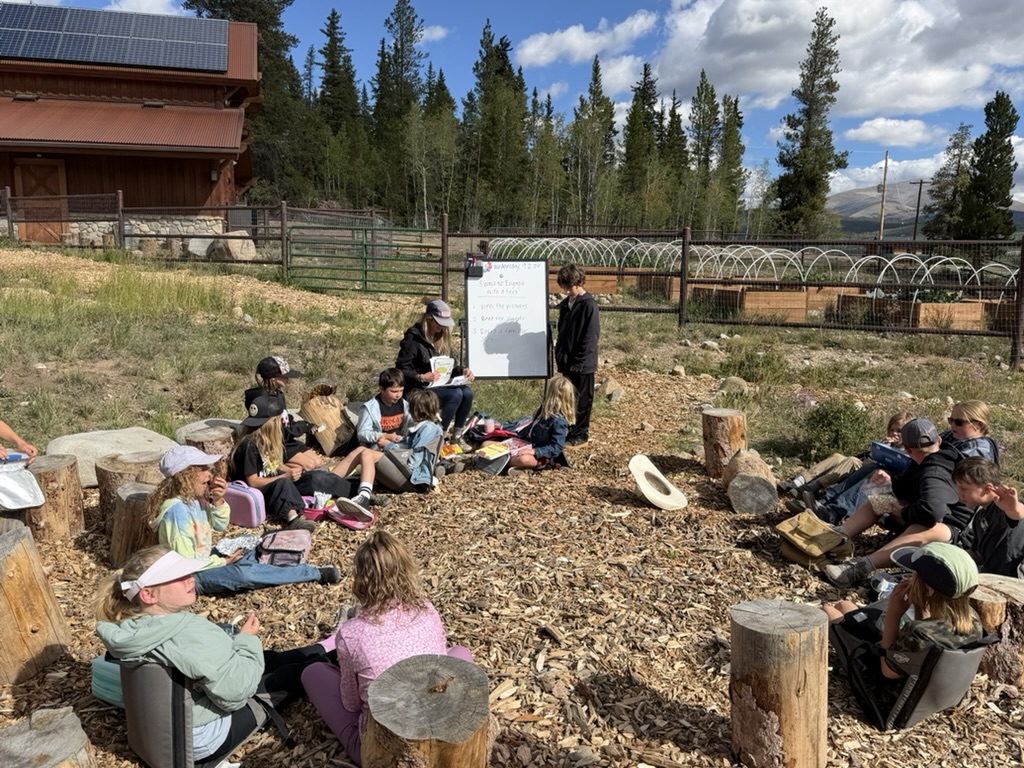
FAIRPLAY — One recent sun-kissed morning, 16 middle-schoolers sat on tree stumps in a semi-circle in a flower-strewn meadow, as teacher and school cofounder Kristine Helsper, working on a portable whiteboard perched on an easel, ran through a lesson on number patterns. Sacramento Creek provided background music, and squirrels darted up and down the surrounding trees. None of the natural beauty seemed to distract the students.
This is High Rockies Community School, a K-8 public charter school located at Sacramento Creek Ranch outside Fairplay. The four-day-a-week school is most notable for holding almost all of its instruction outdoors.
Fifty-one students learn in multi-age bands at Sacramento Creek Ranch, with mornings given to reading, writing and math, and afternoons to interdisciplinary thematic units. Families drive in from Fairplay, Alma, Hartsel and Jefferson, some an hour each way.
The 2026-27 school year marks the school’s second year of full operation, and it is growing. High Rockies opened a second campus in nearby Alma at the beginning of September 2026, as well as an outdoor nature-based preschool for 3- and 4-year-olds at Sacramento Creek, one of the first three licensed in Colorado.
How it started
Helsper, a science major who began as an outdoor educator for the Audubon Society of Greater Denver, taught for several years in traditional schools, then started a Fairplay-based educational enrichment business, Curiosity Clubhouse, in 2021. Families whose kids attended Curiosity Clubhouse frequently asked her when she would open a school.
When Helsper heard that Laurel Dumas had resigned as principal of Park County’s Edith Teter Elementary School, the moment seemed right. Helsper came to Dumas with the idea of starting a charter school.
Dumas had not set out to run a school, or even to work in one. She majored in public relations at the University of Southern California, intending to do communications work for a public school district upon graduation. But she concluded no district would hire her if she had never worked in a school. So she took a paraprofessional job in Novato, California, and ended up staying in classrooms. She taught for six years in California, then moved to Colorado. She taught for two years in Summit County and seven in Park County, mostly fifth grade. She became Park County’s curriculum director in 2019.
Dumas said she never intended to be a principal. But in 2019 teachers struck, the superintendent resigned, and she agreed to serve as interim assistant principal. Then the pandemic hit. “I was suddenly the principal of a school running from my rural living room when we’re all on satellite internet,” she said. “It stuck.”
She had been principal of Edith Teter for four years when she left at the end of 2023, dreaming of starting a different kind of school.
Once the two women decided to work together, they asked families what they wanted. A community focus group told them: a school where kids learned primarily in the outdoors in a hands-on experiential way. Parents also wanted a tight, intentional community.
Rather than wait a year for a charter approval, Dumas and Helsper opened in fall 2024 as a homeschool enrichment program, 15 K-6 students in a converted garage on the Mountain Area Land Trust’s Sacramento Creek property. Another rural district authorized the program and kept 6 percent of the revenue, which under state law is half the per-pupil rate.
“It helped us put things in place with a small group of kids,” Dumas said, “and then we were ready to open strong.” The homeschool enrichment law changed in 2026 so that districts can only authorize programs within their boundaries.
Before working on a charter application, Dumas and Helsper asked Park County School District Re-2 to release them to the Charter School Institute (CSI), Colorado’s statewide authorizer and now the authorizer for HRCS. The school board agreed, a decision Dumas called a unicorn situation. The district knew her, and knew the founding committee of parents.
Helsper is now instructional anchor and lead teacher at Sacramento Creek, teaching the middle school band. Dumas serves as executive director across both campuses.
Outdoors, almost regardless of weather
Dumas described the school’s approach as “place-based rather than project-based.”
Instruction happens outdoors all day, every day, except in the most extreme conditions. Given the mountainous setting at 10,000 feet above sea level, extreme conditions aren’t unusual, and to the extent possible, time indoors is kept to a minimum.
Students pack what they need into backpacks, don snowsuits and boots when necessary, and walk to outdoor classrooms defined by semi-circles of tree stumps or large rocks scattered around the meadows near the renovated barn. The barn is a staging area and a place to get warm and use bathrooms. It is not a classroom.
Learning is clearly occurring, and HRCS does not feel like a school in the traditional sense. On a bright September morning, first and second graders were scattered across a meadow reading, one girl on a rock, a boy flat in the grass. Nobody was at a desk.
“I’ve been in a lot of classrooms,” Dumas said as she surveyed the scene, “and you don’t often see this much focus.”
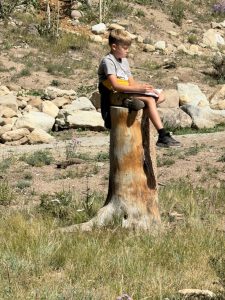 That morning a squirrel had dropped pine cones on the outdoor classroom of Charlotte, a fourth-grader who started in the first-year enrichment program. “We have a whole forest instead of a playground,” she said.
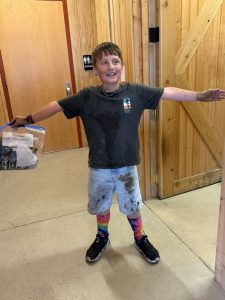
During the lunch hour, students finished eating and then went en masse to Sacramento Creek, where they waded, splashed, and eventually climbed the banks and engaged in a raucous mud fight. When they returned, bespattered, to the barn to change into dry clothes, teachers and administrators listened enthusiastically to descriptions of the melee. There were no recriminations, no reprimands.
The weather can become a curriculum of its own. One September afternoon, a dust devil formed and lifted a coat a hundred feet into the trees and carried a Crazy Creek chair across the road. The coat was recovered. The chair was not. Helsper watched it happen, awestruck, with her class.
“The distractions can be tricky,” she said. “But it’s always, ‘well, that was interesting,’ and then we start going down that rabbit hole, (learning about dust devils).”
A constitution the students wrote
The school’s most striking and unique artifact is its constitution, which students write themselves, modeling its structure on the U.S. Constitution. Students are the local government, parents the state, teachers and staff the federal. A student council legislates, a student mayor and assistant mayor execute, and student judges hear cases, with anything too hard going to what the document calls the supreme court, meaning the teachers. Terms of office last a quarter.
A twelve-article Bill of Rights covers voting, free speech, fair trials, fun learning, and making mistakes, and governs outdoor play with precision. For example: Sticks used as pretend swords must be hip-length or shorter so hands do not get hit. Tree climbing requires a buddy on the ground, three points of contact, branches thicker than your arm and a dry tree. Wrestling is out, except sock wrestling under adult supervision. Thumb wars are fine.
The offices are more than ceremonial. Violette, an eighth-grader, and her classmate Olivia have each served as mayor several times. They’ve given tours to prospective families, presented to the Fairplay and Alma mayors, and spoken to 60 families at a parent info night without notes.
Relationships first
Ask parents what they appreciate most about the school and the answer focuses more on relationships than the outdoor setting. Teachers loop with their students for three years, so they know each child well.
“It’s not just that its nature-based,” said Kenny Shaw, a Presbyterian pastor in Fairplay and Violette’s father, who has had his daughter enrolled since the homeschool enrichment pilot. “The nature-based part is really key and a vessel for a lot of things. But these relationships, and the ways of doing things, the ways of being together, is the most important part of the school.”
Shanna McCann, who has three children enrolled, said a key difference between HRCS and her family’s previous school is a lack of barriers between staff and parents. “It just didn’t feel as a parent like we were as heard,” she said of their former school. She asked Dumas directly whether the community feel of the school had been engineered. “It seems to have happened so seamlessly; I couldn’t pinpoint what exactly you did to make it happen,” she said.
Dumas traced it back to her own classroom. “At my heart, I’m a teacher, and this is what my classroom always felt like,” she said. She taught fifth grade the same way, treating her students as a team that helped each other and helped her, and always giving them a hand in running the place. Leading a school struck her as the same job at a larger scale. “These kids are the people who help with that,” she said.
Staff culture runs on the principle that “we are infinitely improvable,” Dumas said. Trying things and having them fail is built into how the school describes itself, and that changes what it feels like to teach there. “For a teacher, that’s so freeing to know,” she said.
What works, what is challenging
The school projected 24 students in year one and opened with 51. There was no attrition. A waitlist of 28 pushed the Alma campus from idea to reality, and most Alma families came off that list.
CMAS and School Performance Framework results for 2025-26 show a school with strong growth in reading, the 75th percentile, which Dumas attributed to individualization. Math growth lagged a bit at 45th growth percentile and is the focus of this year’s improvement plan, with help from a University of Denver professor.
Teaching math to three grade levels in one class poses surmountable challenges, both Helsper and Dumas said. Helsper added that working in multi-age classrooms is both the hardest and best thing about the job.
More than 50 Chaffee County families have asked the school to come to Buena Vista or Salida. Expansion into Summit County, where demand is even stronger and the Keystone Science School has offered space, has been stymied so far by Summit School District RE-1 and its school board. The district holds exclusive chartering authority and has not been willing to release the school to CSI for chartering, an have pushed back the timeline to review HRCS’s district charter application.
Because of the change to the homeschool enrichment law, that avenue for expansion has been closed off as well. The earliest possible opening is now 2028, for a 45-seat school roughly 130 families have asked for.
Replication is a further question, and a school this leader-dependent is inherently challenging to copy. The key, Dumas said, will be codifying the non-negotiables.
“One of the most important things that we found with opening the Alma site was understanding the culture and the philosophy and the core principles, so that everything grows from there,” she said. Schools built on that culture and philosophy could exist almost everywhere, she said. A lakefront school in Chicago could work, she mused, with students mastering the subway system as part of the challenge, as well as studying the ecology of Lake Michigan.
What parents notice
Parents say the school’s fresh air, collegiality, and calm serve students well. Shaw said that at his daughter’s previous school, Violette frequently came home from fifth grade with migraines he attributed to fluorescent lights and noise. On those headache days, she’d sleep until dinner. She has not had a headache since transferring.
McCann’s son Copeland asked to switch schools at age seven, because he thought it would help him pay attention. He was right, and tested up a grade in math and reading the next year.
Attending school outdoors seems to shift the entire mindset of HRCS students, which makes them stand out from more traditionally taught students. Shaw described a recent church youth group gathering, where tables were split between town middle-schoolers and High Rockies kids.
“The (town) middle schoolers were zeroed in on their phones, and talking about all this weird stuff that you would hope 12-year-olds don’t have to talk about,” he said. “The High Rockies kids were talking about a bird they had seen that day. It was just such a dramatically different experience of life and of engaging with each other.”