The Denver school board on Thursday, Sept. 17 voted unanimously to launch an investigation into allegations that board Director Monica Hunter made anti-smitic comments about fellow board member Amy Klein Molk, who is Jewish.
The board also decided to hold off on any action related to a cornucopia of other allegations against Hunter and Director DJ Torres until the investigation wraps up.
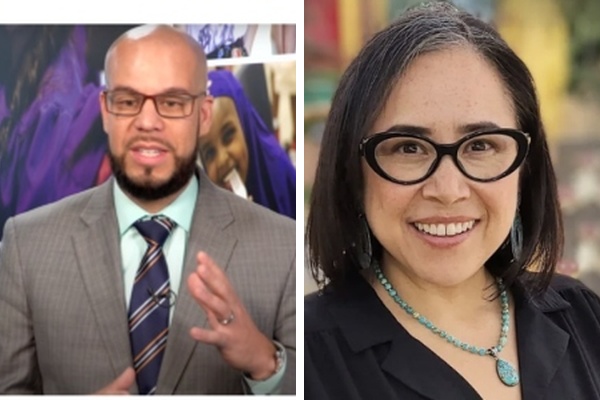
In this episode, co-hosts Alexis Menocal Harrigan and Alan Gottlieb discuss the meeting’s bizarre twists and turns, and impacts on Denver Public Schools students, with Nicholas Hernández, executive director of the advocacy group Transform Education Now. Full transcript can be found below, for those of you who don’t care to watch or listen.
Podcast season 2, episode 23: The Denver school board drama drags on
Alexis Menocal Harrigan: Good morning, everybody, or good afternoon, depending on when you’re listening to this. Welcome back to the Board Hawk podcast. We are recording this on Friday, September 18th at 6:30 in the morning, so you are getting us bright-eyed and bushy-tailed. I almost thought about putting my under-eye patches on, but it was, like, a little bit too intimate. Anyway, we’re excited to bring back for, I think, the third or probably the fourth time now, Nicholas Hernandez from TEN. But before we jump into some of the things we had pre-planned for him to come on and talk about, we wanna dive right into what happened last night at the Denver Public Schools Board of Education meeting.
For context, this meeting was a long one. I don’t think I got out of there until about 9:30.
Alan Gottlieb: And it started at 4:30.
Alexis Menocal Harrigan: Thank you. The Board of Education for the [00:01:00] last week or so has been embroiled in this scandal about investigating one another again, and specifically Directors Monica Hunter and Dr. DJ Torres. The last board meeting, Xóchitl Gaytán, the president, presented, like, a 20-something page slide deck with items for investigation or complaints, with the underlying assumption that those items would be considered for potential censure. It wasn’t said explicitly, but that’s generally how these things go, and we know because now this is becoming a regular item, censuring each other, and that wasn’t something that used to happen before ever.
So the meeting took place, and they finally got to the agenda item where they were going to talk about holding over any type of censure until the investigations took place. As soon as President Gaytán brought that up, John Youngquist stepped in and made a motion, and that [00:02:00] motion said something to the effect of, “I want to cease any investigation or actions against Director Monica Hunter, with the exception of the anti-Semitic claims.”
Then the full board voted in favor of that motion unanimously. It’s important to note that Kimberly Sia was not at that board meeting. She had a family emergency and wasn’t able to vote for any of these things at the end. And then they went back to the original point and passed that, and that’s where the confusion started.
So that’s where we’re at. That’s where we’re jumping into the podcast. I can continue saying what happened, or Alan, Nicholas, if you wanna jump in, feel free.
Alan Gottlieb: Well, the bottom line is that where things were left was that there is going to be an independent outside investigation of the allegations of Monica Hunter having made anti-Semitic statements, and everything else is on hold until then, all the other allegations against her and all of the allegations against DJ Torres.
We have no idea when this [00:03:00] investigation will start, how long it will take, how much it will cost, or any of that. But I think an independent outside investigation was absolutely the right move with these allegations.
Nicholas Hernandez: This is how it’s supposed to go, right? You know, there are allegations made. There’s questions, there’s personal conduct, there’s board violation questions. You don’t just take action, right? I think in the past we have seen folks jump to those conclusions and be like, “This needs to happen.”
I actually applaud this board for taking the necessary steps to put in the work and the time to figure out exactly what happened. Now, the rubber meets the road when you find out if something did happen. How are you willing to hold each other accountable? How are you willing to make sure that your board colleagues say, “This is not how we conduct business, this is not the leadership, this is not the example we wanna set for our community and for our kids”?
Alan Gottlieb: If Monica Hunter’s gonna deny everything that other people are saying she said, then it comes [00:04:00] down to, I don’t know if there will be any clear resolution. There’ll just have to be a preponderance of the evidence based on some things that have been reported by the superintendent and the board president, that we can get into in a minute, that I am highly suspect of.
Alexis Menocal Harrigan: And then I wanna make sure we don’t lose, before we move on, I think they voted three or four times. They were deadlocked. They voted to try to, I think, rescind. They wanted to try to vote to hold over anything about Dr. Torres. There was a really good article posted right after the board meeting by Melanie Asmar from Chalkbeat, so folks should please go ahead and read that.
But it just went over and over, and we were gonna be stuck there. Marlene at one point said, like, “It’s already 9:30. We can’t be here all night.” And us in the audience were like, “We’re locked in. We’re locked in. I’ve got my snacks, I’ve got my water bottle. You know, we’re here.” But I think they knew it was an exercise in futility because it was 3-3, and they weren’t gonna get anything done after [00:05:00] that.
One of the other things I just wanna say is, first of all, let me back up. The board did not do right by either Amy Klein Molk or Monica Hunter. The way that the board conducted themselves at the end, and how disorganized that was, and frankly the bad advice that they got from their legal counsel, Aaron Thompson, is not what Amy or Monica deserve.
Alan Gottlieb: Say more about that, because I’ve heard that from other people too, and I would just like to hear you go a little deeper about why that’s the case.
Alexis Menocal Harrigan: So, they’re conducted by Robert’s Rules of Order, right? And so it is up to the general counsel to give advice about whether they’re conducting business and voting correctly, like, they’re doing everything above board.
At one point there was a lot of confusion about what was going on, and then when it became clear that what Director [00:06:00] Youngquist said and his intention was for the motion that we unanimously passed, and what three of the board members, that’s Amy, Sochi, and Marlene, voted for, was unclear. Aaron Thompson at one point said, ’cause the motion was like, we’re not going to investigate or take action against Director Hunter.
When they were clarifying it, Aaron Thompson put the microphone up and he said, like, “Forever?” It’s like, dude, you don’t want your attorney clarifying after the vote? What the heck happened? And it was just a mess, and so they had to go into executive, or they had to go take a recess. Take a…
Alan Gottlieb: Break, yeah.
Alexis Menocal Harrigan: Take a break. Yeah. And so for President Gaytán to confer with general counsel. What’s so crazy is that general counsel’s only talking to the president. He’s not talking to all the board members, and so this is the whole point of why they wanted to have outside counsel for this kind of stuff, because of the incredible bias that exists, or the [00:07:00] perceived bias that exists, because some people think that what’s happening to Monica and DJ is a witch hunt and it’s retaliatory.
And so then you can’t take seriously the antisemitic claims when it’s lumped in with all of this other stuff, and so that’s what I mean by that. And so what I wanted to get to, where Aaron isn’t giving good advice, and this is gonna be way outside of the scope of just education policy, but I think because we’re in left-of-center progressive Denver where we care about equity for the most part, what John Youngquist did is a perfect example of what white privilege and white allyship looks like.
Because John wasn’t questioned for a second. John spoke with confidence, the assurance of a confident white man in the best way possible, in standing up for a Black woman. He didn’t even allow time for a discussion. After Xóchitl put the motion to the [00:08:00] table, he put his motion forward.
No one questioned it at first. Then Xóchitl said something to the effect of, “Oh, isn’t that what we’re voting for?” Or she said, “Isn’t that the same thing?” He did not affirm that it is the same thing. He just reread the motion, like the confidence of a privileged white man.
And because of that confidence, and because he’s a white man, he just got away with it. Monica, Marlene, Xóchitl, none of them could have gotten away with that. Frankly, none of the other board members, including Amy or DJ, could have gotten away with that. So he used his privilege to really step up in a meaningful way to move that motion forward.
I don’t think anybody else would have been successful, especially when that confusion was created.
Alan Gottlieb: Why do you think nobody else could have gotten away with that?
Nicholas Hernandez: Well, I think regardless of whether that was, like, an intentional strategy or just a byproduct of the moment, right? I [00:09:00] think you’re right. He put forth a motion that seemed reasonable, rational, and everybody just kind of rolled with it, and I think that is the allyship that folks are asking for, is, like, use your power, use your expertise, and go for it.
Part of that is because I think that John has a wealth of experience. John has been a leader and things like that, where, you know, it’s to me, not good, bad, or ugly, right? There is still a lot of learning to do on this board, right? And last night’s meeting around procedure kind of demonstrated that, right?
Like, I don’t know about everybody else, but I got tied up in a knot during that moment trying to figure out what was going on, and I was thinking about previous boards. Clearly our school board directors before this board put in the practice. They were planning things out.
Things were, I don’t wanna say scripted, but they knew the procedure like the back of their hand. And I think to [00:10:00] some of the comments from public comment around our kids needing their full attention, I think folks took that as, like, a no-more-drama thing, but also like, let’s make sure that you guys are doing your job through and through.
And I think the disorder, because I don’t wanna call it dysfunction, the disorder and lack of preparation for the procedural process of governing the state’s largest school district, that is a serious job. And this isn’t the first time we’ve seen this, right? This isn’t the first time that our president has had some challenges running a meeting. To me, that is just another layer of the disorder, dysfunction of this school board, and kind of like why things take so long to get done around here.
Alexis Menocal Harrigan: Mm-hmm.
Alan Gottlieb: One thing, I want you to play that clip, ’cause it seems like the right time, Alexis, maybe because of what Nicholas just referred to, a clip from Amy. But I would just be interested in y’all’s take, because when John first read that motion and then repeated it, I felt [00:11:00] like it was really clear what he was moving.
And so I was kind of baffled that the other board members, and I wasn’t there in person, and I’m not a board member, so I understand there’s a lot of other stuff going on, but I thought it was pretty clear what he was moving, what the motion said.
Alexis Menocal Harrigan: Well, and what’s funny is it was so clear to us in the audience. ‘Cause I was sitting there. It was several members of the audience, some of who, you know, I have no idea what their own political ideologies were, for or against any of the individual board members, but we were all super clear on what was said. And so then when I think one of the board members said it wasn’t clear, we started talking in the audience, being like, “It was clear to us.”
And then John turned at one point and said, “It was clear to the audience.” And then Sochi immediately said, “Well, the audience isn’t, like, on the dais,” or whatever, so that was kind of funny. And the fact that you have audience members who are paying more attention to what is going on and clarity than the board.
And by the way, I was texting with several people online, including Alan, [00:12:00] but other members too, who, I’ll just say, like, a member of the legislature, and they were losing their mind, being like, “How is this allowed to happen?” So Nicholas, as you’re responding, I’m gonna go on mute and find the point, ’cause I have to rewind the clip.
Nicholas Hernandez: Yeah, there was a mom during public comment who said explicitly, like, “Our kids…” Maybe it was a dad. Said, “Our kids deserve your full attention,” right? Like, I think let’s move past some of the adult stuff. Let’s figure out the investigation. Let’s make sure that, you know, we know what was being said and all of that, the interpersonal relationships amongst our leaders.
But that has really stuck with me, this idea: our kids deserve your full attention. They deserve your full attention in setting goals, in progress monitoring, in the board meeting. We expect your full participation and preparation for the kids. Somebody was saying, like, what would happen if this was, like, a sports team, right?
Like, somebody else used an analogy of, if the Broncos… [00:13:00] Shoot, the Broncos did show up unprepared on Monday night, right? Like, they couldn’t tackle. They couldn’t do the fundamentals. And people in this city, sports talk radio is going wild after them. But our board members can’t run a board meeting?
And it’s business as usual.
Alexis Menocal Harrigan: It’s wild.
Alan Gottlieb: And the reason I think it was so clear is, the way I would sum up what John’s motion said, in totally non-jargony, non-official Robert’s Rules language, what his motion said was, “With the exception of the allegations about anti-Semitic comments from Monica Hunter, the rest of all of these allegations against her and DJ Torres are bullshit, and we should just throw them out, and let’s just focus on the one thing that matters.”
Now, some of the other board members, Amy Klein Molk definitely one of them, said, nobody really talked about any of the allegations against DJ that do seem ridiculous. But there were some other allegations about Monica and a conflict of interest in meddling in schools and seeking favoritism for people and stuff [00:14:00] that, you know, at least Amy was saying, “No, we need to investigate some of these other things as well.”
And that’s, I think, why the vote wound up deadlocked. But John’s motion was super clear to me.
Alexis Menocal Harrigan: Yep. Let me just play it, and please give me grace, audience members, and Nick, and Alan.
Xóchitl Gaytán: Item 16.03, the DPS Board of Education will consider and may vote on whether to authorize a formal investigation into allegations concerning comments attributed to Vice President Monica Hunter. Is there a motion to authorize this item?
Alexis Menocal Harrigan: And before I continue playing, here’s what’s confusing about this already. The agenda didn’t differentiate between Monica Hunter and DJ, so the agenda items kept them both together. And so the fact that President Gaytán is reading something that wasn’t actually on the agenda, because she’s only referring to Monica Hunter, already creates some level of confusion.
I’m gonna play now.
John Youngquist: So moved.
Xóchitl Gaytán: Is [00:15:00] there a second?
Alexis Menocal Harrigan: Second.
Xóchitl Gaytán: Thank you. Now the floor is open for discussion and debate.
John Youngquist: I would like to…
Xóchitl Gaytán: Mr. Youngquist.
John Youngquist: Yeah, I would like to, I gotta check the Robert’s Rules on this. And the amendment would be… here it is, the amendment: that I have a motion that questions and concerns that have been represented as violations of GP 13 in regard to Director Hunter, except for the allegation of the use of antisemitic language, be removed from consideration and potential action by the board, and that the accusation of the use of antisemitic language by Director Hunter be investigated by an external independent investigator who will provide a fair and impartial report about the specific accusation, and any details related to the accusation as it evolved between November 2025 and October 2026.
Alexis Menocal Harrigan: So that was the motion. I think that is super clear.
Nicholas Hernandez: Super clear. I think [00:16:00] what confused everybody, or at least the audience and those of us watching at home, was just the chaos that followed. The confusion as to why they were confused.
Alexis Menocal Harrigan: Well, and then let me just play this part, ’cause here’s what Sochi says. Watch.
Aaron Thompson: So, just for clarity, your motion is to only investigate the… Okay.
Alexis Menocal Harrigan: So then you have Aaron Thompson saying you wanna only investigate the antisemitic comments. Aaron, your legal counsel, just said, just to clarify, you’re only going to investigate, and he said the antisemitic piece. So it’s clear to the counsel at this point, it’s clear to Director Youngquist at this point. And I’m sorry, I do wanna play this, Alan. Apologies.
Alan Gottlieb: No, that’s fine.
Xóchitl Gaytán: Isn’t that the same motion?
Alexis Menocal Harrigan: So then you have President Gaytán saying that’s the same motion. It is not the same motion. What President Gaytán said is a motion to hold over any discussions of censure until [00:17:00] you have an investigation, and then John put forward a motion that amended that motion.
And then I’m gonna finish playing, and then we’ll wrap it up.
Xóchitl Gaytán: How is that different from…
Alexis Menocal Harrigan: And watch what John does.
Xóchitl Gaytán: …this motion, Mr. Youngquist? Help me understand.
John Youngquist: Yeah. So my motion is to…
Alexis Menocal Harrigan: He doesn’t say it’s the same motion. Okay? He doesn’t say it’s the same motion.
John Youngquist: …to pull back, to not include any of the questions or concerns that have been represented as violations of GP 13, except for the allegation of the use of antisemitic language. The motion includes the board’s decision to engage an external investigation.
Xóchitl Gaytán: Okay. I think that was basically the same motion, it was just worded a little more generically, [00:18:00] I guess you could say, but yes. Okay. Do we have a…
Alexis Menocal Harrigan: Sure wasn’t. Sure wasn’t. Nope. Okay. So then they move forward, it passes unanimously, and then chaos ensues. This is our Denver school board, everyone. 85,000 students. This is what we get. We get what we deserve. Is that what people say? I don’t believe that, but oh my goodness.
Nicholas Hernandez: You get what you voted for.
Alexis Menocal Harrigan: You get what you voted for. I’ll say that.
Alan Gottlieb: And not enough people are engaged in the process, in voting and paying attention.
Alexis Menocal Harrigan: Exactly right.
Nicholas Hernandez: Yeah. You know, I think obviously this is not a timely conversation, right? But I think there should be better questions for our school board members about their experience, about what makes you suited to be a leader, what makes you suited to be a governance expert, right? We all care about kids. That doesn’t mean we’re all suited well to be school board members and elected officials, but we’ll talk about that at a different point.
Alexis Menocal Harrigan: Yeah.
Alan Gottlieb: And I think the other clip we had talked about playing, that I think is really important, is…
Alexis Menocal Harrigan: Oh, it’s all pulled up.
Alan Gottlieb: Got it. What’s lost [00:19:00] in all this, and people do talk about this, but what’s lost in all this is that as all of this drama is going on, and all this ineptitude and bumbling and stumbling around and having $30,000 retreats that result in absolutely nothing, no work is getting done on behalf of the children of Denver, or certainly not enough.
And I’m really surprised, because I know, I mean, there was a very dysfunctional board, so happens not by coincidence, the last time that President Gaytán was the board president. I thought that was over with the election of this new board, and instead it’s different, but it’s just as bad.
Alexis Menocal Harrigan: So I’m gonna play the clip of what Amy said. One second.
Alan Gottlieb: And to her credit, she calls that out.
Alexis Menocal Harrigan: Yep.
Nicholas Hernandez: Yeah, no, I appreciated Director Klein Molk’s comments here, and so appreciate her.
Amy Klein Molk: I sit here and I come back to what I talked about before in how are we serving our kids. And so in order to serve our kids, we have to be a fully functioning body, and we are not [00:20:00] that right now.
Alexis Menocal Harrigan: Yep.
Amy Klein Molk: And I have very serious concerns around the way conduct has been handled, and I think we need to have a conversation at minimum.
And so I am not comfortable not moving forward with having a conversation. We keep on skirting around these conversations. Community has asked over and over and over again that we talk about the issues on this board and that we be able to move forward. And so I think it would really be a disservice to community for us not to be open and transparent in having a real conversation about what is going on, about potential violations, about things that we all can do to better ourselves so that we can really be serving our kids.
And so if we’re not gonna do it now, then I think it’s something that we owe community. And I do think that, yes, this needs to be put to rest, but I think it has to [00:21:00] actually be put to rest. And just skirting over the issue and not actually addressing it is not the sentiment that I’ve heard from community.
Nicholas Hernandez: And I think that hits the nail on the head, right? Everything that these folks do, everything that this district should be doing is about serving kids, and every minute we spend talking about interpersonal relationships, about adult drama, is a minute we’re not spending with kids. And I think I need to be very clear with how I feel about this: the goal isn’t nice board members who are running polite, efficient meetings.
The goal is a school system that works for every kid. The governance piece of this is a tool in how we get there. You can’t have the great school system if your board members aren’t asking the right questions. But if your board members aren’t talking to each other, if your board members are fighting about adult stuff that has frankly nothing to do with children, they’re never gonna get to the right questions that drive a [00:22:00] world-class school system.
And I think that’s the opportunity cost across this entire board, and multiple boards. And to Alan’s point, right? It starts with leadership.
Alexis Menocal Harrigan: So well said. I was debriefing with my friend, and I’ll just out her on the podcast. I was debriefing with my friend Julie Gonzalez on the way back, ’cause she was the legislator I was talking about that was watching the board meeting.
And I was like, “What do I say on the podcast tomorrow?” Because at one point I was like, “Who wins?” We were talking about who is winning at the end of all of this. And what she said to me was, “At the end of all of this, the only person who comes out ahead is Ed Perlmutter.” And let me explain why she said that.
Let me back up a little bit. Before this motion, before all of this, the previous item on the agenda was outside external counsel. I don’t know that the board members all read the memo, but at the very top of the memo from Holland & Knight, the partner that would be representing them is Ed Perlmutter.
For those of you who are new to Denver, Ed Perlmutter [00:23:00] was our former member of Congress for CD6. Is it CD6? Right. CD6, yeah, which is now Congresswoman Brittany Pettersen.
So our former member of Congress is now the partner. They were trying to approve $1,000 billable, it was $1,000 per hour for outside counsel, for the lawyer, and for the legislative assistant, which I think means legal assistant, but legislative assistant, I think it was, like, 360 an hour.
I’ll have to go back and pull it up. And I don’t think they’re gonna do this, by the way. I did clarify that with Senator Gonzalez. I don’t think they’re gonna do this. But if they were to use the same counsel that they are going to likely approve, which is Ed Perlmutter’s firm, imagine if it was $1,000 an hour for every phone call DJ, Monica, Amy, John, Kimberly, and Xóchitl make.
To investigate each other and to clarify the incompetence of General [00:24:00] Counsel Thompson, to, like, say, “I don’t believe in him.” $1,000 an hour is… And, like, I don’t know. I don’t think Ed Perlmutter is struggling to pay his bills. But by the way, I don’t think they’re going to hire him, because I think it would be really biased.
They’re probably gonna hire somebody else. But who the heck is gonna take on another investigation of this board?
Nicholas Hernandez: And it almost doesn’t matter if it’s Ed Perlmutter, right? Like, the fact that they are doing this and having to spend this money is the part that… It’s funny that it’s Ed Perlmutter.
Alexis Menocal Harrigan: It’s hilarious.
Nicholas Hernandez: Yeah, yeah, it’s Ed Perlmutter. For sure. For sure. And appreciate the fine-tooth comb with which Senator Gonzalez was combing through board documents and materials, right? That’s what I’m talking about. Like, those are the folks that do their homework, that read the playbook, that are ready for Sunday, ready for game day.
Alan Gottlieb: And I think that, yeah, that would be a lot of money to spend. I think doing an investigation remains really important on this particular issue. One of the other things we wanted to have Nicholas on to talk about, [00:25:00] even though we did a deep dive on this with Cody Ostenson a week or two ago, is, you know, while all this is going on, where are we in DPS?
We’ve got all of this new data that came out about student performance and opportunity gaps and just abysmal student learning going on in the district. So I would just love to hear Nicholas’s take as an advocate and the head of an organization that pushes for improvement. What’s your take on all this?
Nicholas Hernandez: Well, I think connected to last night’s board meeting, a couple of things stood out that don’t seem like they’re gonna get any media coverage, right, and that’s the Latino student success and the Black student success presentation. I think there’s some nuggets of gold in there.
I think there’s some real progress happening in early literacy, and I think for the first time since Dr. Marrero has been a superintendent here in Colorado that I can remember, we have, like, a very clear North Star with our most [00:26:00] marginalized kids, right? And that’s not being covered, right? I think they said in that presentation, and it shouldn’t be a surprise or anything revolutionary to any of your listeners, that third grade is a critical inflection point that this district has to hit the nail on its head.
And they’ve taken some steps to invest and support and do something different to make sure that our youngest learners are ready for third grade. I would argue it’s probably not enough, right? And I think there were some of those questions last night about, like, what does the scale of this look like? And I would argue that maybe it doesn’t meet the urgency of the moment to kind of slow grow this out, but at least they’re doing something.
But I think broader, right, like, while we’re talking about the board, again, we are missing the fact that white students across this district are three times as likely to be on grade level than their Black and Latino peers, right? [00:27:00] That is an opportunity gap, that is an achievement gap, however you wanna word it, that should be enraging to every person, to Alexis’s point, who claims that they care about equity, right?
And it just doesn’t seem like it’s getting any of the coverage it deserves. The board isn’t talking about it because they have to talk about other things, right? And all while we are out here making social media videos about how great the district is, how we’re green again. And again, it’s the system we have.
In 2019, when they walked away from the Denver SPF, there were a lot of us that were like, “Hey, the state hides so much of this. What are we gonna do to replace it?” And nothing ever came, and, you know, almost 10 years later we’re at a world where you can have single-digit proficiency but a solid graduation rate, and nobody blinks an eye at a green school and nobody raises the question of, “How are those two things not connected?” [00:28:00] And I think that is, again, the missing component of this conversation: what do we actually want for our kids? ‘Cause right now I look at this and I’m disgusted by how we’re serving our kids.
Alexis Menocal Harrigan: Who’s the gentleman who leads the Black student excellence work? I forgot his name. I can’t remember. Michael… Atkins?
Nicholas Hernandez: He was the…
Alan Gottlieb: Yes.
Nicholas Hernandez: Is it Atkins? Yeah.
Alexis Menocal Harrigan: I was like, it’s some sort of Diet Atkins. Okay. He, I think, did a really nice job of balancing the growth and the progress, but consistently going back to it’s not enough.
Nicholas Hernandez: 100% agree.
Alexis Menocal Harrigan: And we need more of that transparency. And then at one point, I think with the Latino student success, Laura de la Cruz, I think Dr. de la Cruz, I’m not sure if she’s a doctor, I’m pretty sure. If not, I’ll give it to her. She, I think, was talking about what type… ’cause this was for the READ Act for parts of it, for the Latino student success versus CMAS, and I think even then the fact that they were able to [00:29:00] differentiate between state standardized testing and, like, formative versus summative assessments, that’s the kind of stuff that I think really matters when you’re talking about student progress.
And the staff is doing good work. So when y’all are hearing me say DPS is dysfunctional, what I’m talking about is the top, top, top brass, okay? I am not talking about the people who are the chief academic officers, the deputy superintendents of operations, the deputy superintendent of student excellence. I’m just making up titles at this point.
Nicholas Hernandez: Yeah, yeah.
Alexis Menocal Harrigan: I’ve seen a lot of these people in action at board meetings, in community meetings. They are doing great work, and despite the dysfunction on the board. So I wanna just give credit, and this is a plug, and I am saying this as an independent person not representing any organization.
This is why all these people deserve raises and why the mill is really important, the upcoming mill levy override. And the teachers deserve the raise, too.[00:30:00] Say it, Alan. Say what you’re gonna say.
Alan Gottlieb: I agree with everything you said about teachers and everybody deserving a raise. I also think that voters, other than at elections, have limited opportunities to send a clear message to the district, and at the very least, I would like this mill levy election to be very, very close, because I think there needs to be a message sent that this is not acceptable. That’s all I’m gonna say about it.
Nicholas Hernandez: I’m gonna offer a third way here, right?
Alexis Menocal Harrigan: Uh-oh.
Nicholas Hernandez: I think we could pass NN and make sure that state funding gets a massive boost through TABOR reform, that teachers get paid, that more than just Denver teachers are taken care of, because while Denver teachers matter, there’s teachers all across this state doing incredible work.
And to Alan’s point, we gotta have a conversation about, like, how do we fund schools? How do we fund Denver schools? And what do we expect out of our kids? Because I’ll be honest with you, like, a 51-point gap between white students and [00:31:00] Latino students…
Alexis Menocal Harrigan: Unacceptable.
Nicholas Hernandez: Unacceptable.
Alexis Menocal Harrigan: Nicholas, can you back up and explain what NN is really quick?
Nicholas Hernandez: Yeah, so I’m gonna do a terrible job of this, so NN folks listening, my bad.
Alexis Menocal Harrigan: It’s fine.
Nicholas Hernandez: NN is gonna be our attempt at a ballot effort to raise the cap on what is allowable to collect revenue from TABOR. Everybody knows the Taxpayer Bill of Rights is kind of hamstringing our state in the ability to provide basic services, not just education, but education is a huge piece of that.
NN would raise the allowable cap to collect revenue to put dollars into education funding, and right now, a lot of that has been, I don’t know if earmarked is the right way to say that, but tagged to go toward teacher salaries, to go toward career and technical learning opportunities for kids.
And so that’s a real opportunity to really boost the [00:32:00] money that we invest in education, short of, like, a full TABOR repeal, which is probably what we need, ’cause if you haven’t driven on some of the streets in Colorado and hit all those potholes, right? Like, that’s why we don’t fix them, right?
Like, that’s why everything takes long and everything is, frankly, like, subpar, in a state that makes as much money and has as many people as we do, because we’re not allowed to use the revenue we collect from taxes.
Alexis Menocal Harrigan: Yep. I’ll just read it really quick. It’s a short one. “NN, a yes vote supports increasing the TABOR cap,” which is exactly what you said, “and using surplus funds equal to about 4.6 billion,” that’s billion with a B, “for K12 education expenses such as educational programs, increasing teacher pay, reducing teacher turnover, limiting the number of students in classrooms, and preparing students for the workforce.”
Alan Gottlieb: One thing that’s always puzzled me, in an increasingly blue state like Colorado, is why TABOR seems like it’s so popular, and it’s so hard to pass [00:33:00] these kinds of very sensible ballot issues. It’s so hard. I mean, I hope it passes, but things like this have failed almost every time they’ve been put to the voters. Not every time, but it’s really a weird dichotomy.
Nicholas Hernandez: Mm-hmm. TABOR is a masterclass in political messaging, right? You call it the Taxpayer Bill of Rights, right? That’s us. The Bill of Rights is a thing we all can get behind. And I think people underestimate how much people like getting their $25 check, right?
Like, that’s a nice two and a half cups of coffee. I think we need to do a better job of explaining what could be done and the positive vision of the world in front of us, because I don’t think people get it.
Alexis Menocal Harrigan: I think this is the problem, the people don’t get it. Voters are stupid. I said it. I said what I said. People are so uninformed. People don’t know what’s going on. It is on the responsibility of every single one of us working in education that cares about this to do a [00:34:00] better job of talking to our neighbors, talking to our teachers, talking to the people at the places that we gather, whether it’s a church or a synagogue or a mosque, wherever, your knitting club, your book club. Talk about it, ’cause people don’t know what’s going on.
Alan Gottlieb: How do you reform civics education to get people more engaged in this kind of thing instead of in TikTok?
Nicholas Hernandez: We start with teaching children how to read. That is foundation number one, right?
Alexis Menocal Harrigan: Yes. There you go. Yes, yes.
Nicholas Hernandez: You can’t read the Blue Book if you don’t know how to read. You can’t engage in civil discourse if you don’t know how to read, which is, I think, such the frustrating part for folks like myself who consistently talk about student outcomes and get pushback around, like, “Student outcomes don’t matter,” “CMAS isn’t real,” this, that. And then it’s like, no, no, no, these have real-world outcomes.
The state standards matter because they are basic academic skills that we expect children to master from grade level to grade level. If we talked about it as [00:35:00] a third grader needs to be able to read a paragraph, rather than a state standard, maybe people would get beyond that.
But I think the way that we change civics engagement and civics education in this country is making sure that every child has the ability to read.
Alexis Menocal Harrigan: So here’s my hot take, and then I’m gonna have to hop, because I have to walk my kid to school and then take the other one to middle school, and I can hear them fighting upstairs.
Here’s a hot take that I just came up with, subject to change, so I’m allowed to amend my motion. The most important teachers in our public school systems are our K through third grade teachers, because those are the ones teaching the kids to read. Then equally important are the middle school history teachers, okay?
Because they are teaching those students, who hopefully know how to read, our history so that we don’t repeat it. And then finally, the social studies and civics teachers in high school, because they are the ones that are going to teach these kids some critical thinking. And then hopefully, if we do that well in Colorado, within a [00:36:00] generation we can finally rescind, or what’s the word, revoke TABOR, so that people are informed.
And if kids can’t read, back to your point, kids cannot have critical thinking skills, and we’re severely lacking critical thinking skills from our electorate.
Nicholas Hernandez: As a former history teacher in middle school, I’m gonna rubber stamp that and say all of the NN money should be allocated to history teachers, specifically sixth grade ones, ’cause it’s the Wild West out there.
Alan Gottlieb: There was something I wanted to talk about. I know you need to jump, Alexis, but this actually…
Alexis Menocal Harrigan: I’m gonna jump. I’m gonna let you guys go, because I have a feeling this kid hasn’t brushed his teeth or put his shoes on like I’ve asked him to. All right. You guys enjoy.
Alan Gottlieb: You don’t have anything? Okay, that’s fine. Yeah, you can take him. Sorry. I have one more hot take.
Alexis Menocal Harrigan: Okay, thanks. Okay, see ya.
Alan Gottlieb: One more hot take I have, Nicholas, is that I CORA’d like everybody else and got all the supposed evidence against the directors that Xóchitl Gaytán had compiled.
And one thing that nobody’s reported on, and that came out that’s really fascinating to me, I don’t know if you’ve seen [00:37:00] it, but there’s like a nine-page email from the superintendent, Alex Marrero, to Xóchitl Gaytán, the board president, about a bunch of GP 9, governance policy nine, and I don’t actually remember which one that is.
But this was written on July 30th, after a Denver Post article about all the stuff going on and the real dissatisfaction with Marrero among board members. And this is like a whiny nine-page memo that was clearly crafted with the assistance of a lawyer, about how all these violations, because these people talked to the Denver Post and said critical things about the superintendent, that it violated his contract or it violated GP 9.
So it was ridiculous. But the one that really caught my attention, because I feel like the superintendent, among other people, is trying always to use identity as a way to deflect criticism. In this place, this is the one that really caught my attention, quote four from Amy Klein Molk in the Denver Post story.
Quote: “This was a big job for him, and I think [00:38:00] there have been wins for him for sure, but one thing I don’t think he’s ever effectively succeeded at is managing the board.” Okay. Well, that’s true. So he says this violated GP 9 because it expressly evaluates what Director Molk believes I have not effectively succeeded at, because it shifts the public discussion toward my perceived personal deficiencies.
I don’t think it says anything about personal, it says professional. Because it undermines my professional integrity and public standing, and because it reinforces an individual supervisory posture rather than a collective board evaluation. So basically, he’s saying she has no First Amendment rights because his contract supersedes the First Amendment.
But this is what really caught my attention. Then he says, “Aside from the clear supremacist and oppressive statement from a white woman to an Afro-Latino, the contractual significance is equally important.” It’s like, come on, man. I mean, really? Is that where you wanna go with this?
Nicholas Hernandez: I mean, I guess maybe I have a slightly different take. I think he’s managed his board incredibly well, to his own gain, right? Like, there’s been very little oversight, there’s been [00:39:00] very little public evaluation of his outcomes. And you only do that if you can manage up really, really well. But I think his stance that he should be without criticism is wildly out of touch.
I think he is the senior-most executive in charge of the largest school district, and regardless of whether he is Latino, Afro-Latino, whether he is the greatest superintendent we’ve ever had or not, I think he is subject to criticism. And frankly, in an ideal world, the board is the right people, because they are monitoring, they are staying engaged, they are setting lofty goals and doing progress monitoring with him on a regular basis.
Obviously, our previous part of this conversation says that those are probably not the conditions. But I think it’s a shame that we have leadership, not just Marrero, but we have leadership who believe that they are so [00:40:00] elevated that they should be free from criticism, because there’s a lot to criticize, right?
Like, the academic data of this district demonstrates that there should be nobody who is free from evaluation, from scrutiny. The financials of this district, right? Like, we know that declining enrollment continues to be a challenge in this city, and we’re not really talking about it. It has become a thing that we talked about at one point.
It’s crazy to think that we’ve solved that problem as a district, and that is a huge responsibility for both the superintendent and the board. One thing that I caught that I was really excited about was the revamp, the re-engagement of the strategic roadmap, which, I was not a fan of the first several iterations of this.
I don’t think it was lofty, I don’t think it was ambitious, I don’t think it met the moment. I don’t think that it [00:41:00] had a sense of urgency to close these massive gaps. But they named that they’re gonna start doing some editing, they’re gonna open it up for a new version. I’m curious, is this guy gonna open it up to community?
Are families, are school leaders, are the people who are actually served by this system finally gonna have a say in that strategic roadmap and what we should be working towards? Because I’ll tell you, like, a green school district where a third of Black and brown students are able to read on grade level, but we have the highest graduation rates in our history, that’s not cutting it for me.
That’s not enough, and I think we are missing the forest through the trees here when our kids are struggling with basic skills, but we’re still handing them diplomas.
Alan Gottlieb: Amen to that, Nicholas. Great way to end the podcast, I think. Any final thoughts? I think that was a great final thought, but if you have anything else you want to say before we sign off, this is your chance.
Nicholas Hernandez: You know, one thing I’ve been really thinking about is, what if these dynamics were in reverse, [00:42:00] right? What if Black and Latino students, what if free and reduced lunch kids were meeting these lofty outcomes and our white students were being left behind? I don’t think anybody at the district, I don’t think anybody in the media, I don’t think anybody would be kind of operating with a business-as-usual mindset.
And to Alexis’s earlier point, there are people in the district busting their butt every day, and so this is not a condemnation on staff, on teachers, on individual schools. But a system that looks at the data that we have today and operates as business as usual is a morally broken system.
We are literally leaving children behind day in and day out, and we are all operating as if this is just how it goes. In reverse, I know that wouldn’t be the case, and I think we have a duty to our kids and to the well-being of this city and this state to fix it with the sense of urgency that those kids deserve.[00:43:00]
Alan Gottlieb: Yeah, I totally agree with you. And, you know, the squeaky wheel gets the grease is the saying, and money and privilege, it creates a lot of squeakiness. So the people who don’t have that just don’t have a voice.
Nicholas Hernandez: And I think as our communities engage more, and as this information is shared more broadly, I’m really hoping this is the most viral podcast y’all really have, not because it’s me, but because I think if we talk about this more with families, our community knows how to be squeaky.
Our community knows how to talk and show up when they have a reason, and there is no greater reason than the well-being of their children. And I think with enough people power, we become the squeaky wheel, and my hope is that what this board continues to do, not focus on children, becomes the rationale for people in community to start asking questions about how well their kids are being served, because they’re not talking [00:44:00] about it at the board level. They’re not talking about it at Emily Griffith, in the board rooms.
Alan Gottlieb: Right. Agreed. Nicholas, always great to have you on, ’cause you always tell it like it is, and I really appreciate that. Thanks to everybody, and we will be back with another episode soon. Let’s just hope no more drama occurs between now and then. Bye, everybody.