Imagine a Denver Public Schools principal learns that a teacher allegedly made discriminatory comments about a colleague. Rather than addressing the concerns, the principal decides to ignore them. A month later, another district leader reports similar allegations against the same colleague. Still, the principal takes no meaningful action.
Months pass before the allegations are formally addressed, and only after the alleged teacher starts to question the leadership of the principal.
What would we expect of that principal? At a minimum, an explanation for the delay, an examination of whether district policies were followed, and accountability for any failure to act.
Why should we expect anything less from the president of the Denver Public Schools Board of Education?
On October 9, the Denver school board voted 4-2 to censure Vice President Monica Hunter over allegations that she made antisemitic remarks about fellow board member Amy Klein Molk. Hunter denies the allegations. The vote took place after an independent investigation was unable to determine conclusively whether Hunter made the alleged statements.
Antisemitism and discrimination have no place in our schools or among the elected officials entrusted with overseeing them. Allegations of this nature deserve to be taken seriously, investigated thoroughly, and addressed promptly and fairly.
Board President Xóchitil Gaytán and Superintendent Alex Marrero’s handling of these allegations raises serious questions about whether those expectations were met.
The delay demands accountability
According to the independent investigator’s report, Gaytán described hearing concerning statements from Hunter in December 2025. Marrero reported hearing additional alleged comments in January and said he informed Gaytán shortly afterward.
Yet it wasn’t until September that the allegations became the subject of formal board action.
The delay in reporting the alleged comments deserves scrutiny.
The issue is not whether Gaytán should have immediately assumed the allegations were true. She should not have. Nor is it reasonable to expect a board president to independently adjudicate every disagreement among elected colleagues.
But when allegations involve potential discrimination against a fellow board member, particularly when a second district leader reports similar concerns, what responsibility does the board president have to ensure those allegations are appropriately addressed?
What procedures were followed? Who was informed? Were district counsel or other appropriate officials consulted? And why did it take approximately nine months for the allegations to reach a formal investigation?
Those are legitimate questions of governance, not simply interpersonal conflict.
Hunter is not blameless in the delay for an investigation either. While I can appreciate having healthy boundaries with colleagues with whom you may disagree on values and policy, you have a responsibility to communicate with your board colleagues in order to move work forward and resolve interpersonal matters privately.
Hunter is alleged to have informed some board members that she would only communicate with them via email. If true, she should also be removed as vice president of the board, because leadership demands having difficult conversations and doing hard things, even when they make you uncomfortable. This role is not for the faint of heart.
An inconclusive investigation and a consequential vote
The board’s decision to censure Hunter raises a separate set of questions.
The independent investigator had approximately one week to conduct her work. Her report described conflicting accounts from the individuals involved and identified additional witnesses she would have interviewed if time had permitted.
Despite those limitations, the board proceeded with a censure vote.
A censure is a serious public rebuke of an elected official. The board has a responsibility to explain the evidentiary basis for such an action, particularly when the investigation it commissioned could not resolve the central factual dispute.
This does not mean the allegations should have been dismissed. It means the process matters.
A credible process protects people who report discrimination. It also protects those accused from conclusions unsupported by sufficient evidence. Both are essential to maintaining trust in public institutions.
Hunter was deemed guilty by many in the court of public opinion, and she deserved better from us. This censure vote should not be conflated with guilt.
The standards cannot change at the boardroom door
DPS expects its principals and educators to model professionalism, respond appropriately to allegations of discrimination, follow established procedures, and maintain environments where students and employees feel safe and respected.
Those expectations should not disappear when we reach the board of education.
Elected officials have different responsibilities and accountability mechanisms than district employees. But their obligation to exercise sound judgment, follow governing policies, and act responsibly is no less important.
And the stakes extend well beyond this controversy.
Denver Public Schools faces declining enrollment, difficult financial decisions, a board vacancy, and the ongoing challenge of ensuring every student has access to a great education.
The board should be focused on those responsibilities. Instead, its internal disputes have repeatedly dominated public attention.
Healthy disagreement is a necessary part of democratic governance. Board members should debate difficult issues, question district leadership, and represent different perspectives. None of that requires personal hostility, procedural confusion, or an inability to work together.
The question facing the board is whether its current leadership can establish the conditions for effective governance.
A new officer election is an opportunity for a reset
Below are the transcribed October 8 remarks of Gaytán’s statement from the dais , where she answered questions that many of us have been asking for weeks, why the delay?
She acknowledged that she deliberately chose not to address the allegations at the time, hoping to preserve relationships among board members, avoid causing further harm, and allow the board to move forward. She explained that she had attempted to resolve the matter privately but struggled to communicate directly with Hunter, who she said insisted on corresponding by email. Gaytán apologized to Klein Molk, acknowledging that she failed her as a leader and not prioritizing accountability. She expressed regret for her handling of the situation.
I appreciate President Gaytán’s apology (and for admitting her mistake) and her expressing that, “Accountability applies to every single one of us, including board leadership because the board’s ability to govern effectively depends on following the policies it has collectively adopted and maintaining a productive working relationship with the superintendent as well.”
It is for that reason, that I believe it is time for the board to call for new leadership of the body.
The voters of Denver elect their representatives to the school board. Board members, in turn, select the officers who lead the governing body.
Those are distinct responsibilities.
Changing board officers does not remove anyone from their elected seat or silence the communities they represent. It changes who is responsible for leading the board’s work.
A new officer election would give members an opportunity to reconsider that leadership and publicly articulate the expectations they have of those serving as president, vice president, and other offices.
It would also create an opportunity to establish clearer commitments around professional conduct, timely responses to serious allegations, transparent decision-making, and adherence to the board’s governing policies.
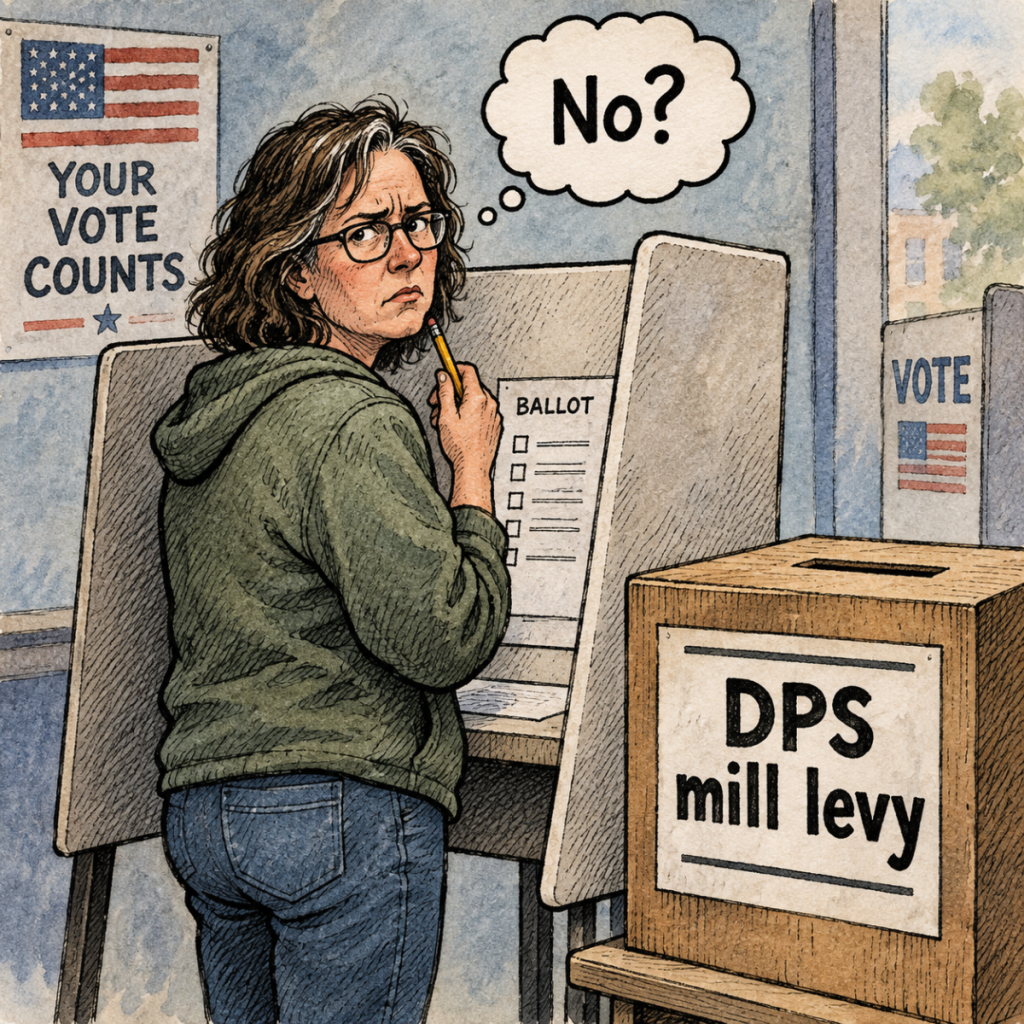
I would also hope that this re-organization would also send a message to the leaders and organizations who have chosen to remain neutral or oppose the DPS Mill Levy Override.
The Denver Gazette and the Denver Post’s editorial boards both opposed the mill which would increase the annual pay of full-time DPS employees by $1,750. The Rose Community Foundation, whose impact areas include education and Jewish life, took a “No Position” on the DPS mill while supporting various Bonds and Mills of the Douglas, Jeffco, and Littleton school districts.
Terrance Carroll, Colorado’s former speaker of house and former general counsel to DPS also came out with a voter guide where he took “no position” on the DPS mill. There are other Black leaders, whose private life I will preserve by not naming them here, who have taken it a step further and called for a no vote on the mill.
Denver’s Black and Jewish leaders are taking bold positions by taking positions of neutrality or opposition, and I hope the DPS board is paying attention.
It’s time for a new chapter
Many on the board have expressed the need to move on, and I agree we must close the chapter on this issue involving Hunter. With that closure we must also look ahead and a new chapter and new leadership.
A board cannot credibly demand effective leadership from the superintendent, principals, and educators while avoiding difficult questions about its own conduct and governance.
It was a lack of integrity, courage, and leadership that brought the board to this critical inflection point.
Monica Hunter and Amy Klein Molk deserved better from board President Gaytán. Denver’s Black and Jewish communities deserve better leadership, as do the children, educators, and families of DPS.
President Gaytan concluded her statement with “ Accountability is very difficult, and we will do it when it has to be done.”
It has to be done, board members.
It is time to hold new officer elections, reorganize leadership, and demonstrate through actions that accountability starts at the top.
Our students deserve nothing less.
Gaytán’s full October 9 statement
“When I heard about the derogatory comments that were made by Vice President Hunter, I was very shocked. We were a new team back then, and I had to quickly figure out how I was going to keep us together and I thought we could work past all of our differences. I was also trying to just spare both of my colleagues the hurt, the pain, the discomfort, the embarrassment. I wanted to be able to control that harm that I knew had already rolled out from this issue and from it becoming this public spectacle that it is now.
But once Director Klien-Molk came to me with some concerns about what she was hearing from staff out there in the community as well, I had no option at that point but to address it. Director Klein Molk and I had an intimate, private, emotional conversation and I apologized to her for failing her as a leader. And I want to apologize again publicly for failing you, Director Klein Molk as a leader of this board.
I did not prioritize that accountability for Vice President Hunter’s demeaning, anti-semetic remarks. I do believe remarks were serious and egregious in their reference to our fellow director regarding her Jewish heritage and identity. My hope was that I could ignore the bad behavior and help our board work on becoming a functional board that would be respectful of one another, inclusive and professional with one another.
And that was the expectation that I thought I was setting forward when we hired the three different facilitators, had three different board retreats in such a short span of time.
As board members, we have a responsibility to engage with one another but engage with dignity and respect, particularly when we have disagreements that involve matters of our own identity, our religion, ethnicity, or deeply held beliefs.
So regardless of differing views on political, geopolitical issues, those disagreements should not become a basis for disparaging or demeaning a fellow board member. There’s no easy way through any of this except for us moving forward now.
I made several, several attempts to talk to Vice President Hunter privately, and I was either not responded to, or told to only correspond through email, which makes the issues now a public matter since our emails are subject to open records law.
I did not want her to hear about these concerns for the first time over email, but I eventually had no choice but to document the concern and bring it forward to the board and in this very public manner.
I heard the words of our community, and I took them to heart. And I appreciate everyone for expressing their truth and their own feelings about this situation, and I also thank all of you who have reached out who have helped with the healing and the dialogue not only here within the board but across our communities. We need it now more than ever. We are a microcosm of what is happening out there in the city and across the nation and geopolitically.
Accountability applies to every single one of us, including board leadership because the board’s ability to govern effectively depends on following the policies it has collectively adopted and maintaining a productive working relationship with the superintendent as well.
Our community is looking to us to resolve these issues quickly and productively and I’m dedicated to all of you, to all of my colleagues, to our community in doing so constructively and collaboratively and I’ll continue to take those responsibilities as board president seriously including holding space to do what is right. Accountability is very difficult, and we will do it when it has to be done.
Thank you.”