Editor’s note: The SHIFT Chronicles is a monthly feature dedicated to amplifying student voices, where those most impacted by the public education system share their thoughts, reflections, and experiences. In collaboration with FaithBridge SHIFT fellows, these commentaries offer a genuine glimpse into the challenges students are facing within our city’s schools. These students represent a diverse range of schools across the city, each with distinct cultures and expectations, yet all united under the DPS banner. A special thank you to all the student writers who contributed their entries.
This month’s entries focus on student views on last month’s Denver school board elections.
Jada Pulsipher, senior, East High School
There are 547,112 registered voters in Denver, according to Denver Elections, and a majority of those voters were missing in action during this last election cycle on the matter of school board directors.
This low voter turnout not only causes the elected candidates to not be fully representative of Denver schools, but it also allows for certain endorsements to play a larger role in who gets elected. Who is elected to the school board should be important to all people in the Denver community and increased voter turnout is the best way to get the most representative members on the board.

During this election cycle, Amy Klein Molk won the at-large seat. Xóchitl Gaytán, an incumbent, won District 2. Monica Hunter bested the other 3 candidates (including as incumbent) in the District 4 race, and DJ Torres won over an incumbent and one other candidate in District 3. I have learned in our SHIFT Fellowship how Denver uses a public election system to elect members to the school board in contrast to a system of mayoral appointment that, for example, Boston Public Schools in Massachusetts uses.
Every one of the newly elected and re-elected board members were endorsed by the Denver Classroom Teachers Association (DCTA). A majority of their opponents were endorsed by Denver Families Action (DFA). In the last election for the DPS school board in 2023, all of the winning candidates were endorsed by Denver Families Action.
It seems like a back and forth between these groups and still students are struggling in school. These endorsements are a large factor in which candidates win the election. The problem with this is that it can create factions. The school board should not be controlled by factions but by the community as a whole focused on actually moving together for students.
The truth is that students do not care about the same things that any one particular adult group does.
As a student, what is most important to me is the quality of my school and education. When I go to school everyday, I think mostly about if I have access to resources and opportunities, if I feel like my teachers are teaching me productively, and if my community and environment are positive.
My peers and I don’t have a uniform idea of what makes a school great. We learn to listen and learn and to seek equitable solutions that work for all of us. The factions are not healthy if we really want to move forward.
As a student in a DPS school I know that the resources and opportunities that I want are different from the wants of whoever sits across from me in my statistics class, for example. So, the thing that matters most is that every student gets a high-quality education and has all of the opportunities they can imagine.
Students don’t come to school and think about if their school is a charter school or if it’s this school model or that school model. We don’t think about what organization or individual endorsed who.
We come to school wanting to learn and build community and these elections reinforce that adults don’t get that.
Lily Becker, junior, George Washington High School
Elections don’t just reveal who wins. They reveal who shows up.
In the recent New York City mayoral election, younger voters turned out in unusually high numbers, shaping the direction of the results.
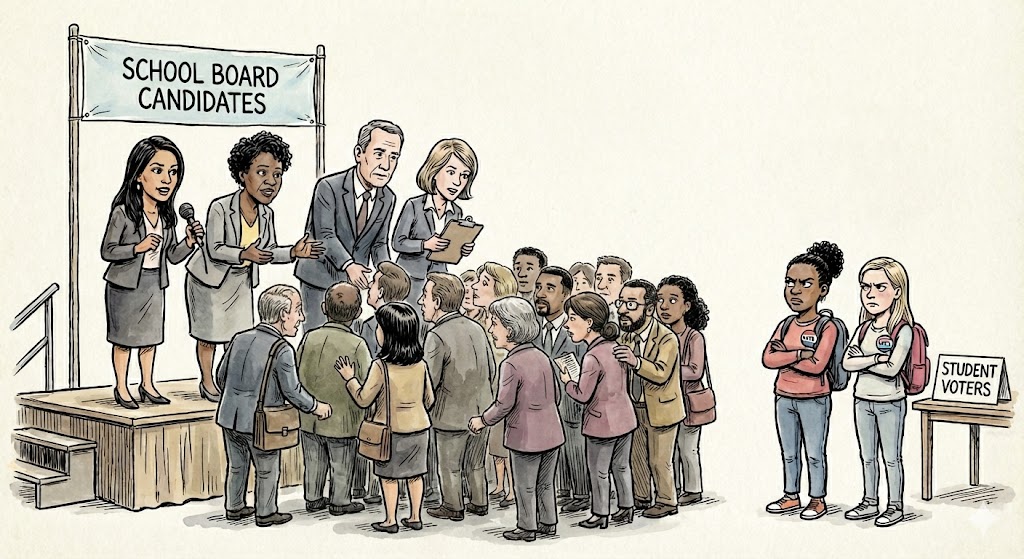
Meanwhile, in Denver’s school board election, the voter base looked quite different, dominated largely by older individuals. When comparing these two elections we see how age demographics can shift political outcomes and influence which issues get the most attention.
The New York election was to elect a new mayor, so it focused on broader issues and had more media attention. The Denver election was more localized, education focused, had lower turnout, and had more participation from older or longtime residents.

Zohran Mamdani, who is the new mayor-elect of New York, won by captivating the eye of the youth and bringing a new perspective into the political atmosphere, thus winning by an average margin of 30 points with a median voter age below 45.
According to The New York Times, “Voters younger than 45 — about 46 percent of registered voters in the city — made up about 43 percent of those who cast their ballots in person early or on Election Day. That outpaces the 2022 midterms…”
Younger voters represented 36 percent of those who cast ballots in the 2022 midterm elections, that is a 10 percent increase of youth participation. Mr. Mamdani’s ideas seemed so fresh because he was representing the ideas of the youth in New York; he brought up problems and ideas that younger generations have been advocating for. That’s what the future needs, more younger, innovative, representation, and ideas not only in the political atmosphere but in general.
There is no age-specific data publicly available for the 2025 DPS school board election, but citywide and statewide trends in Colorado’s 2025 off-year elections show older voters returned a disproportionate share of ballots. According to Denverite, “about 23 percent of the electorate was under 35…” even though this age group represents more than a third of Denver’s adult population.” These numbers demonstrate younger Denver residents were under-represented amongst voters, which suggests that a disproportionately larger share of the ballots came from older adults.
The reason for the lack of participation is the lack of the younger generation’s ideas being presented. Why would the youth want to participate in voting if their own problems and ideas aren’t represented?
People show up if they are being seen. If the Denver school board wants more parent and youth engagement they have to know and embody the ideas and hopes that we have.
Overall, there are a lot of issues when it comes to the age demographic in voting; there needs to be more of a younger presence and influence because as the future adapts so do the young.