
Editor’s note:
This is the monthly contribution from Boardhawk columnist Dr. Aaron Massey.
Accountability is a narrow concept in education.
When we think of accountability, we typically think about teachers and their impact on test scores, administrators with discipline data, or School Resource Officers with school safety.
These are the most visible folks in our education system. And research suggests that teachers are the most important people in the building for student achievement.
Critiquing our most visible leaders in education makes sense to families as well. On average, they saw the same folks in their education journey. Teachers, administrators, and possibly SROs.
But while holding the right people accountable to the implementation of schooling is critical, a primary focus on accountability of implementation is incomplete. How excellent teachers and administrators navigate the conditions/systems of school, are a) are impacted by constraints of a system and b) have an impact on what we all want from school: results.
Think of it like this:
How engineers design a building impacts how it’s used. How they design roads influences traffic patterns.
Car manufacturers’ design decisions impact how drivers navigate.
Executives of professional sports teams make decisions on roster configurations. Those decisions significantly impact a team’s ability to win. Not just if the players are making shots on game day.
System design and policy decisions are a container for what’s possible to implement in programming.
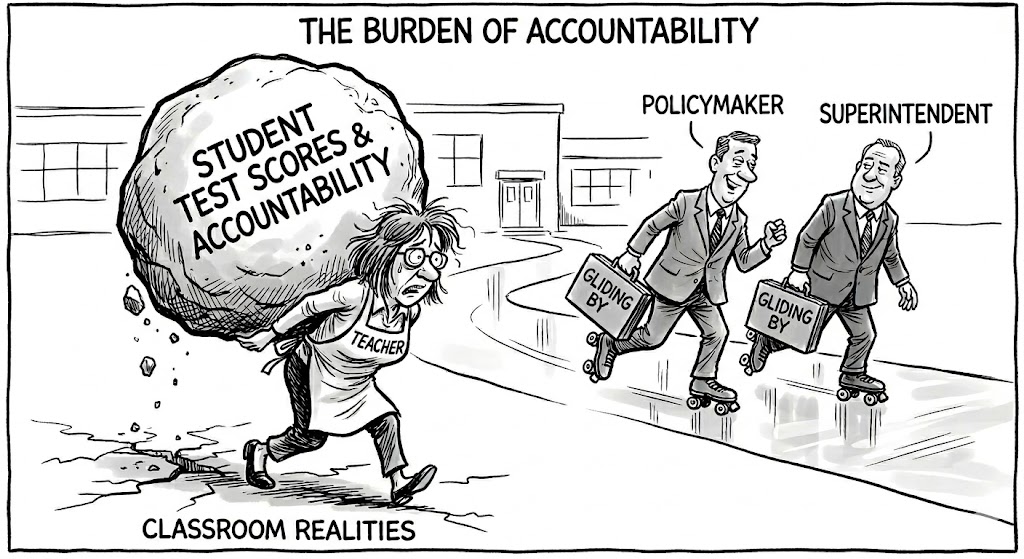
In education, we see this pattern in how people generally discuss school performance and accountability. When outcomes like CMAS test results or school performance ratings are evaluated, attention is typically directed toward teachers and school leaders in implementation – folks whose work is most visible in student outcomes and reporting systems.
In these moments, accountability functions as a response to measurable performance rather than an examination of the conditions that shape that performance. Less visible are the policy and system-level decisions that determine the metrics being used, how resources are allocated, and how the constraints schools navigate are defined.
The consequences of this narrow thinking are significant.
When we use this narrowed approach, we:
- Fix only parts of the problem, allowing other factors to undermine the execution of full programing
- Use data that tells an incomplete story.
- Push teachers towards a particular focus on what’s measured instead of what’s needed (think compliance and teaching to the test).
- Lose teachers due to outsized pressure.
- Risk eroding parent trust by painting a picture that doesn’t align with what parents see.
But when we add design and policy- and system-level decision accountability to the already established implementation accountability, we are able to uncover the conditions in which people (implementers) thrive, the components of a program that are least/most effective, how decisions contribute to program efficacy, size of intervention, unobserved costs, etc.
Some folks might see this reframe as risky.
Implementers and designers could get into an unproductive back and forth on why results are not being achieved on a particular timeline. Why muddy the focus of those on the ground? Or some might say board members shouldn’t make day-to-day decisions. Let them focus on their lane.
Just like implementation accountability, this thinking makes sense but is incomplete. There is an inherent value in listening/exploring/debating with folks who have different vantage points. Exposing not people, but components of a decision or beliefs or a system is productive. And has the ability to widen the container.
When accountability is defined too narrowly, it reveals less about achievement and more about limits of the system itself.