
Last week, with the release of the 2026 state testing CMAS results, we published longtime educator and education advocate van Schoales’ examination of Colorado’s recent boast, thanks to the magazine US News and World Report, that it is the number one state in the nation for education.
We thought his analysis merited a conversation, so we invited him on the podcast.
Recently Schoales has honed his AI skills using Anthropic’s Claude, and combined with his deep knowledge and keen data sense, has been doing some in-depth analyses of important Colorado and national education issues. His recent post combines a dive into CMAS data with a contextualized look at Colorado’s ranking on the National Assessment of Educational Progress (NAEP), commonly know as the nation’s report card.
Schoales has been active in Colorado and Denver public education for more than 25 years, as a teacher, charter school founder and leader, advocacy organization executive, and as an influential voice locally and nationally in education change efforts. Loke many other of our guests, Schoales doesn’t shy away from telling hard truths, which made for a lively conversation.
A transcript of our conversation can be found below.
Season 2, episode 20: The truth about Colorado’s national education ranking
[00:00:00] Alan Gottlieb: Hi, everybody, and welcome back to the Boardhawk Podcast. It’s been a few weeks since we’ve done an episode. There’s been a lot of churn in the background, but not a lot exciting happening overtly, so we just took a little break. And I’m gonna show you where I am, because I’m at the home of some friends in northern Idaho, on a lake, Lake Pend Oreille, way up near Sandpoint, an hour south of the Canadian border.
Alan Gottlieb: Our guest today is Van Schoales, who’s been with us before, and most of you who are listening probably know him, but I’ll do a quick introduction, and then I’ll tell you what we’re talking about today. Van’s been active in Colorado and Denver public education for more than twenty-five years, as a teacher, charter school founder and leader, advocacy organization executive, and as an influential voice locally and nationally in education change efforts.
Recently, Van has honed his AI skills using Claude AI, and combined with his deep knowledge and keen data sense, [00:01:00] has been doing some interesting in-depth analyses of important Colorado and national education issues. This week, with the release of the 2026 state testing CMAS results, we published his examination of Colorado’s recent boasts, thanks to the magazine US News, that it is number one in education nationally.
Van, like many other of our guests, doesn’t shy away from telling hard truths, so it should be an interesting conversation as we dig into that claim and into what the numbers really tell us. So Van, thanks for being here.
Van Schoales: Oh, thank you. It’s a pleasure.
Alexis Menocal Harrigan: Thanks, Van.
Alan Gottlieb: Great, let’s jump in by starting with the press release the state put out, the Colorado Department of Education and the governor’s office, about the CMAS results. It trumpeted, once again, the fact that US News & World Report said Colorado’s number one in education, which seems, even on the surface, a bit disingenuous.
What’s your high-level take, based on this analysis you’ve done of the new CMAS data, which, by the way, we published on Board Hawk yesterday? What does it tell you about where we really are, given NAEP [00:02:00] scores (the Nation’s Report Card) and other things?
Van Schoales: Yeah. First off, some good news: the state is improving, particularly on math, which a number of us have been screaming about in one way or another for a while. So we are seeing improvement.
But to suggest that Colorado is somehow number one, with the exception of this ranking that comes from US News & World Report, which is this weird combo of figures mixing higher ed numbers with early childhood numbers, well, because of the way the math is done, it allows Colorado to end up in the number one spot.
But if you look at any of the achievement indicators from NAEP, which is the best measure we have, [00:03:00] the gold standard for comparing states and comparing populations of kids within states, or look at the numbers on who’s going to college and how many kids are going to college, Colorado ends up being overall somewhere in the middle, or sometimes in the top half of the middle. Colorado’s been that way for twenty-plus years. Sometimes we end up in the top quarter, and often we end up in the top fifty percent, but it’s more toward the average nationally, and the most recent numbers suggest that’s where we are now.
I will say I did look at how we’re doing on CMAS, our state test, compared to other states that have released their state test data. And [00:04:00] unfortunately, there aren’t that many states with data released for 2026. But of those, again, Colorado’s in the middle.
We didn’t look exceptionally better at making improvements. And so one of my frustrations is that we live in a time where, unfortunately, as I said in the piece, there are a lot of politicians, especially our president, who have normalized lying about the facts on anything.
And I feel like there are more and more politicians and leaders who think it’s okay to be braggadocious in one way or another. It’s not untrue that Colorado did get this US News & World Report ranking of number one, but it is untrue to suggest that we’re somehow number one in terms of achievement, or any of the other things that most of us would [00:05:00] consider reality.
Alexis Menocal Harrigan: That’s right.
Alan Gottlieb: One thing I wanted to follow up on: what do you feel is the practical impact of exaggerating Colorado’s status in terms of its education performance? What does that hurt, or help?
Van Schoales: Yeah. It’s suggestive that we don’t need to do anything about where we are. It’s also suggestive that what we’re doing is working, so we should just keep doing what we’re doing. And, as I point out in the piece, one of the frustrating things about Colorado, and it’s difficult for those of us who’d like to see the system get better, is that we’re among the most educated states when it comes to adults with degrees.
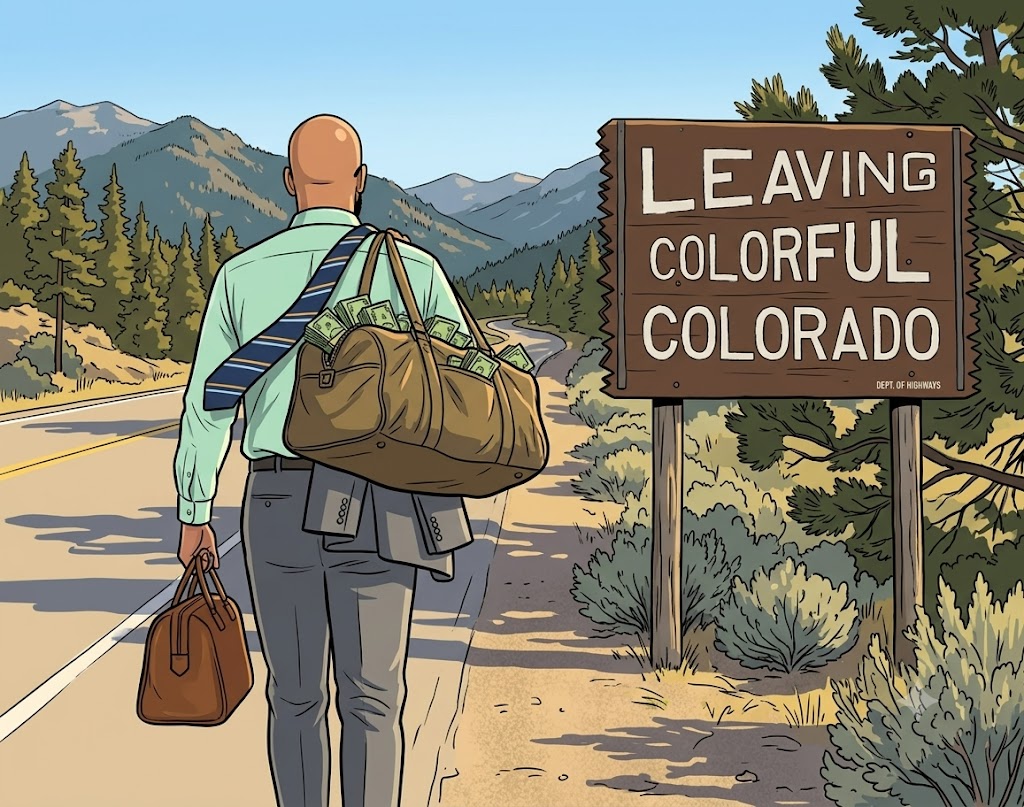
Depending on the year, it’s Connecticut or Massachusetts, [00:06:00] or Colorado, that has the highest number of adults with college degrees. And that tends to mask how many kids from Colorado actually go on to college. We are, in fact, number one in the country in the gap between the share of adults who have college degrees and the share of kids who move through the system and get college degrees.
Alan Gottlieb: That’s the old Colorado paradox, right?
Van Schoales: That’s the old paradox, yeah. And, as we’ve talked about before, I hate the term paradox. I prefer to call it the mirage, or the mask, because it’s suggestive that we don’t have a deep problem in this state when it comes to K-twelve, and also higher ed. It’s as if we [00:07:00] showed up at this big, fun group dinner, and when it comes time for the bill and we’re dividing it up with a twenty percent tip, we’re like, “Oh, gotta run to the bathroom. Oh, the car’s waiting outside,” and we just run off. So we’re shirking our responsibility to actually support our own kids, and the kids who were already here, before I immigrated with a degree from Michigan or Wisconsin or wherever, some other state that’s actually investing in creating that college degree for me.
Alexis Menocal Harrigan: And I just want to dig a little bit deeper into that. I think you did a nice summary, Van, describing that mirage, the Colorado Mirage. I like that term instead of the Colorado Paradox. In the US News & World Report ranking, half the score was for [00:08:00] higher ed. We’re number three in higher ed, and part of that includes being number one for educational attainment of adult residents. So, to your point, the challenge is that a lot of the people reflected in that number didn’t get their degrees in Colorado.
They didn’t graduate from CU or DU or CSU. They brought those degrees, sometimes advanced degrees, with them from another state, maybe even another country. So what we’re not looking at in these figures is the educational attainment, the higher ed or advanced degrees, of Colorado-raised and Colorado-graduated students.
And in fact, what’s fascinating about your analysis, and I have the Board Hawk article up right now, is you have one column on the left with the higher ed information and a column on the right with the K-12 information. Colorado’s high school graduation rate ranked 39th among the 50 states.
So [00:09:00] how do you reconcile that gap between having the most college-educated adults and how many of those adults actually came through Denver Public Schools, Littleton Public Schools, Colorado Springs, wherever?
Van Schoales: Yeah. It’s a huge problem, particularly if we go back to the premise that college isn’t for everyone, and I want to be clear about that. I think there’s a lot of information and research that suggests a lot of the skills, habits, and even knowledge that one gets from having a college degree are becoming more and more important in this age of AI [00:10:00] and everything else, in terms of problem-solving.
We also know, there’s a famous study at Georgetown that everybody cites, that suggests 70% of jobs are going to require some sort of higher education degree.
Alexis Menocal Harrigan: Sorry for interrupting you there, Van. The thing we also don’t talk about enough, I think, is the social capital you build through a college education.
I’m the first in my family to graduate high school, the first to go to college, and, more than the content of what I learned, I’d say the social capital I built by going to college, the soft skills, how to talk to people, how to communicate, was far more valuable than what I learned in my incredible liberal arts degree that I don’t use today.
And it would be really fascinating, and this is a bit of a tangent, if there were some sort of study on the social capital of people who graduate from Colorado high schools versus those who are now in the workforce and [00:11:00] leadership across our state. Even if we took, say, the Denver Metro Chamber of Commerce or Colorado Concern, and did an analysis of their members, how many of them were born in Colorado and graduated with a degree from Colorado? I’d be interested to know that myself.
Van Schoales: Yeah. Just as an aside, the last time I remember actually being at one of those meetings, this was pre-pandemic, so numbers may have changed, but it was at the Denver Metro Chamber, a pretty big meeting, hundreds of people there, and somebody asked that question. Half the people said they had degrees from somewhere else. So that’s reflective of where we are. And again, it’s not… I have a future son-in-law who’s just getting his journeyman’s license as an electrician, and those are good jobs.
Alexis Menocal Harrigan: An AI-proof job.
Van Schoales: Yeah, a great one. But many of these other things are often tickets to nowhere. And the other thing I’ll say about Colorado [00:12:00] is that back in 2008 there was a law passed that we were going to create pathways to success, which included college as well as other things, and we were going to have a data pipeline that would let us see what kids were doing, where they were going, how successful they were, whether they were getting jobs.
That was 2008. It’s 2026. We’re still talking about connecting. We barely connect K-12 to higher ed, and we don’t connect anything to jobs. There’s all this talk of internships and school-to-work programs, but we don’t really have data on that. So we’re constantly, I would say, making decisions on policy with at least one eye, and the other one [00:13:00] needing cataract surgery.
Alexis Menocal Harrigan: I’ll just push back for one second. I don’t know if it was this year, or I think it was the year before, where we actually started making efforts to do more data transfer about degrees. I don’t know if that was legislation or something the department did, but they’re making attempts. Though the fact remains, it started in 2008.
Van Schoales: Yes. Incremental, but there is some. I can’t tell you if, say, St. Vrain is doing a great job of getting people into work and into the sectors that need it. I should be able to tell you that, the same way I can tell you how school districts are doing in terms of low-income kids and their math scores.
And I don’t want to change the subject, but one other thing I wanted to say, stepping back globally, is, I’ve been doing this stuff, you said 25 years, I should update that. It’s now, gosh, I’ve been doing education work in [00:14:00] Denver since 1996.
Alan Gottlieb: Thirty years? What?
Van Schoales: I’m one…
Alan Gottlieb: One year? I’m one year ahead of you, man.
Van Schoales: Okay, so I’m old. I’ve been doing, probably since 2003 or 2004, analyses of grad rates or state test scores or whatever. So I’ve been doing this for a long time, one way or another.
And then, as is the case now, unfortunately, what happens is we have press conferences, like we had on Wednesday. Somebody gets up and talks and says, “Oh, here are the test scores. We’re a little disappointed,” or, “We’re really psyched that things have gotten better.” And then we move on, and we never dig into any of this. I did this on Board Hawk, but I’ve done it a bunch of times: you do [00:15:00] these scatter plots where you look at how kids are doing on achievement, or graduation, or college, and you compare it to the demographics, and you find these bands, like half the graph, or at least a third of the graph, in terms of variation.
Some places are doing really well, some places are doing terrible, and we say, “Oh, that’s cool,” and maybe give an award to some of the schools on the higher end of that predicted line, but otherwise we just move on. If there were a pandemic going on and we were testing some new drug to deal with the symptoms, we would never do that.
We’d say, “Oh my gosh, what’s happening in that place? Let’s dig [00:16:00] into it, and what’s happening in the place down below? Let’s find out what’s different between those two things, and let’s stop doing that, and do more of this, and try to understand what’s going on up here.”
And we don’t have a culture in education policy where that happens, hardly at all. It’s a very rare thing.
Alan Gottlieb: I had a beer the other day with our mutual friend Rob Stein, who’s now the acting superintendent in Jeffco, and he said the exact same thing, that if education only acted more like medical research, actually looked at treatments that were effective and then replicated and expanded them, we’d be in a lot better place than we are the way we operate today. Which is pretty much what you just said, exactly.
Van Schoales: No, it’s like, it’s as if we’ve barely noticed that there’s this new thing we discovered called bacteria or whatever, but we keep noticing that E. coli seems to show up in places, and people drop dead. But we’re not doing anything about, making sure that our [00:17:00] vegetables don’t have E. coli on them.
Alexis Menocal Harrigan: I mean, we used to. But, to your point, the fact that the semblance of the CDE that we now have under Robert F. Kennedy, you at least get information going out, like, “Hey, the popsicles you like” (which were mine, I’m really sad) “are now recalled ’cause they have glass in them.”
Great to know. Wouldn’t it be nice, as a parent, to know, “Hey, the school you’re sending your kid to, if they’re a Black student whose parents don’t have a high school or college degree, is less likely to achieve at this school than at this school”? I would want to know that as a parent, the same way I’ll know that the popsicle I’m about to give my kid has glass in it.
Alan Gottlieb: I think part of it is not wanting to hurt anybody’s feelings. That feeling comes way too much into play. I know, I don’t care anymore, but that’s what it comes down to. It’s like, “Oh, we don’t want to make that school feel bad about itself.”
Van Schoales: And, [00:18:00] I also want to say that a lot of my analyses use numbers, and the reason I use numbers isn’t because I don’t believe that qualitative measures, like what makes a quality school, measuring culture and all kinds of other things, are also really important. It’s just that’s all I have access to. And that’s a really important caveat to all of this.
Alan Gottlieb: Yeah. I had a lot of other things I wanted to say about higher ed, based partly on the report I’m working on for Van and the Keystone Center, but that would get us way off topic, so maybe we should do this again and start talking about that once that report’s out.
But let’s walk through pieces of your piece on Board Hawk, section by section, without getting too wonky. Let’s go back to the K-12 side, since we talked about higher ed a bit just now. What do the NAEP results tell us about where Colorado really stands, and whether that position has really changed for better or worse over the [00:19:00] years, particularly as it relates to low-income students, which I think is what really matters?
Because, as you pointed out in your piece, for kids of affluent, highly educated parents, school is a nice add-on, but for lower-income kids, it’s the main intervention in many cases. Not all cases, but many. So really what we want to look at is how Colorado is really doing with those students, low-income students and students of color, who tend to need that intervention more.
Van Schoales: Yeah. And we find that Colorado is again doing average, which is not that great, and in some cases doing worse. I have a bar chart of where Colorado ranked on NAEP the last time we had it, math NAEP was [00:20:00] 2024.
If the state test is indicative, we’re doing better, but so is probably the rest of the country. So, for grade four math, for instance, economically disadvantaged students, we’re 28th. That’s pretty far from number one. Not economically disadvantaged, we’re number nine.
So we see, reflected in almost all of the data, some pretty massive achievement gaps, which, my hypothesis, is related back to this question we talked about, importing talent. My guess, and I don’t have data around this, is that the kids of folks coming from out of state [00:21:00] with college degrees from other places are probably doing marginally better than the kids of multi-generation Coloradans, at least based on the data.
Maybe I’m wrong, but I’ll throw that out as a hypothesis.
Alexis Menocal Harrigan: I do appreciate that the NAEP scores let you do that analysis, students based on economic disadvantage or not. And this is my PSA for any DPS parents, or any parents listening right now: if your kids are going back to school, please fill out your free and reduced lunch form, even if you don’t qualify for free and reduced price lunch, so that we do have accurate data about how students are doing based on parents’ income. I always roll my eyes, I’m like, “I don’t need to fill this out.” Yes, I do, for accountability to other parents. Please fill out the free and reduced lunch forms. Okay, PSA over.
Van Schoales: Thank you. Yeah, yep. No, thank you. Yeah, no, it’s really important to know this stuff.
Alan Gottlieb: Just [00:22:00] looking at the CMAS data for a minute, Van, what did you see in terms of trends, low-income kids of color, as well as overall in Colorado, in math, ELA, and then at the high school level, the SAT data? What did you see there?
Van Schoales: Yeah. So we saw more improvement, just as the state said in their press release and press conference, more improvement on math than on literacy, and more improvement at the elementary and middle school levels than at the high school level.
We didn’t see much change in high school. And I’ll throw out a couple of hypotheses, I don’t know this to be true, but we think it’s easier for kids to either pick up math or lose math when they’re in school, which kind of makes sense, most of us don’t learn math at home.
[00:23:00] Literacy is much more dependent on what’s happening in the home. Because of that, schools probably have less impact on literacy than they do on math. We saw that during the pandemic: when kids weren’t in school, their math scores dropped precipitously, faster than their literacy scores.
And we’re seeing that now, as kids are back in school, the improvement is steeper on the math side than on the literacy side. I’d also say it’s harder to move the needle once kids get into high school. Schools have less impact there. There have been all kinds of studies on this, particularly on basic achievement. For better or worse, a lot of it gets baked in [00:24:00] for most kids in the earlier grades.
Alexis Menocal Harrigan: Intuitively, what you’re saying about math versus literacy and the effects of home environment makes sense. I’m not totally convinced, though, because I think about the interventions, particularly on literacy, with the passage of the READ Act. And anecdotally, my own child, who was struggling with reading, went, through interventions, from a couple of grade levels behind to actually winning a literacy award because of his growth.
I do think interventions make a huge difference when you can target them, that’s not exactly what you were saying, but I wanted to put a caveat in that comment. I do think some of these interventions work, but we don’t have the funding to do them at the level we’d probably want, school by school.
Van Schoales: There have periodically been people, even leaders of [00:25:00] states or the country, who raise questions about the value of school. One of the things we discovered, or were reminded of, through the pandemic, is that school matters.
If kids aren’t in school, they don’t learn as much, and that’s true for literacy and math. I just wanted to suggest that all of us, if we have younger kids, should be reading to them every night, that’s a good thing to do. And very few of us hang out with our kids and do math with them outside of what school asks. There are occasionally some people who do that, but most of us don’t.
Alexis Menocal Harrigan: So you mentioned there are some leaders who basically want to, and you didn’t say these words, I’m putting them in your mouth, abolish education, we don’t need it.
But we do have leaders running for governor right now. We have Victor Marks and Phil Weiser running for governor. [00:26:00] Governors come in, they usually have their own agendas on education. I’ve seen that with the last two, where they do some sort of work through a committee.
They have to figure out how they’re going to work with the Colorado Department of Education, because it’s not through statute, it doesn’t report to the governor, it’s independent. What guidance would you give Victor Marks or Phil Weiser on how they should show up, as potentially our next governor, in dealing with this data?
Van Schoales: Well, first off, I’d want to start with a question: does public education matter? Do you think it has an impact on building communities, on the economic development of a community or a state? I think we have to start with some real basic stuff, because I don’t think we can assume that’s the case for everyone.
I believe it does, and I think the research shows it does, but [00:27:00] again, some people don’t believe that.
Alan Gottlieb: Up here in northern Idaho, nobody believes it.
Van Schoales: Right. Anyway, so once we get beyond that, I’d say, rather than starting with “this is what we need to do,” I’d hope they and their senior staff would take an honest look at where we are. How is Colorado doing, and what do you want Colorado to do? And then, what are all the different levers you have?
I get it that a Colorado governor has less power than many other governors, because we have a very decentralized system. We have a Department of Education that basically is mostly a pass-through for federal money. Having said that, the governor has enormous power with a bully pulpit, and so does the [00:28:00] commissioner of education. There are a variety of policy things that could be done, and the state has a history of passing laws to try to improve education and then forgetting about them, moving on to the next legislative session, and layering another one on top, never really evaluating whether or not anything worked.
So, as an ex-geologist, I’d say we have these layers of policy strata that we never bother to dig into. We never look at the fossils down below.
Alan Gottlieb: Amen.
Van Schoales: We need to crack open the geode and actually look at it. And it’s not to suggest that just deregulating things is going to help, because we know just deregulating things only exacerbates differences. We need to look at, what are the [00:29:00] priorities, what are the levers, and so on. I’m super excited that we have full-day K and early childhood education. How are we going to figure out if any of it’s working? What’s quality? How do we know that?
So on and so forth. I’m super excited that Colorado is a national leader at creating pathways from high school to work. Again, how do we know any of that’s working or not? I’m not so excited that the state hasn’t really thought about school leadership, has no programs around it, has hardly anything at the moment around school improvement, and pays next to no attention to what’s working or not.
I know there’s a legislative task force that’s going to be looking at some of this, and I hope they dig into it and it doesn’t fall into this sort of ridiculous schism between the, quote-unquote, “reform people” and [00:30:00] the, quote-unquote, “union people,” which is what usually happens.
Alexis Menocal Harrigan: The leadership piece is an interesting one, and I think very hard to affect at the state level with legislation.
But that’s where my personal passion and frustrations come in, with the apathy that we see from voters, from parents, from community members, at the district-by-district level. I was recently having a conversation with an education leader in our state, and, anecdotally, I believe this is true, I’d love to dig into the Secretary of State data on this, but in a lot of rural districts, we have a hard time getting people to run for school board, for example. They told me actually that in some rural districts, there are no term limits. So people have been on the school board for 30 years, and that may be great, but it could also be an opportunity for some really bad stuff too.
I don’t know exactly where I’m going with this little rant, but I [00:31:00] think it’s incumbent on us, from the governor all the way down to local voters voting on who their school board members are, to pay attention and don’t just take the Instagram or TikTok post about how we’re number one at face value.
Do some critical thinking, people, please.
Van Schoales: Yep. Yeah. And I’ll say, when I look back on the history of education in Colorado, there were governors on both sides of the aisle. Governor Owens did all kinds of, he was a Republican, not a Trump Republican, a pre-Trump Republican, back when Trump was still just talking about how tall his buildings were, when they were actually not as tall.
Alan Gottlieb: And bankrupting casinos.
Van Schoales: But, anyway, Bill Owens did a lot of really interesting and good things on the education front, and so did Roy Romer, who was a Democrat.
Both of them have had impacts that have been lasting, that have made Colorado better than it [00:32:00] was prior to them having been governors.
Alexis Menocal Harrigan: And also give Jared Polis credit, the full-day preschool, or, I’m sorry, the full-day kindergarten, that’s huge. Trying to move towards more preschool is great. Like, that’s great.
Van Schoales: No question. I hope that sticks as part of his legacy. And I’m guessing that it will. But again, as is the case with all these other folks, Romer liked standards, and it’s nice we have standards, but there’s no accountability for them. It’s not his fault, but we don’t really have any.
Alan Gottlieb: I wanted to touch on a couple more data points from your piece before we sign off. The first one, and the last one’s DPS, but the first one is the section you wrote about how the state’s doing in terms of graduating kids and then preparing them for work and college, which are not the same thing, obviously.
Van Schoales: One little side note, and I pointed out in the piece, [00:33:00] is that our graduation numbers are, of course, better than the federally reported graduation numbers. That’s typically the case in most states.
Let me just veer a little bit off into a tangent, which is: one of the things you found was, in terms of not only high school graduation but preparing kids for college, and just on some of your data charts, in particular, DSST network high schools just kick butt over almost any other schools in the state.
Alan Gottlieb: And again, I’m working on this report for you on higher ed ROI, and the work that they do, the intentionality of the work they do, I think explains a lot of that. I’m sure we’ll have you back on when that report gets released. But what do you see in terms of why, and why that works so well, what they’re doing, and, over time, why it has worked so well?
And, this is more of a philosophical question, a leading question, [00:34:00] why, since it so clearly does work, does nobody else emulate them, especially districts?
Van Schoales: I think Alexis and I were talking about this before we started recording a little bit, about different types of school models.
I think, unfortunately, it’s very uncommon to find schools that do what they say. There’s often a disconnect between a school’s description of its philosophy and practice, and how that translates into what happens in the classroom, in terms of how people behave in the hallways, adults and kids.
Alan Gottlieb: It’s easy to put core values on the wall, but does anybody actually pay attention to what they mean?
Van Schoales: Pay attention to. Yeah. And DSST, for better or worse, you either like the model or you don’t, but they say that they’re about preparing kids to get into and succeed in college.
And [00:35:00] lo and behold, they do that. The data suggests that they do that better than other places. They have a whole host of practices around that. Some of them are around preparing kids academically. Some of them are around making sure that they and their families are oriented towards that, and helping them get there, et cetera, et cetera.
So I think that they do all of those things, but, stepping back, it’s that they actually do those things. And it also means they don’t do some other things. I wrote, or worked on, a paper that came out with FutureEd at Georgetown last year.
It talked about what makes a quality school, and the research around it, and this has been going on for, gosh, since the late ’60s. We know that one indicator of a quality school [00:36:00] is intentionality around a focus. I think what’s really remarkable about DSST is it’s not just a school, it’s a group of schools.
They’ve been able to replicate those practices across the group. That’s really hard to do. And to answer your question about why others don’t, I think we have a culture in education where the first thing that most of us think, when somebody has done well at something, is, “Oh, they’re cheating,” or, “They have a different group of kids,” or, “They have more money,” or whatever.
It’s really different from, my dad was a medical researcher, when somebody gets some new data, they don’t immediately think that they’re cheating. They go into it with some skepticism, but they’re like, “Holy cow, what is it [00:37:00] that they’re doing?
How’d they get those numbers that way? I want to understand that.” And then they’ll jump to some conclusions about whether or not it’s replicable or whatever. We don’t do that.
Alexis Menocal Harrigan: I want to add a little bit more color to this as a parent of a DSST middle schooler.
That school works really well for my son. I don’t know that it’s going to work as well for my other child, and that’s going to be a decision my husband and I have to make when we’re doing school choice for my next middle schooler. But there are trade-offs, and we’ve talked about this a little bit on the podcast before, Alan.
You’re not going to get the traditional high school experience a lot of people associate with their high school experience. You’re not going to get a band, ’cause there’s no band. You’re not going to get the performing arts. You’re not going to get the high school football pep rallies, right?
They have pep rallies, but it’s not the same type of traditional giant high school experience. And I don’t want to use the [00:38:00] word “fluff,” because for some students, that band or that orchestra is actually the thing that kept them in school, the thing that helped them graduate, right?
So I think it’s incumbent on parents to understand what’s the motivating factor for your child, what is it that helps them succeed in that school, and be laser focused on that. I was also sharing with Van before we started, one of the factors that helped me be very clear that DSST was the right school was, we were choosing between DSST, Maury, and Highline.
Highline was just a little bit too small for us. But it was really between DSST and Maury, and no knock to Maury, but, the check-in process. The fact that, when we were doing the open house, the family night, “hey, come tour the school,” it was, like, a 20-minute wait just to [00:39:00] check in at the front office at Maury. It’s like, “You knew we were coming. Why is there a line to get into the front office to then get into the auditorium?” And it started late.
Versus at DSST, they curated that event so well that parents knew exactly what to expect. It started on time, ended on time. They had things for students to do. They had student ambassadors there, and I give them a ton of credit. If they’re going to do something, they do it very well.
That’s one of the things I love about DSST, is they don’t half-ass anything, and I think that’s because they don’t have a lot of other things and distractions to pull them from their core focus, which is getting students to college, or getting students to graduate, academically, in a good spot.
Van Schoales: Yeah, and again, I want to say, it has to do with focus. It’s not necessarily the DSST program specifically. That’s what a good school is. I’ve been in hundreds of schools, and, as somebody who went to project-based schools [00:40:00] and had some learning disabilities as a kid, I actually have a verbal SAT score of 400, so I get it. I didn’t get into all the schools I wanted ’cause I had such crappy SAT scores.
Alexis Menocal Harrigan: Me too. Take that, Dartmouth. Hate you guys.
Van Schoales: That’s right. Yes. I’m grateful I didn’t go to Cornell. Kids are different, and different kids need different kinds of programs, and they need different kinds of supports, and it needs to be individualized. Parents need to know that when they’re helping choose schools, and schools have to be flexible about providing those supports.
Alan Gottlieb: Okay, we’ve gone pretty long, which is great, because it’s been a good and wider-ranging conversation than I had originally intended. But for our listeners who care primarily about DPS, I did want to at least touch on, and again, this isn’t part of your piece, [00:41:00] but I know you’ve done some looking into it because you sent me some stuff.
What did you see in terms of the current, the latest CMAS scores, and what’s going on in DPS, again, particularly among low-income kids of color?
Van Schoales: Yeah, so Denver, I would describe it as, eh, doing slightly better in some cases than the state. I think that the folks, and maybe me included, who’ve been very unhappy with Marrero’s leadership, were surprised that maybe the scores didn’t tank or something.
And they didn’t. But neither did they go up. There’s a range of things, but I would say that Denver is eh. It’s a reminder, I think, I was talking to somebody else [00:42:00] earlier this week about the roles of superintendents.
It’s a little bit like the roles of governors and state scores. It’s really hard to move the needle on a school district with, now, a multi-billion dollar budget, thousands of employees, and close to a hundred thousand kids. It’s really hard to do that.
You either have to be an incredibly amazing leader with lots of really good levers, or you have to be incredibly terrible and do whatever you can do to destroy the place. Most superintendents are neither of those things, and I’d say that Alex Marrero is somewhere in between.
I think he’s not a very good superintendent, but he could be much worse, and the system would probably still [00:43:00] move along.
Alan Gottlieb: It takes Trump-level malfeasance to drive something into the ground as quickly as Trump has driven parts of the United States into the ground, and Alex Marrero, as critical as I am of him as well, is not Donald Trump in that regard. He is nowhere near that bad.
Alexis Menocal Harrigan: Alex is phenomenal at maintaining a status quo.
Van Schoales: Yeah, but I’d say that’s true of almost anybody. It’s really hard to move the needle one way or the other in a place like Denver. And, in Denver, when you look at the overall numbers, it’s like an exaggeration of the state.
If you happen to be white and not poor, you’re doing amazing in Denver. In fact, it’s probably the best place to be, other than maybe Boulder. It’s better than Dougco or Cherry Creek, white kids do really well in Denver. But if you’re poor, you’re now doing about the [00:44:00] same as you are in the rest of the state. If you’re Latino, I looked at the Latino numbers, and they’re basically the same as other places.
Pretty much. And in some other districts, you’re much worse off being Latino than in Denver.
Alan Gottlieb: Hardly a billboard to put up on the side of the highway.
Van Schoales: Yeah. No, and it is hardly for those that think Alex Marrero is amazing, nor is it for those of us that maybe think he needs to go.
Alexis Menocal Harrigan: That’s a podcast for another day.
Van Schoales: Yeah.
Alan Gottlieb: That’s a good point. Van, thanks so much for coming on. This has been a really interesting conversation. Again, I’m sure we’ll have you back on for multiple things going forward in the future. Any last words, Alexis?
Alexis Menocal Harrigan: No, this was great. Thanks so much, Van. Always love to have you on.
Van Schoales: Yeah, no, thanks so much. It was fun. I wish I could dive off that balcony into the water.
Alan Gottlieb: I’m gonna go swimming in a few minutes here.
Van Schoales: Okay.
Alan Gottlieb: [00:45:00] Okay. Talk to y’all later.
Van Schoales: Okay. Okay, good.