

Word that Denver Public Schools Superintendent Alex Marrero is one of 21 candidates to become superintendent of Miami-Dade Public Schools in Florida should come as good news to people who pay attention to data and facts on the ground rather than spin.
It’s apparent Marrero hopes he is a short-timer here in Denver, since this is the second big-time job (Chicago being the other) to which he has been linked in the past few months. I’ve watched enough superintendent searches over the years to know that search firms don’t always send districts the best candidates, and school boards don’t always make the wisest hiring decisions. So I’d give Marrero a solid shot in Miami-Dade.
I’ll save a thorough analysis of his record here in Denver for when he actually is on the way out the door. But as I’ve written on several occasions, Marrero and his team are far more adept at spin and self-aggrandizement than at improving learning outcomes for Denver’s children. He has been aided and abetted in this by fawning school board members, past and present.
What bothers me most about Marrero’s tenure, and the spin that has surrounded it, is that district leadership doesn’t seem to believe low-income kids of color can learn at high levels in large numbers. There’s a bit of “pobrecito” syndrome prevalent inside DPS.
It sounds something like this. “Many of these kids come from incredibly challenging backgrounds. We do our best for them, but we can only take things so far. Societal inequities and familial dysfunction just make this job so hard.”
Nothing about that statement is untrue on its face. But if that’s the mindset underlying the work the district does, then the message to everyone will be: Do your best. No one expects miracles.
And that’s the wrong message to send.
Lest you think I’m pontificating out of thin air, consider the following example. Last week, Denver’s North High School posted the following image on its Facebook page:
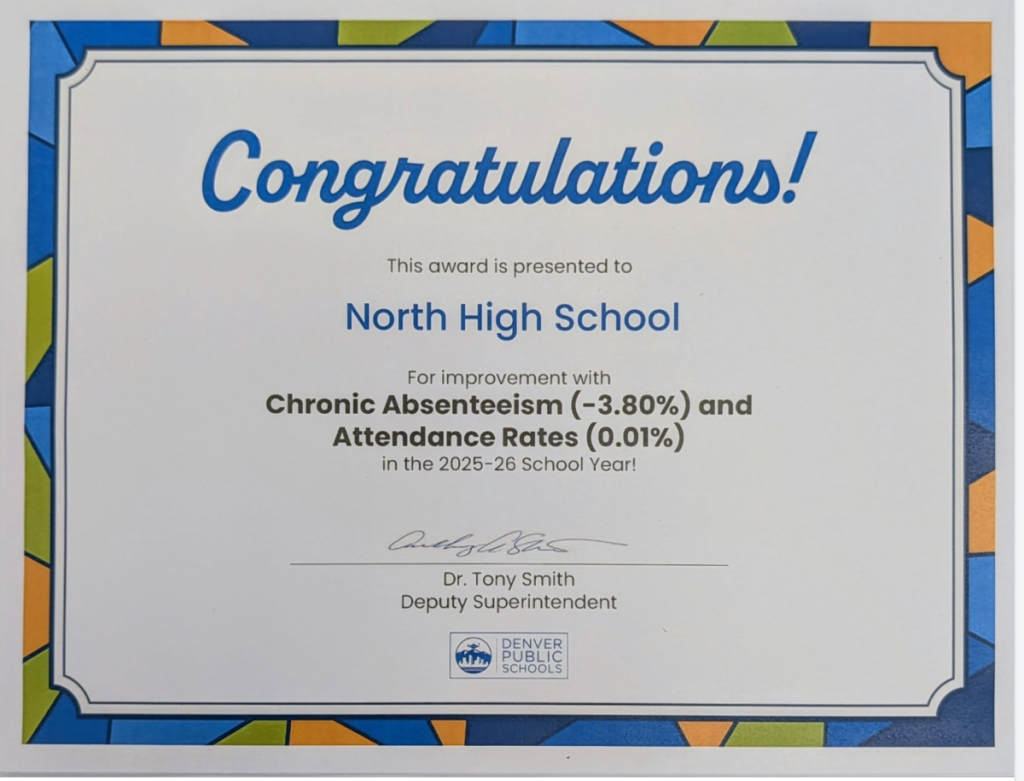
The certificate, signed by Deputy Superintendent Tony Smith, congratulates North for reducing chronic absenteeism by 3.8 percent (whether actual percent or percentage points isn’t clear).
The certificate also lauds the school for increasing its attendance rate by one-one-hundredth of a percent. You saw that right. As in 0.01%.
Here’s a bit of context. Colorado Department of Education data shows that in 2024-25, North had a chronic absenteeism rate of 44.1 percent. CDE defines chronic absenteeism as missing 10 percent or more days of school per year. The chronic absenteeism rate for the state that year was 28.4 percent, and the DPS as a whole it was 38.1 percent.
So while an improvement of either 3.8 percent or percentage points is better than remaining flat or going up, it is certainly not worthy of an award.
Similarly, North’s 2024-25 attendance rate was 88.1 percent, slightly below the district and the state. That .01 percent doesn’t make a dent.
The point here is simple. While it’s understandable that leaders of any organization must take measures to keep morale from tanking, they fool no one by pretending that things are looking rosy while deep challenges go unaddressed.
This regime has shown minimal interest in deeply examining data and taking concrete steps to improve matters. It seems focused instead on making Marrero look good so he can slip out the door into a bigger job in a bigger city, with a bigger salary.
I wish him all the best in his endeavors. Once he is gone, Denver can start repairing the damage he has done.