I cannot recommend the new book by James Traub, The Cradle of Citizenship, highly enough. It arrives at an opportune time for our schools as the nation celebrates its 250th anniversary.
Optimistically subtitled How Schools Can Help Save Democracy, Traub’s investigation speaks to educators and policymakers. How well, he asks, are we preparing students to be the informed and thoughtful adults a democracy needs?
I see three reasons why his book could be especially meaningful to us in Colorado.
First, Traub spent the 2023-24 school year visiting schools in seven states and in New York City. We see how state policy can influence a wide range of approaches to the teaching of history and civics.
As a “purplish” state, Colorado can learn from (red) Florida and (blue) Minnesota. Traub writes about several governors (DeSantis, Noem, Abbott, Youngkin) promoting “patriotic education.” We also read about the push from the left in two chapters, “In Minneapolis, There is Only Racism and Antiracism” and (in Illinois), “Culturally Responsive Teaching.”
Most Coloradans will find Traub fair-minded in criticizing both extremes. Each leads schools, in his view, “to falsify American history.” Charges of indoctrination run through his narrative.
Second, Traub’s book might speak to Colorado teachers who sound fearful, who ask, “What is safe to teach?” (See the RAND study from 2023, “Walking on eggshells: Teachers’ responses to classroom restrictions.”)
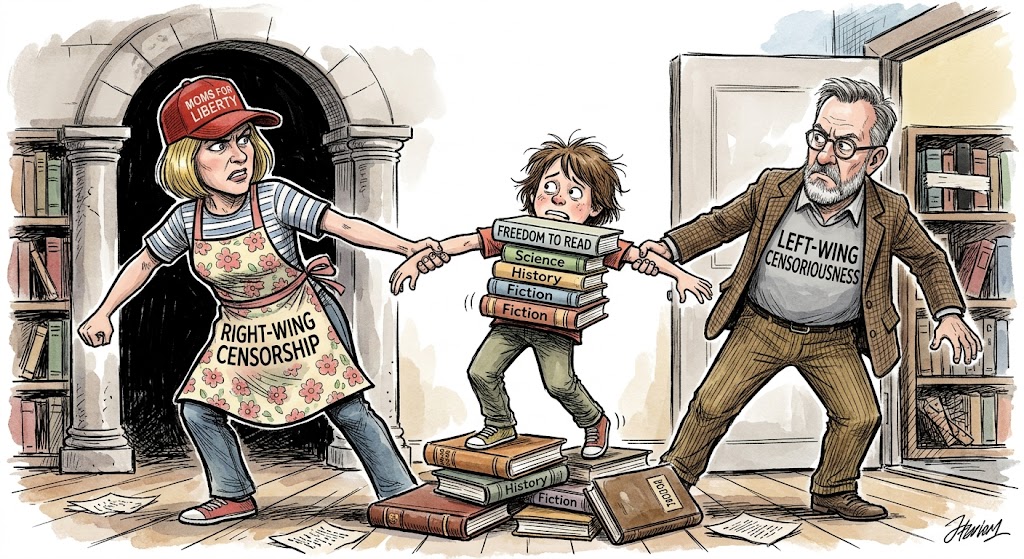
We can learn from Traub’s account of the poisonous atmosphere in Florida and what the group called Moms for Liberty has accomplished there. “The mobilization of right-wing forces,” he writes, “is designed not to open up discussion and debate but to foreclose it.”
Traub asks: “Why would a great teacher want to teach in Florida?”
He observes conflicts over what books students can access. (In Colorado, following several attempts to ban books from schools and libraries, our legislature passed Senate Bill 25-63, called the Freedom to Read Act.) Traub’s take on the controversy in other states: Both sides might have a point. He asks, “Is there really no book so vulgar, so reprehensible, so stupid that a librarian might not purchase it…?”
However, he also asserts: “we should be concerned not only about the opportunity to read young-adult novels or memoirs about someone just like yourself but also its opposite—the opportunity to discover in books a world utterly unlike your own.”
Third, while Traub does not visit Colorado, two school models that most impress him base their curriculum largely on one quite popular in Colorado.
He takes us into two charter networks, both with a “content-rich curriculum”: the Founders Classical (23 schools) and the Great Hearts Network (46 schools). Traub describes remarkable teachers leading rich classroom discussions. We see students who have clearly read the texts carefully, who come to class eager to contribute. Those visits inform his conclusion.
In “What Is to Be Done?” he writes: “I am convinced that we must restore the centrality of books—of words and language, of facts and knowledge, of the depth of experience that comes only with learning from an early age to navigate challenging texts.”
That requires a strong curriculum.
The Colorado connection? The academic program in the charter networks he admires is built largely on the Core Knowledge curriculum. Few states have as many Core Knowledge K-5 and K-8 schools as we do — over 60, according to the Core Knowledge Foundation. I taught in two of them here in Douglas County.
A self-described liberal, Traub knows that Core Knowledge is seen as a conservative educational model. His response? “But the fact that conservatives like it doesn’t make it wrong.”
On our 250th, let’s hope political divisions won’t keep us from agreeing on one simple idea: that a democracy depends on students who are literate and who have a solid understanding of our history.
Founding Fathers like John Adams, Benjamin Franklin, and Thomas Jefferson, Traub reminds us, “advocated for the diffusion of knowledge through schools.”
But can schools really “help save our democracy”? Is this asking too much?
Traub might reply, listen to Jefferson.
“Only through the study of history, Jefferson wrote, could citizens ‘be able to know ambition under all its shapes, and prompt to exert their natural powers to defeat its purposes.’”