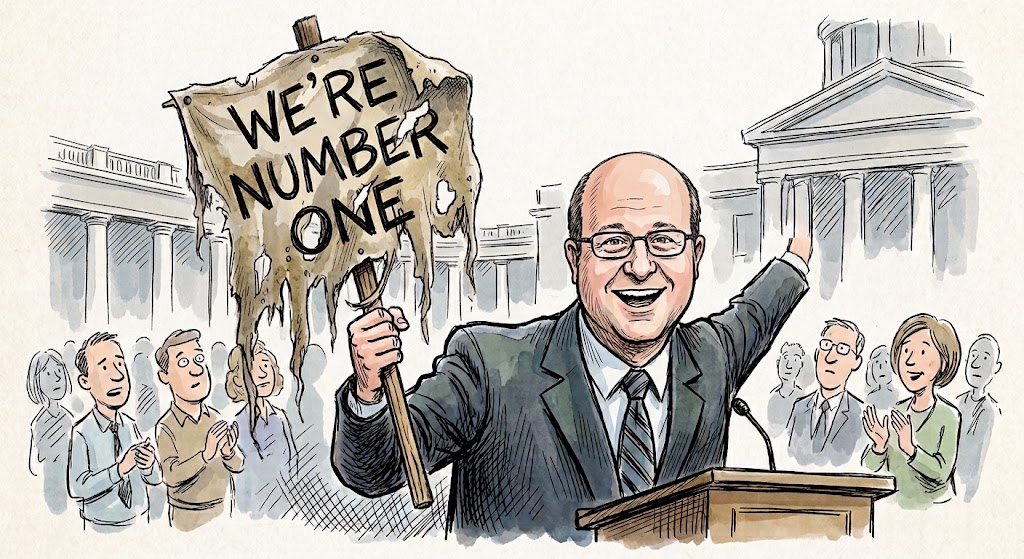

The school year starts again in less than a month, and a remarkable number of big districts in Colorado and elsewhere will open it without a permanent superintendent.
Jeffco. Cherry Creek. Los Angeles. Miami-Dade. I’m guessing Denver will soon join this group of districts given the Denver school board’s growing frustrations with Alex Marrero’s top-down leadership, poor performance and his search for other jobs.
That’s a lot of empty chairs in a lot of big districts, and it got me wondering who’s going to fill them, and whether the pipeline that used to fill them looks anything like it did 20 years ago.
My hunch going in was that running a large school district has gotten harder since the pandemic: more expected of schools on mental health and basic student support, more divisive politics around almost everything a board does. So I decided to check that hunch with the help of my assistants Claude and Google.
The applicant pools are shallower
These are not low-paying jobs. Tracy Dorland’s starting salary when Jeffco hired her in 2021 was $260,000, and comparable big-district contracts run higher still ($440,000 for Los Angeles starting salary plus benefits). Yet the number of applicants for these jobs seems to be dropping.
Jeffco’s applicant pool fell from 69 applicants in the 2017 search to 43 candidates reviewed (only 23 of them formal applications) in 2021. Broward County, Florida went from 39 applicants in 2021-22 to 26 in 2023, of whom just 15 were considered qualified. Charlotte-Mecklenburg dropped from roughly 52 applicants in 2017 to 37-39 in 2023.
And it’s not just volume of applicants. Max McGee, a longtime superintendent search-firm president, wrote in AASA’s School Administrator magazine in 2023 that “in most of our searches, applicants without previous experience outnumber those with experience by at least 3 to 1.”
School boards aren’t just getting fewer résumés. They’re getting fewer good ones.
Superintendent turnover is increasing
The Council of the Great City Schools’ most recent survey puts average tenure at 2.72 years, which is close to where it stood in 2003 (2.80 years). But that flat-looking comparison hides a real story: tenure climbed through the 2000s, peaking at 3.64 years in 2010, and has been sliding since. The same survey revealed something I found more telling: the predecessor of today’s average sitting superintendent had served 4.85 completed years, nearly double the 2.72 years current superintendents have logged so far.
It’s worth remembering how differently this job used to be talked about. Rod Paige, U.S. Secretary of Education from 2001 to 2005 and Houston’s superintendent before that, told ASCD in April 2004: “Our nation is crying out for leadership in education. We’re asking more from schools and asking for it more quickly,” and, more bluntly, “I believe that superintendents are the best agents for change and have a great opportunity at hand.”
Eli Broad put it in CEO terms in his foundation’s annual report: “Success in any organization starts at the top. With responsibility for curriculum, instruction, facilities, finance, personnel, technology and community relations, school superintendents are chief executive officers of complex and demanding public sector enterprises.”
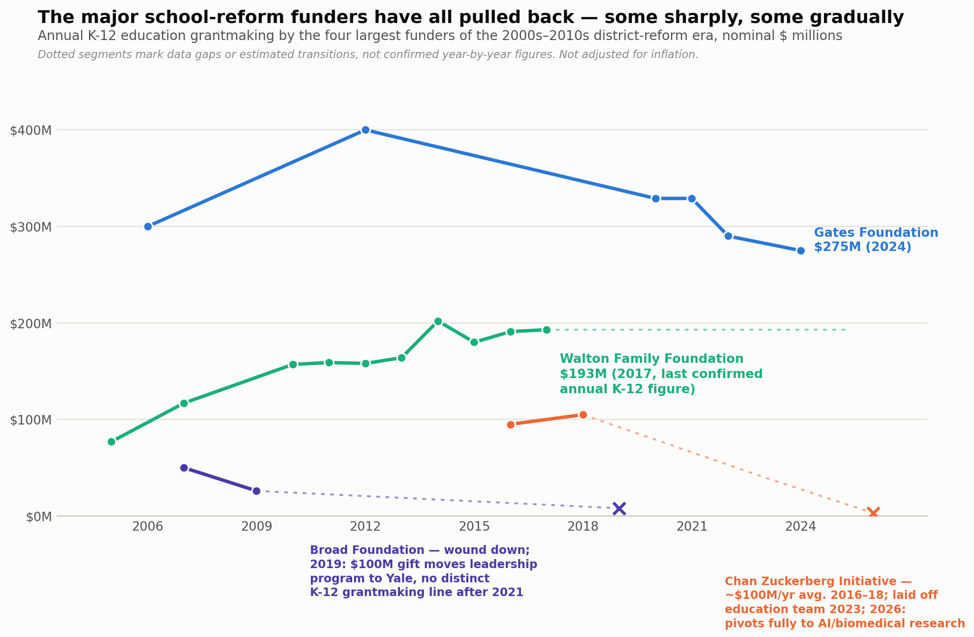
Not long ago, the right superintendent, especially a non-traditional one, could land on the cover of Time, get regular New York Times coverage, and pull in serious money from Gates, Walton, Broad and other foundations to remake a district. That’s a different world than the one Jeffco, Cherry Creek and Denver are hiring into right now.
How have superintendent backgrounds changed?
I asked my assistant Claude to code the résumés of every superintendent leading the 20 largest U.S. school districts at five checkpoints: 2006, 2011, 2016, 2021 and today (2026), 100 person-year records in all which was a fun exercise for me to manage.
Four traits got tracked for each person: whether they climbed the conventional teacher-to-principal-to-central-office ladder (“traditional”) or skipped it (“non-traditional”); whether they’d led anything outside K-12 education at any point (a company, a law practice, a military command, an elected office); whether their undergraduate degree was in education or something else; and whether that degree came from a conservatively defined selective institution.
The headline finding is a real decline in non-traditional hiring. Non-traditional pathway held flat at 20% from 2006 through 2016, eased to 15% by 2021, then dropped to 5% today. Outside-leadership experience climbed after 2006, peaking at 40% in 2011, held around 30% through 2016 and 2021, and fell to 10% in the last few years.
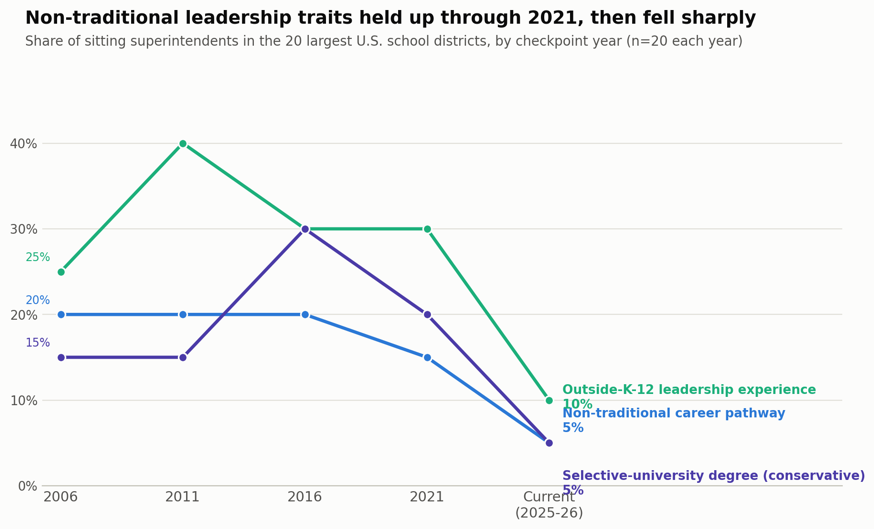
All 20 largest U.S. school districts, one superintendent coded per district per checkpoint year (n=20 each year).
None of that happened by accident. The Broad Superintendents Academy, launched in 2002, set out explicitly to recruit business, law and military leaders into big-city superintendencies, and by 2009-2011 its alumni filled 43-48% of large-urban-district superintendent openings nationally, almost exactly the window where this study’s own outside-leadership measure peaks, at 40% in 2011.
All of this was also reinforced with federal investments to improve big school districts whether through programs like “Race to the Top” or a broad range of national philanthropic investments in school district reform and improvement.
Broad wound down its placement program more abruptly, folding it into Yale in 2019 with a $100 million gift and no distinct K-12 placement pipeline surviving after that. A recent conversation with the current Broad class from Yale revealed that there were no non-traditional participants in the current class.
In summary, the infrastructure that created a broader pipeline for superintendents has been dismantled over the last decade.
And how did this bigger pipeline that included non-traditional candidates impact student achievement? It’s mixed
A recent study by a team of Stanford researchers on the impact of Broad’s superintendents showed that they had fewer years in the superintendency seat than traditional candidates, no impact on student achievement, but increased charter school enrollment.
Looking at several non-traditional superintendent experiences, some supported by Broad and some who were part of the non-traditional wave have had impacts on achievement small and large.
Tom Boasberg’s nearly decade at Denver Public Schools is probably the most-studied case in the state: the district’s graduation rate rose from 39% in 2007 to 71% in 2019. Enrollment grew by more than 14,000 students at a time most urban districts were shrinking, and an independent comparison-group study found that two years of exposure to DPS’s reforms produced achievement gains roughly equivalent to six months to two years of additional schooling.
Mike Miles in Houston shows the same tension in miniature, on a faster timeline. STAAR score gains under his state-appointed leadership are real. But Texas Monthly reported that at least some of that improvement came from restructuring course access, delaying biology to 10th grade, and narrowing algebra access. The article quoted an testing coordinator warning that the tactic can “increase your scores… at the cost of advanced academics.” It’s still too early to assess the impact of Miles changes in Houston
And then there’s Roy Romer, the former Colorado governor who ran LAUSD from 2000 to 2006, proof this pattern isn’t new. Romer’s district saw several years of real, sustained gains in reading on both state and national tests, driven by an enormous investment in teacher training. A governor with real political skill produced real gains and then hit a wall, 20 years before Denver, Houston and Chicago would each rediscover some version of the same ceiling.
Regardless of the superintendent’s background, leadership skills and management training, improving a big, complicated school district is enormously challenging.
So what’s a school board supposed to do heading into a 2026 search?
School boards are going to have to dig deeper and work harder to get great district leaders. They will need to look to closely at their own bench and will probably be limited to a pool of traditional district candidates.
With the lack of an outside pipeline and a smaller applicant pool, the job of finding the right person to improve the district is harder than it has ever been.
Here’s hoping a new generation of philanthropists and national policy leaders will rediscover what Paige and Broad were saying 20 years ago: Great public schools still need serious leadership at the top, and that the job is worth investing in again. Regardless of whether your preference is for traditional or non-traditional backgrounds for big district leaders, we will need more effective superintendents and an ecosystem that supports wider and better pipelines for these critical seats.
Until then, Colorado and other school boards are going to have to do the hard, difficult work of finding a leader than can drive district improvement. Choosing and managing the superintendent is THE important job of a school board and it’s harder than ever today.