Students across rural Colorado have been back in school for a few weeks now. In far too many of their classrooms, they were greeted by a brand-new teacher. In some, they’ll find a rotating substitute, a class merged into one down the hall, or simply no permanent teacher at all, because the position was never filled.
While not a perfect proxy for teacher effectiveness, the data that is available on turnover, vacancies, and certifications are the best available proxies we have in Colorado.
For context, let’s start with teacher pay followed by the buying power for Colorado teachers, then let’s look at teacher turnover.
Colorado teacher pay and buying power
Rural teacher pay is genuinely low (see a recent Keystone Policy Center report here). The average pay for too many school districts is barely a living wage. Kit Carson, Kim and Vilas have average salaries under $40,000 a year.
On paper, Colorado pays its teachers close to the national average. In practice, it is one of the hardest places in the country to make a living as one. Colorado’s average teacher salary ranks a middling 20th, just below the $72,030 national average.
The Economic Policy Institute has pegged Colorado’s teacher “wage penalty” — how far teacher pay trails comparable college graduates — at roughly 36 percent, the largest of any state.
Now adjust Colorado teacher salaries for overall cost of living and the state slips to 29th. But then adjust specifically for housing and Colorado collapses to 49th, at an effective $52,603. Colorado is now the second least affordable state in the country for a teacher to buy a home, behind only Hawaii: our median home costs eight times the average teacher salary, when the national norm is closer to five.
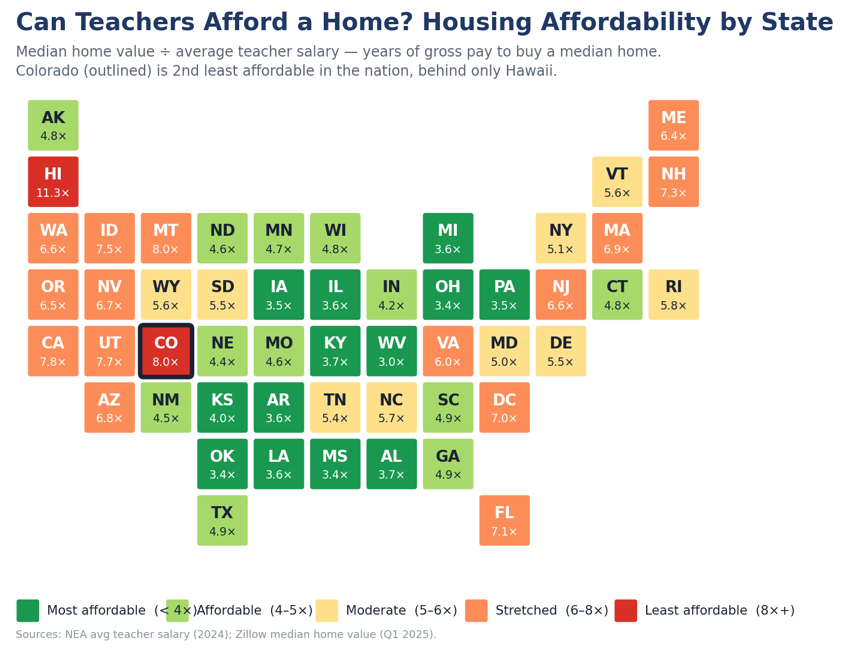 Nationally, Colorado is the 2nd least affordable state for a teacher to buy a home — behind only Hawaii. Analysis of ACS, Zillow, and NEA data (*see below for more details).
The more you view Colorado teacher pay through purchasing power, the more the problem looks like housing as much as pay — and it splits by place: some communities have housing but not at any affordable price; others have no livable housing at any price.
In rural Colorado, the housing problem comes in two forms
In the mountains and along the Front Range fringe, housing exists but the price is absurd. Consider Park County, where teachers face a rent burden north of 60 percent of salary — a $2,000-a-month rent on a $42,000 paycheck. In the Roaring Fork Valley, a home runs $1.4 million while the district’s teachers earn in the $50,000s. The ski-town districts pay the highest rural salaries in the state and still can’t house their teachers.
But out on the high eastern plains and in the truly remote districts as defined by the Colorado Department of Education, the problem isn’t affordability, it’s that there is nothing to buy or rent at any price. In much of eastern and southern Colorado, there is no rental market to speak of, no new construction, and no starter homes, because for decades there’s been no market signal to build one.
A district can offer a teacher a job in a town where the housing “cost” looks cheap on a spreadsheet and still have no actual house to put them in. “Affordable” is meaningless when the vacancy rate is zero. That’s why you now see districts from the plains to the Western Slope — Norwood, Gunnison, Ouray, Buena Vista, Fairplay, Rifle, the Vail Valley, Roaring Fork — getting into the housing-development business themselves, building modular units and district-owned apartments because the private market simply will not.
Layer pay on top of that and the recruitment challenge grows. On the plains, salaries start in the low $30,000s, and a new teacher can drive an hour to Kansas and earn roughly $20,000 more often in a town with housing possibilities, the same is true along the New Mexico border. When Vilas School District pays an average of $39,775 and a district over the state line pays a first-year teacher $44,500, no motivational poster about rural community is going to close that gap.
It doesn’t help those small rural districts, saddled with high fixed costs and thin enrollment, can only direct 60 to 65 percent of their budgets to salaries, versus about 90 percent in a big suburban system. They are structurally unable to compete on pay even when they want to and now some districts are being asked to become housing developers on top of everything else.
“Rural pay” can be misleading in Colorado
A word on the pay numbers, because averages can mislead. The Colorado average teacher salary in 2023-24 was $71,570 in non-rural districts, $58,797 in rural districts, and just $49,387 in small-rural districts, against a statewide average of $68,647.
If you lump all “rural” districts into one bucket, you will get a distorted picture, because a handful of resort and mountain districts sit inside that bucket paying resort wages. The 26 or so ski-town and mountain districts — which include Aspen, Telluride, Summit, Steamboat, and Roaring Fork — average $62,890. The other 122 rural districts average $54,003. In fact, the four highest-paying rural districts in the entire state are all resorts: Aspen tops out at $75,110, followed by Summit, Roaring Fork, and Telluride. Meanwhile the floor is Agate, on the plains east of Denver, at $37,025. That’s a $38,000 range for “rural” districts.

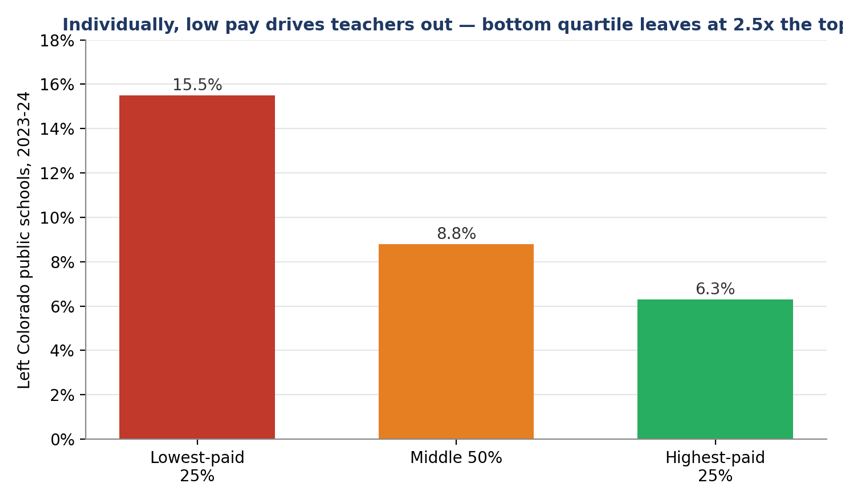
We have written some about teacher housing and affordability with Keystone reports that covered teacher perspectives on housing and what some districts are doing to address this problem but with the new school year about to start, I wanted to take a closer look at teacher turnover.
Teacher turnover is worst where the roads are longest
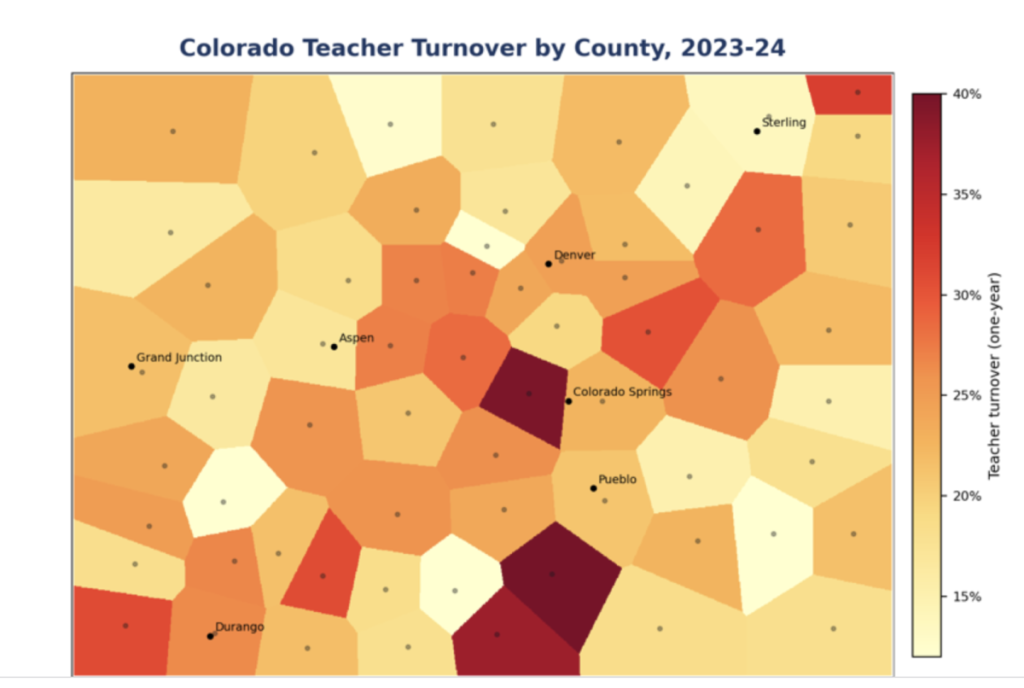
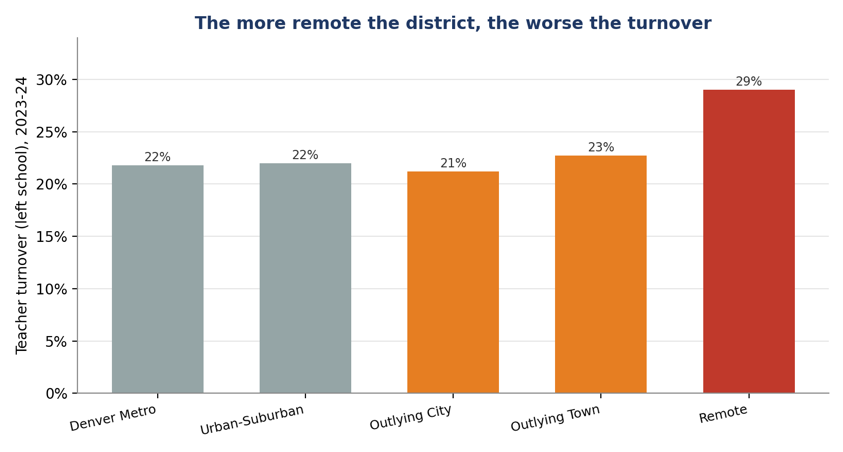
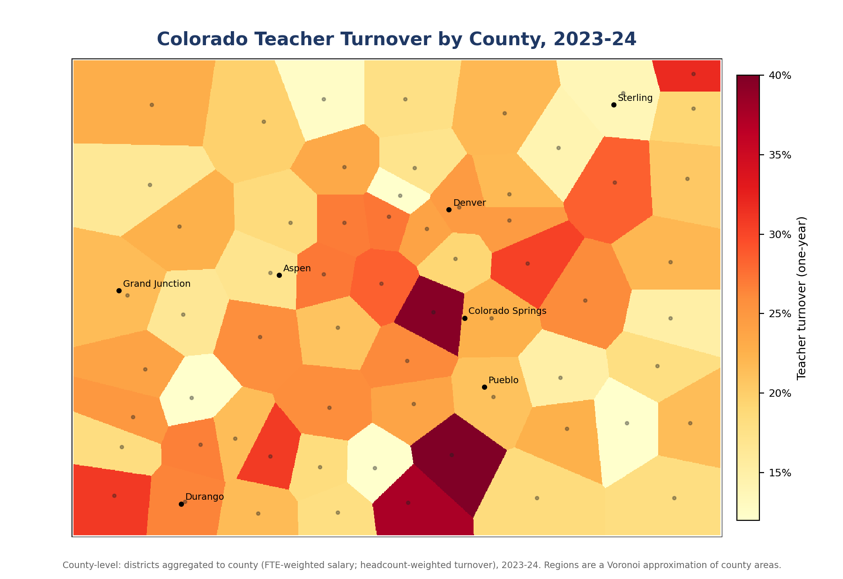
Using the Colorado Department of Education’s educator retention data for 2023-24, teachers in rural and small-rural districts left their schools at a rate of 24.2 percent, compared with 21.9 percent in non-rural districts and 22.4 percent statewide. The rate is 16%. That two-point gap in Colorado sounds modest until you look at where those teachers go. When a rural teacher leaves, they’re far more likely to leave the district or the profession entirely. Rural teachers left their districts at 17.1 percent versus 13.5 percent for non-rural, and they left Colorado public schools altogether at 12 percent versus 9.4 percent.
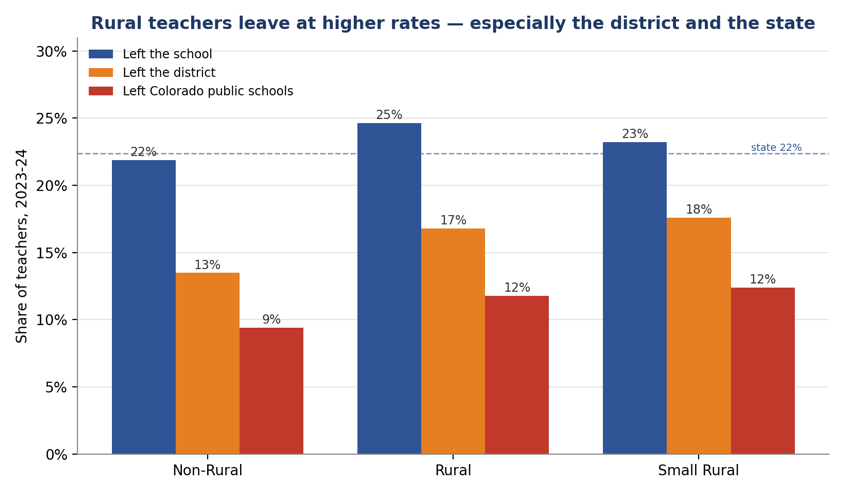
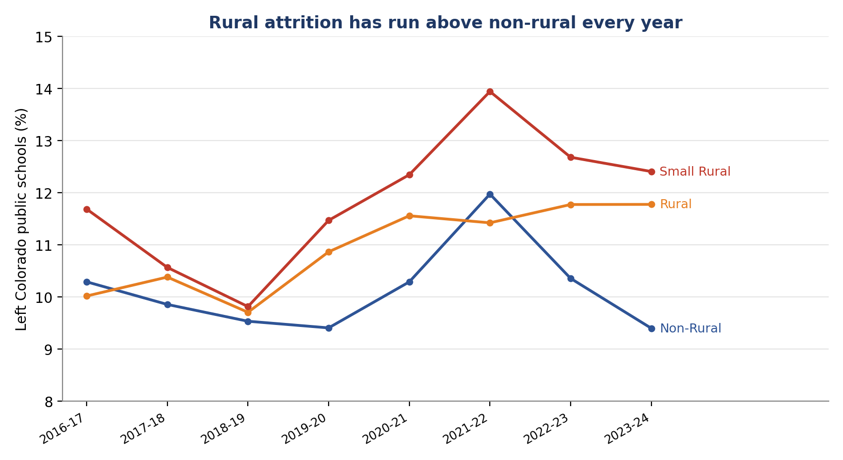
Attrition — leaving Colorado public schools entirely — has run higher in rural and small-rural districts than non-rural in every year since 2016-17.
That distinction matters enormously for a 40-teacher district. A Denver-area school that loses a teacher to the district across town keeps that educator in the regional talent pool. A district in Kiowa County that loses one is often replacing them from a national market or not replacing them at all. And the pattern gets more intense for smaller more isolated school districts: in Colorado’s most remote districts, teacher turnover hit 29 percent, with more than 13 percent walking away from Colorado schools in a single year.
In small rural districts, nearly three-quarters of the teaching jobs districts needed to fill in 2023-24 were staffed through a “shortage mechanism” which could be a long-term sub, a retiree, or someone on an alternative or emergency license in comparison to just a quarter statewide (CDE Educator Shortage Survey).
The actual cost of all this churn
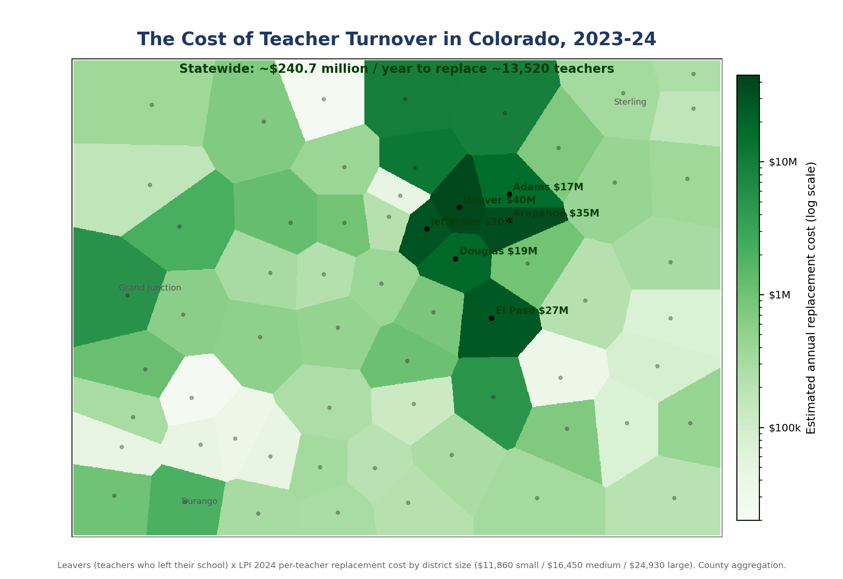
This churn is enormously expensive. Using the Learning Policy Institute’s 2024 cost-of-turnover calculator — which pegs the price of replacing a departing teacher at $11,860 in a small district, $16,450 in a mid-size one, and $24,930 in a large one — Colorado’s 2023-24 turnover carries an estimated price tag of roughly $240 million a year, the cost of recruiting, hiring, and training the more than 13,500 teachers who left their classrooms. That’s money spent standing still: paid out just to replace the people who walked out the door, not to improve a single school. The absolute dollars are biggest in the metro districts — Denver’s costs run about $40 million a year — but in small rural districts the same churn, even at a lower per-teacher cost, lands on budgets with far less flexibility, particularly where there is no additional local tax revenue. Every dollar spent replacing a teacher is a dollar not spent keeping one.
What could this mean for state policy?
Target the money where it is most needed.
Fund the plains and San Luis Valley districts paying in the $40,000s, not the resort districts already near the state average. A flat “rural” formula — or across-the-board state spending increases that simply trickle down to small rural districts — will produce little change in teacher salaries in the districts that most need help. The state should target rural teacher salaries in the same way it has successfully targeted improved facilities through the “BEST” program.
Treat housing as a teacher-pay issue — and, in much of rural Colorado, as a construction issue.
In a state ranked 49th on housing-adjusted pay, rent support and down-payment help matter where housing exists. But in the plains and remote districts, no amount of housing subsidy helps if there’s no unit to rent; those places need actual supply — district-owned housing, modular builds, state construction dollars. A raise a teacher can’t spend on a home that doesn’t exist is not a housing strategy.
Focus on and manage the challenge.
The data are clear that poverty and working conditions drive churn as much as pay. Rural retention needs mentoring, manageable loads, and real support for the teacher who is also the coach, the bus route, and the entire math department.
Colorado is a relatively wealthy state with an entrepreneurial, problem-solving ethic. It is time that our state’s leaders step up to build its future by ensuring we have effective teachers to support student learning.
* These state rankings are my own analysis — for each state I divided Zillow’s Q1-2025 median home value by the average teacher salary (NEA, 2024) to produce a home-price-to-salary ratio (Colorado 8.0×, second-worst behind Hawaii, versus a ~5× national norm), and divided that same salary by the U.S. Bureau of Economic Analysis’s 2023 Regional Price Parities — overall for the cost-of-living-adjusted figure and the housing (rents) component for the housing-adjusted $52,603, which ranks Colorado 49th of 51.
Sources: Colorado Department of Education Educator Retention Dashboard (2023-24) and Average Teacher Salary & FTE file (2023-24); Keystone Policy Center, “Insufficient at Any Altitude” (2025); NEA educator pay data (2024); Economic Policy Institute teacher wage-penalty analysis; U.S. Census ACS and BEA Regional Price Parities; reporting on rural teacher-housing shortages (Rocky Mountain Voice, Colorado Sun, Chalkbeat); Learning Policy Institute cost-of-turnover calculator (2024); author’s district-level analysis. County maps aggregate districts to county; Colorado regions are a Voronoi approximation of county areas.