Editor’s note: Van Schoales conducted this data analysis with help from Claude AI.
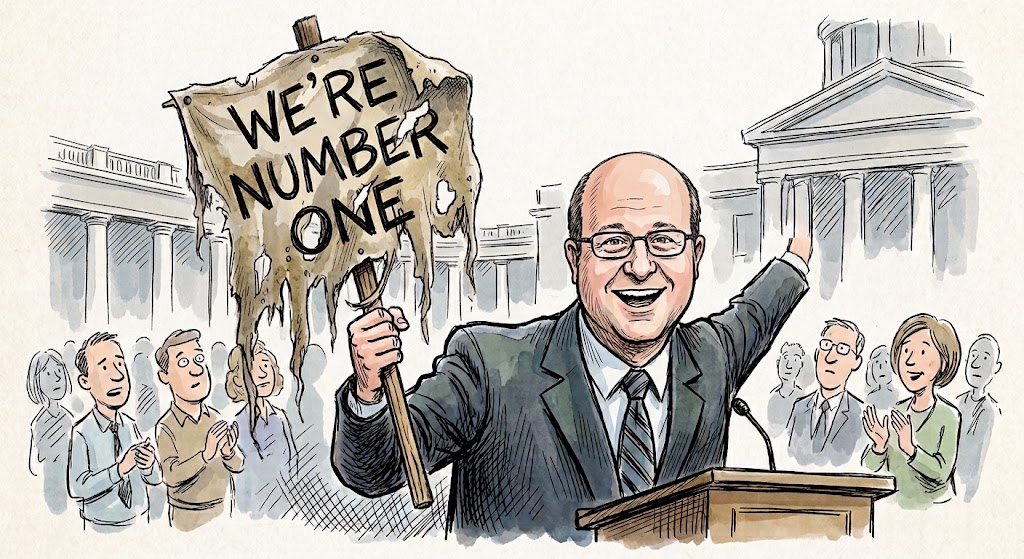
Colorado Governor Jared Polis, referring to a highly questionable national magazine rating, says in today’s state testing press release that Colorado is number one in education.
It’s a bit bizarre, given that a quick look at the new, 2026 data suggests we are far from the top on most of the measures that matter — from student learning to high school graduation rates to college-going and success.
At the same time, some of the press about Colorado’s progress is warranted, which is why I wanted to dig a bit deeper into the most recent achievement scores and put them into a historical and national context to get a better sense of how Colorado is doing with its public schools.
What matters?
Before any of the detail on numbers, a bit about what is most critical when looking at a state’s public education system.
What’s most important is not how well public schools serve the children of college-educated parents in Boulder, Cherry Creek and Douglas County. Those students would do fine in most systems, in most states, in most decades. Their scores tend to tell you about their parents’ education and their household income far more than they tell you about their schools.
Yes, of course it matters how all groups of students including wealthy white students are being served. But the real measure is how a system serves low-income students. Those are the children for whom school is the primary intervention rather than a supplement.
What the recent US News ranking says
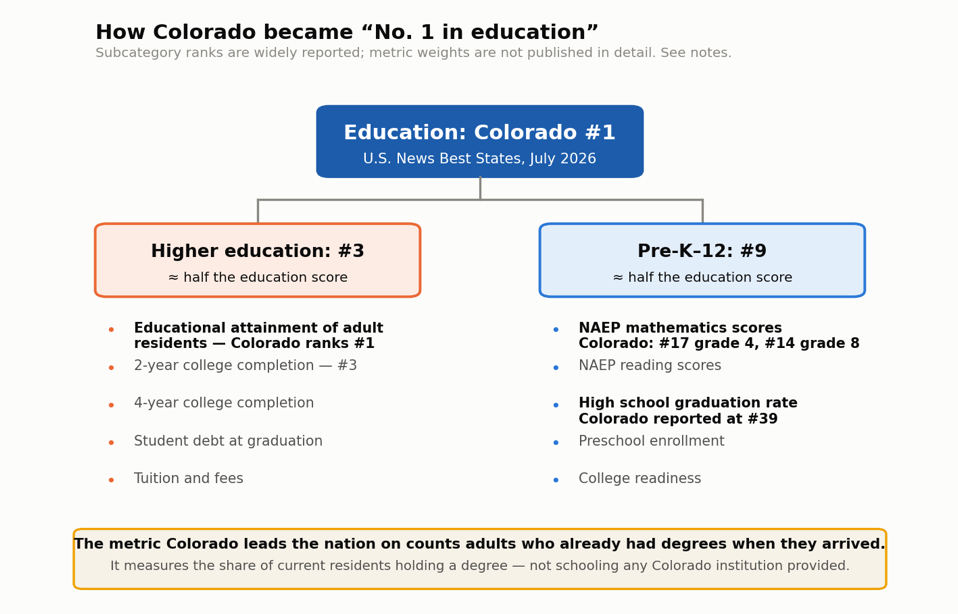
The U.S. News and World Report Best States ranking that produced the headline builds its education score from two parts. Colorado ranks third in higher education and ninth in Pre-K–12. First place overall is a result of combining these two rankings in the context of the other states. It says nothing about how Colorado’s education system is educating Colorado students.
The higher education number is where Colorado shines (we do have roughly 300 days of sunshine, which turns out to matter for this metric), and it is deeply misleading. It comes from the percentage of Colorado adult residents holding a college degree.
That statistic counts who lives here. It says nothing about where they went to school. Colorado’s State Demographer’s Office shows that 29 percent of Colorado-born adults hold a bachelor’s degree, compared to 45 percent of those born in another state. We import educated adults, which says more about the sunshine, mountains, and our labor market than it does about Colorado’s public education system. This ranking masks the reality of where Colorado sits relative to other states.
It’s unfortunate that we are living in a time where braggadocious claims (or among some national leaders outright lies) are becoming normalized for political leaders of all stripes. To be clear, Polis’s statement falls into the braggadocious claim category while also cherry-picking the positive data. Given Polis’s understanding of public education, along with some of his great work improving public education, he knows better than to overstate our state’s status.
So where does Colorado rank in terms of the impact of public education?
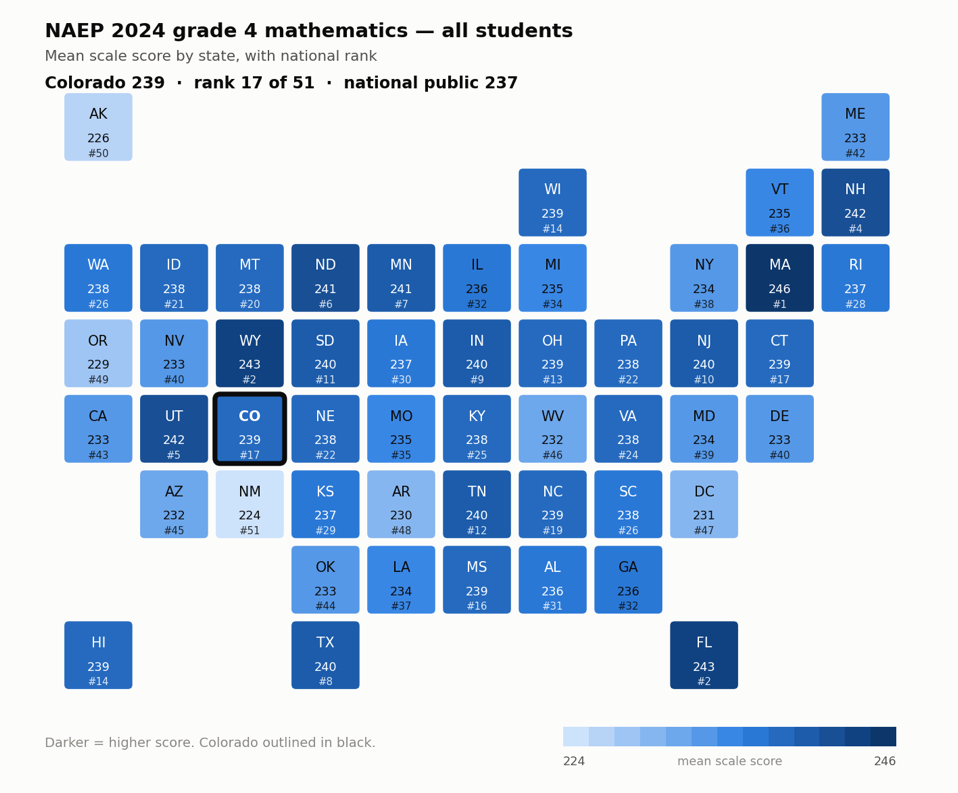
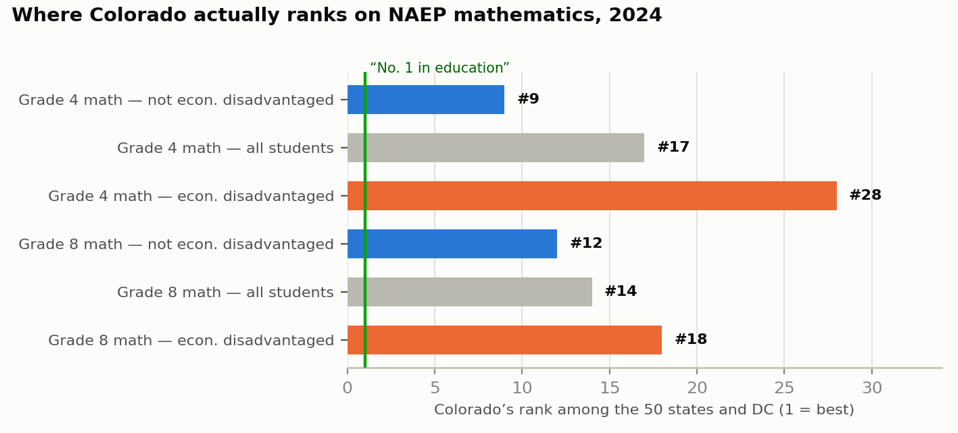
The National Assessment of Educational Progress is the only test that puts all 50 states on one scale. On its 2024 results, Colorado ranks 17th in fourth grade math and 14th in eighth grade math. Above average. Not first, not even close.
Keep in mind that having fewer low-income students improves your overall state education ranking, and Colorado is a relatively well-off state.
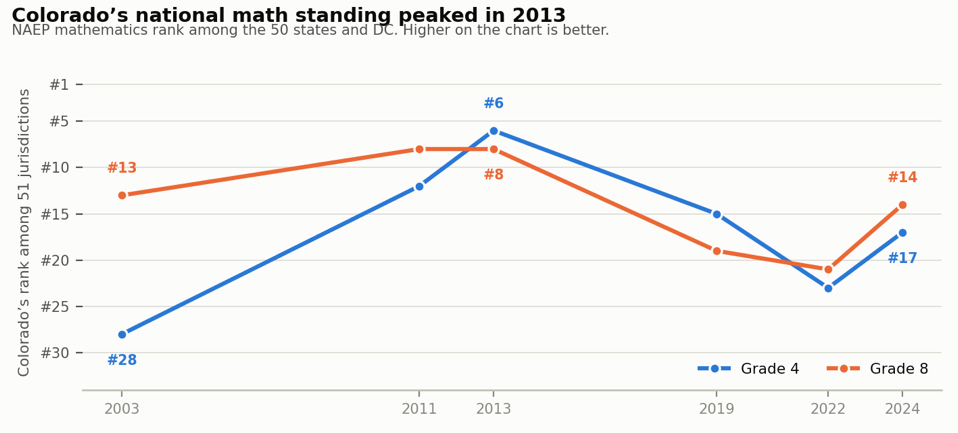
And what about Colorado’s NAEP scores over the last two decades? Colorado’s fourth grade math standing peaked at sixth in the nation in 2013 and has fallen eleven places since. Eighth grade went from eighth to 14th.
In fairness, Colorado’s 2024 rank at eighth grade is slightly better than its 2019 rank. The whole country’s scores fell after the pandemic, and we fell a bit less. But holding your place in a national decline is not a great bragging point.
What about low-income students?
Comparing state education outcomes without breaking down the demographics can be highly misleading. Yes, sometimes overall state averages can be driven up by all demographic groups doing relatively well as is often the case often with Massachusetts and Florida. But sometimes a state with relatively few low-income students can look far better on the public education front than it deserves.
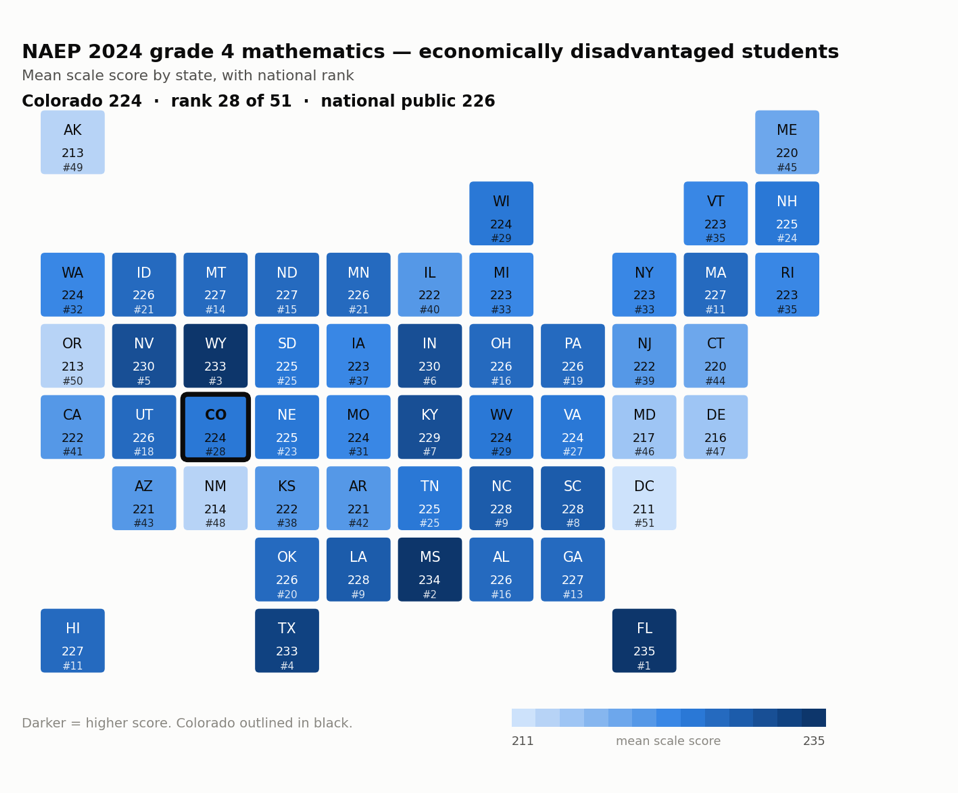
Breaking down NAEP scores by student demographics provides a more accurate assessment of Colorado’s public education system. Colorado ranks ninth in the nation for fourth graders who are not economically disadvantaged and 28th for low-income students. Same grade, same subject and 19 places apart.
Worse: Colorado’s low-income fourth graders score below the national average for low-income fourth graders. Our better-off students score above the national average compared to their peers. Whatever Colorado is doing well, it is not reaching the students who most depend on school.
Look at who is ahead of us on this map. Florida, Mississippi, Wyoming, Texas, Nevada, Indiana, Kentucky, South Carolina. These are not wealthy states with elite school systems. Several sit near the bottom nationally on adult attainment and household income. What they have in common is that their low-income students learn more math than ours do. These are states that have decided the students who most need support will get it through their public schools.
The distance between Colorado’s low-income students and everyone else is the eighth widest in the country at fourth grade. Narrowing that gap is precisely what an effective public education system is supposed to do
Math: Some good news and the challenge
Unfortunately, NAEP scores lag CMAS and SAT scores and are not perfectly aligned. But they are the only instrument that establishes where Colorado sits relative to other states over time.
First the good news, based on the 2026 CMAS scores. We can say that Colorado math results are genuinely improving, and I want to give Colorado leaders and educators their due. Every CMAS grade from three through eight now scores above its 2019 level (not true for reading). As we know from the impact of the pandemic, being in a traditional school has a huge impact on math achievement. Roughly two-thirds of Colorado schools gained ground in math over the last three years.
Now let’s look at which students made the most progress.

In five of six grades, students who are not low-income gained more than low-income students did. The income gap in CMAS math now runs 30 to 34 percentage points at every grade, and it is wider in 2026 than it was in 2024 in five grades out of six. Colorado’s public education system has a greater impact on non-low-income students than low-income students.
The high school numbers are far worse.
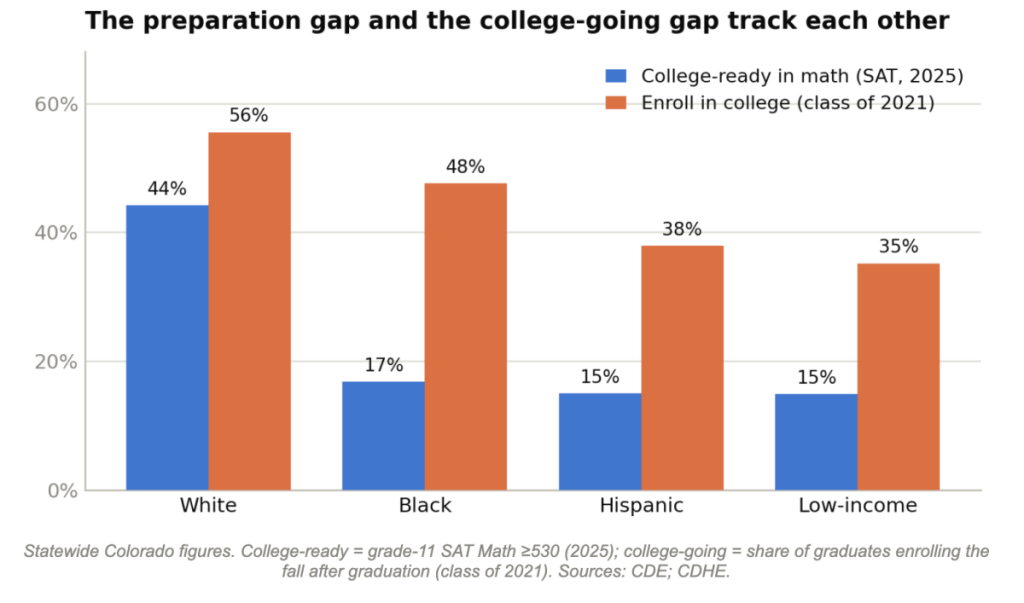
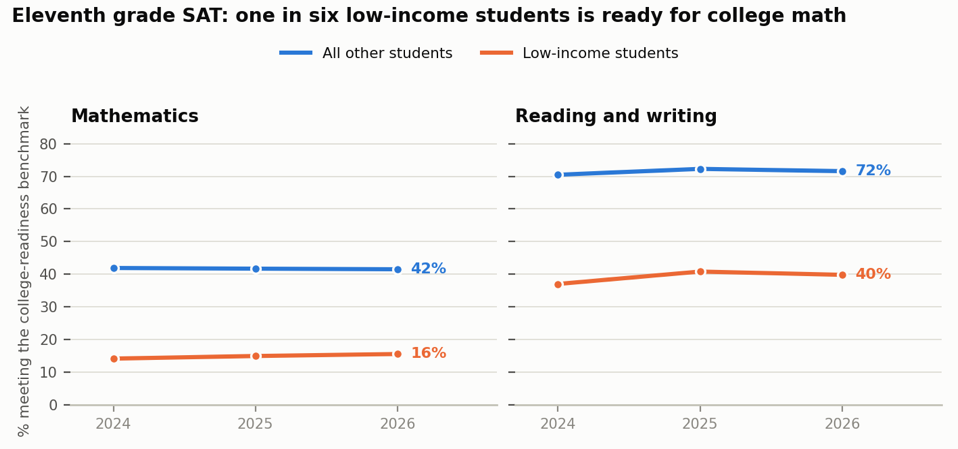
Among Colorado’s eleventh graders, 15.5 percent of low-income students met the SAT college-readiness benchmark in math, compared to 41.5 percent for everyone else. One in six. In reading and writing, it is 40 percent compared to 72 percent. To Colorado’s credit, both gaps narrowed slightly over three years. This is the one place in this analysis where the trend runs the right direction. But starting from one in six, slight is not enough.
And how does Colorado’s math improvement compares to other states?
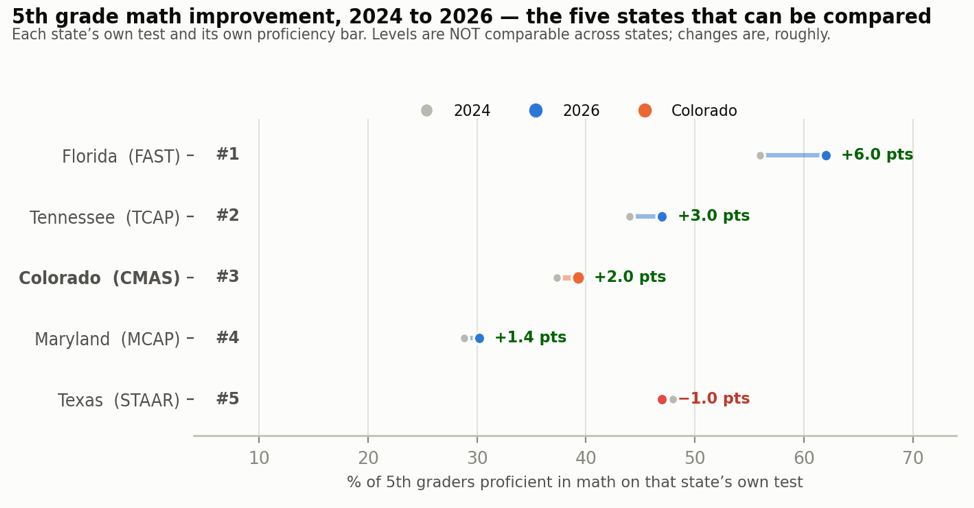
Colorado’s fifth graders gained 2.0 percentage points in math proficiency between 2024 and 2026 which is a real improvement. But among the five states that have released comparable 2026 results, Colorado ranks third of five, gaining a third as much as Florida and less than Tennessee. Colorado is improving; it is not leading.
A note of caution on this simple cross-state comparison: Maryland’s proficiency benchmark catches 29 percent of fifth graders, Texas’s catches 48 percent. The same underlying gain in learning therefore produces different point changes in different states, depending on where the cut score sits relative to the bulk of students. This is why the Harvard and Stanford Education Recovery Scorecard converts state tests onto the NAEP scale rather than comparing raw proficiency changes. Treat the ranking above as suggestive rather than authoritative.
Graduating kids and preparing them for work and college
On the federal four-year graduation rate, Colorado ranks 40th of the 49 states that report. Only six rank lower. Colorado’s own methodology produces a friendlier number — 85.6 percent for the class of 2025, the best in over a decade, and that improvement appears real (but there remains no standard for what a Colorado high school graduate needs to know and do).
On the common federal measure that lets you compare states, we are in the bottom fifth (and remember we are a relatively well-off state). Breaking down the federal number: 78.8 percent of economically disadvantaged students graduate, 72.6 percent of multilingual learners, 65 percent of students experiencing homelessness, 44.8 percent of students in foster care.
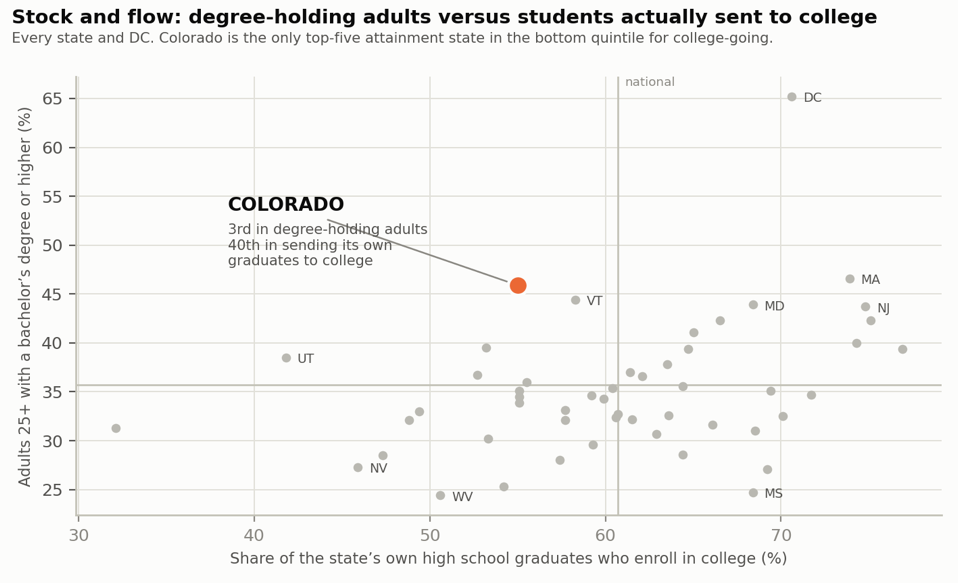
On the share of our own high school graduates who go on to enroll in college, Colorado ranks about 40th as well. The Colorado Department of Higher Education’s own assessment: “our college-going rate has remained virtually unchanged for nearly a decade.”
Colorado is the only top-five state for degree-holding adults that sits in the bottom quintile for sending its own graduates to college.
Third in degree-holding adults. Fortieth at graduating our students. Fortieth at sending them on. That is the Colorado Paradox — or more accurately, Colorado’s college-going mirage, and it is exactly the shape you would expect from a state that imports talent rather than builds it.
The truth
Colorado is a great state to live in and a decent state to go to school in if your family is already doing well. Its math scores are moving in the right direction. Universal Early Childhood Education is an important investment that should pay off over the next several years, assuming it is high quality. The gains of the last three years reached high-poverty schools at close to the same rate as everywhere else, which is better than the usual pattern.
That is an important foundation that is useful to build upon. It does not in any sense that matters, make us number one, and pretending otherwise sends the false message that Colorado’s public education system is already working for everyone.
Colorado’s leaders should not be celebrating success when our low-income students are learning less math than their counterparts in Mississippi. Rankings on almost any measure can be useful but taken out of a larger context can be seriously misleading.
It’s important for all of us to have the full picture of where we are so that we can develop a future path for improvement
Sources: NAEP Data Service, 2024 mathematics (nationsreportcard.gov); NCES Digest of Education Statistics tables 219.46, 309.20 and 104.88; Colorado Department of Education 2026 CMAS and PSAT/SAT state summary files and graduation data; Colorado Department of Higher Education; Colorado State Demography Office; U.S. News Best States 2026 as reported July 28, 2026.