

Monday’s Denver school board meeting offered an almost perfect microcosm of the board’s operational ineptitude over the past 16 months: struggling to get out of its own way, and then making terrible decisions when it finally does.
The recent proposal from DPS Superintendent Alex Marrero to revoke the district’s partnership with the Beacon Innovation Zone breaks my heart. It is deeply troubling to me that a leader like Alex Magaña, who is leading on equitable education, is being penalized for all of his hard work.
The current Denver Public Schools Board of Education has failed in its oversight responsibilities and has demonstrated an inability to lead and manage effectively. We are among a group of DPS parents that has banded together and launched a petition drive to demand that all seven members resign immediately.
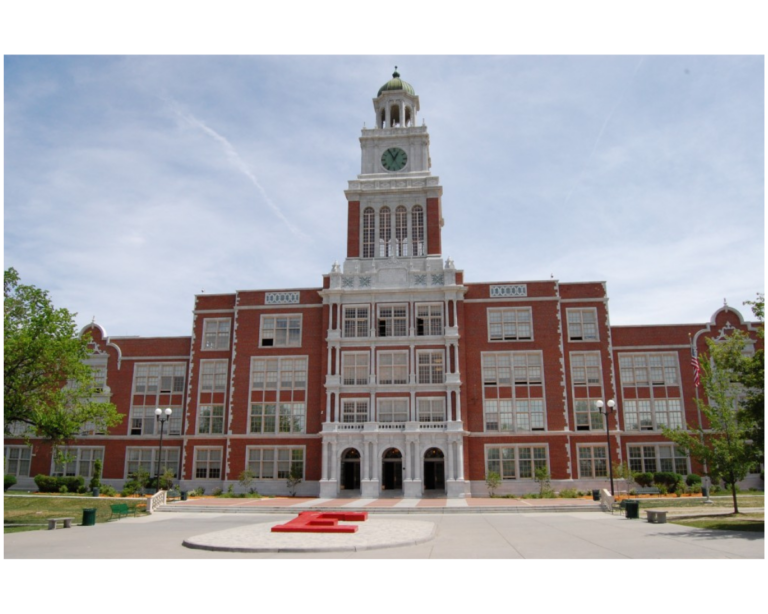
As Wednesday’s shooting of two administrators at East High School demonstrates in the starkest possible terms, the decision by the Denver Board of Education to remove school resource officers from high schools in 2021 was a grave mistake, and one with tragic consequences. Not surprisingly, no one involved is acknowledging this, at least not publicly.
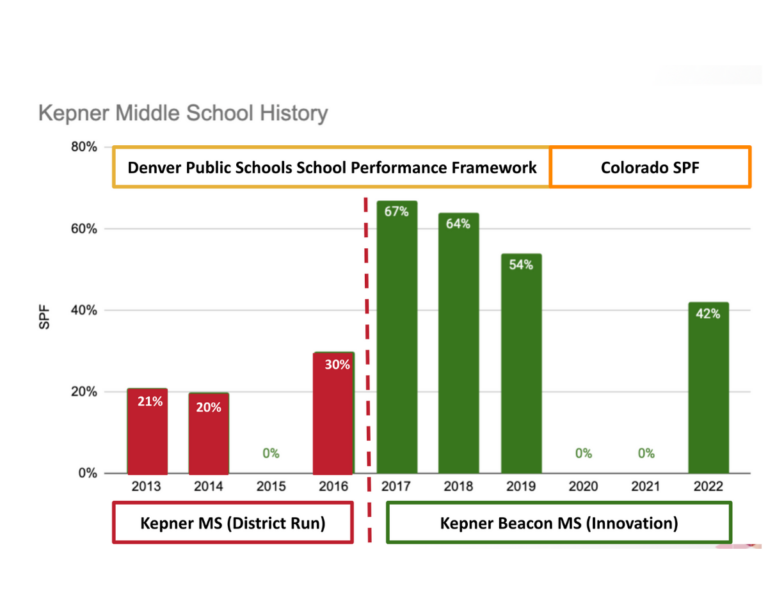
Why does DPS want to put an end to an organization that is showing promise? Power and control seem to be the answer.
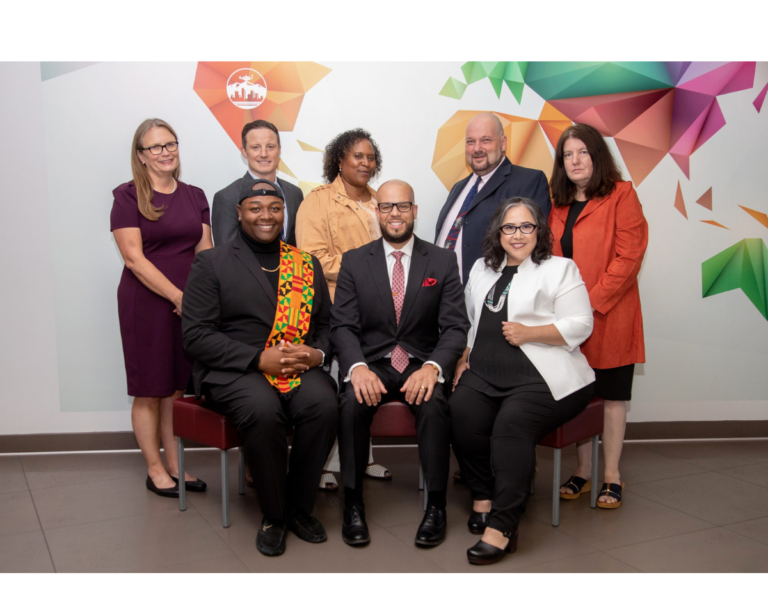
The school board might close three severely under-enrolled schools, and members are getting along, but they continue a drive toward less transparency.
The DPS board and leadership seem more interested in imposing their will and reining in innovative practices than in focusing on what we at Beacon Network Schools are doing to serve our students.

The simple, straightforward Denver Public Schools Debt Clock website, debuting today, serves as a stark reminder that postponing important decisions for political reasons can be costly -– literally as well as figuratively.
With Denver Public Schools innovation plan renewals coming up for votes over the next few months, we’ll be able to see in real time just how badly the school board has, with its meddling, damaged the concept of innovation.

Students, namely Black boys, are significantly more likely to graduate high school and enroll in college if they have a Black man as a teacher in elementary school. Black boys improve standardized test scores when they have Black men as teachers. Simply put, Black boys – and students more broadly – benefit from having Black men in the classroom.
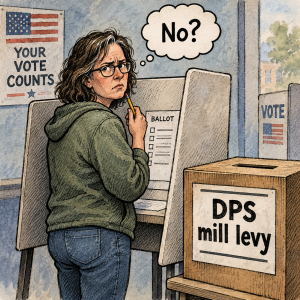
Maybe it is time for all of us to say NO to the board’s request for a $44 million mill levy tax increase. I am torn. Denver’s teachers need to be paid more. But I do not see how Denver will ever do better by most of its students without a clear plan, transparency, honest discussion of progress, and real accountability for student success — none of which this board has offered.

News broke midday Thursday that DJ Torres, who has served on the Denver Public Schools Board of Education, had resigned, effective immediately. So what happens now? And how will this affect the problematic board dynamics? We invited to the podcast to discuss this Parker Baxter, Scholar in Residence and Director of the Center for Education Policy Analysis at the School of Pubic Affairs at the University of Colorado Denver. Baxter is also a lawyer, and spent 20 years working on education policy, including a stint in the central office of Denver Public Schools during the Tom Boasberg era.

Alleged antisemitic statements by Denver school board member Monica Hunter aimed at her colleague Amy Klein Molk are problematic. Equally troubling, however, is why the superintendent and board president sat on them for nine months until it became politically expedient to release them. In this episode, co-hosts Alexis Menocal Harrigan and Alan Gottlieb discuss whether board relationships and trust in board President Xóchitl Gaytán and Superintendent Alex Marrero are irreparably damaged, and if so, what should happen as a result.
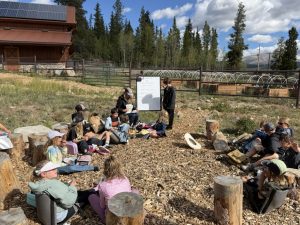
This is High Rockies Community School, a K-8 public charter school located at Sacramento Creek Ranch outside Fairplay. The four-day-a-week school is most notable for holding almost all of its instruction outdoors.

The Denver school board on Thursday, Sept. 17 voted unanimously to launch an investigation into allegations that board Director Monica Hunter made anti-semitic comments about fellow board member Amy Klein Molk, who is Jewish. In this episode, co-hosts Alexis Menocal Harrigan and Alan Gottlieb discuss the meeting’s bizarre twists and turns, and impacts on Denver Public Schools students, with Nicholas Hernández, executive director of the advocacy group Transform Education Now.

At the September 17 Denver Public Schools Board of Education public comment session, 14 people addressed the board and community about allegations leveled against two board members by the board President Xóchitl Gaytán, with an assist from Superintendent Alex Marrero. Two comments stood out, so we are publishing them here.

In its 2024–25 State of Charter Schools Report, the Colorado Department of Education concluded that charter schools had lower chronic absenteeism rates than non-charter schools in each of the previous three years.

In this episode, cohosts Alexis Menocal Harrigan and Alan Gottlieb discuss the latest Denver school board imbroglio, including potentially serious allegations, and its implications for Colorado’s largest school district.

Last week, Boardhawk published a detailed analysis of Denver Public Schools’ 2026 state test score (CMAS) data, as well as an evaluation of the state school performance framework rating of DPS. We invited the author of the piece, Cody Ostenson, on the podcast to discuss the findings.
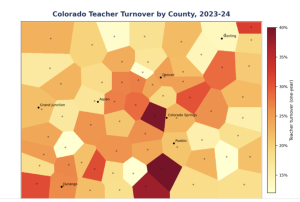
Students across rural Colorado have been back in school for a few weeks now. In far too many of their classrooms, they were greeted by a brand-new teacher. In some, they’ll find a rotating substitute, a class merged into one down the hall, or simply no permanent teacher at all, because the position was never filled. While not a perfect proxy for teacher effectiveness, the data that is available on turnover, vacancies, and certifications are the best available proxies we have in Colorado.


Should Denver voters say no to DPS mill levy?
Maybe it is time for all of us to say NO to the board’s request for a $44 million mill levy tax increase. I am torn. Denver’s teachers need to be paid more. But I do not see how Denver will ever do better by most of its students without a clear plan, transparency, honest discussion of progress, and real accountability for student success — none of which this board has offered.