We have made some progress. But we still send only 35% of our low-income students on to higher education, though the national average is 52%, even as more than 70% of jobs will soon require a college certificate or degree.
Colorado will soon have a new governor, and Denver, the state’s largest district and one of its most innovative over the past two decades, will, with any luck, have a new superintendent. New leadership is a chance for the state and my city to look freshly at where we are, what we’ve tried, and what’s actually working.
Because even in a fairly dismal statewide picture, there are some genuinely exciting bright spots.
A few districts, a handful of schools, and one Denver charter network in particular offer real lessons in how to prepare more students, and especially more low-income students, for college.
I recently went back through Colorado’s SAT files to answer one question: How many of Denver’s 11th-graders are leaving high school ready for college-level work, and how has that changed since the pandemic? The picture is even more dramatic than I expected.
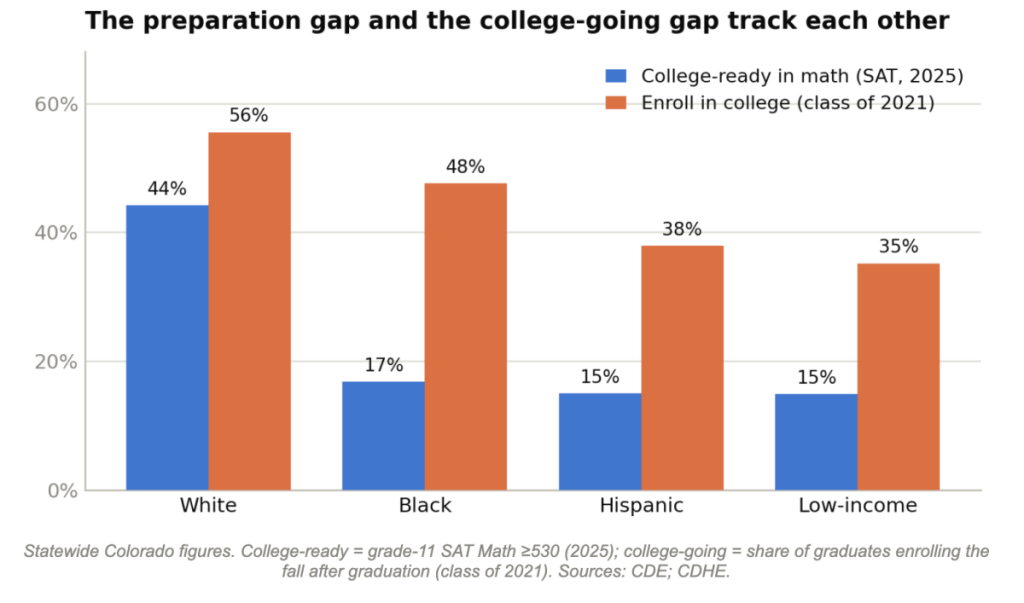
Start with the gap. In 2025, about 65% of Denver’s white 11th-graders cleared the SAT math college-ready benchmark, a score of 530, the point where the College Board estimates a student has a roughly 75% chance of earning at least a C in a credit-bearing college course. Among our Hispanic, Black, and low-income juniors, the figure is closer to 18%. That’s a three to four-fold gap, and here’s the most depressing part: it looks almost exactly the way it did in 2017. Eight years, a pandemic, several strategic plans, and billions of dollars later, the gap hasn’t budged.
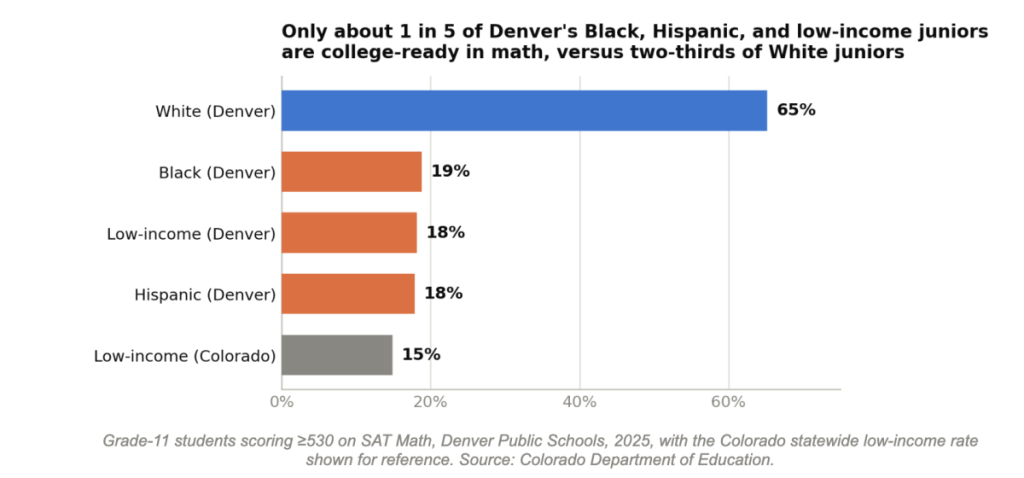 And for most groups, readiness didn’t just hold steady. It fell. The numbers dropped from 2017 to 2025 for Hispanic, Black, and low-income students at every level: state, district, and even at our highest-performing schools. White students are the lone exception, holding roughly flat near 63-65% in Denver (which raises all sorts of questions, but that’s a subject for another post).
Why does the SAT scale score of 530 matter so much? Because students who land below it are far more likely to be funneled into non-credit remedial courses (paying tuition and burning time on classes that don’t count toward a degree), and they finish college at markedly lower rates.
The stakes are enormous. A worker with a bachelor’s degree earns a median of about $2.8 million over a career, versus roughly $1.6 million for someone with only a high school diploma, a difference of about $1.2 million.
For all the noise about college being overpriced and irrelevant, most degrees still deliver a real return, and most good jobs in Colorado still demand college-ready skills. So when only 15 to 18% of our Black, Hispanic, and low-income juniors clear this bar, we are quietly narrowing their options for the rest of their lives.
The enrollment numbers tell the same story. Colorado is a national outlier in how few of its low-income graduates go on to college. Only about 35% enroll the fall after high school, compared with a national average of 52% and 64% in California. Statewide, overall matriculation held near 56% from 2016 through 2019, then dropped about six points with the pandemic classes and hasn’t recovered. We’re sending fewer of our graduates to college at the very moment a credential matters more than ever.
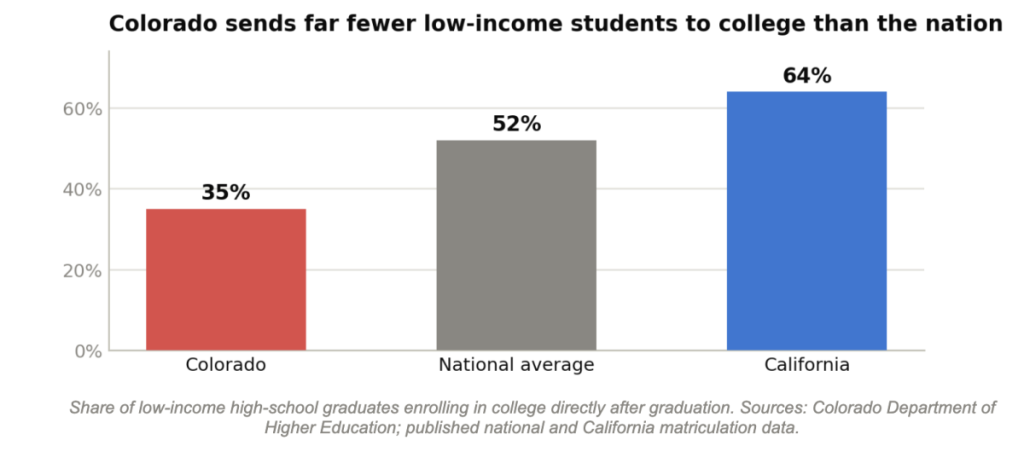
The students least likely to clear the SAT readiness bar are the same ones least likely to ever enroll. If we want more low-income students and students of color enrolling in and finishing college, we have to prepare more of them to succeed there.
So what can be done?
The clearest bright spot in the state is DSST, the public charter network whose schools are mostly authorized and overseen right here in Denver. DSST has quietly been propping up the entire district’s numbers and, in the process, masking how poorly the rest of Denver’s high schools are doing.
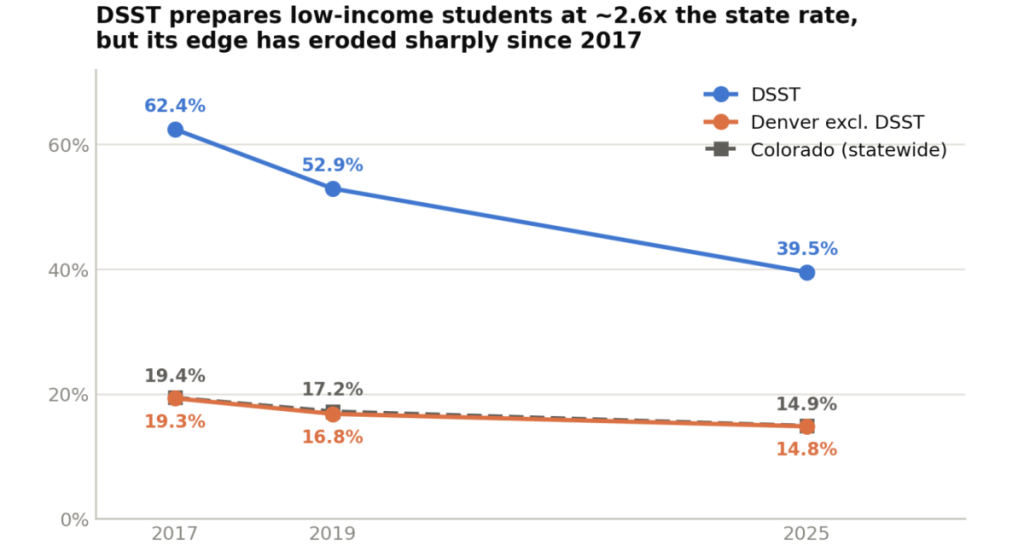
DSST prepares its Hispanic, Black, and low-income students for college-level math at two to three times the district rate. Its low-income readiness in 2025 was 39.5%, about 2.6 times the state’s rate for the same students.
DSST enrolls roughly 7,000 students in Denver, about 8 percent of the district, and that 8percent carries a startling share of Denver’s apparent edge over the state. Take DSST out of Denver’s numbers, and the rest of DPS sits at or below the Colorado average for those same students.
Much of what makes Denver look better than the state turns out to be concentrated in a single network.
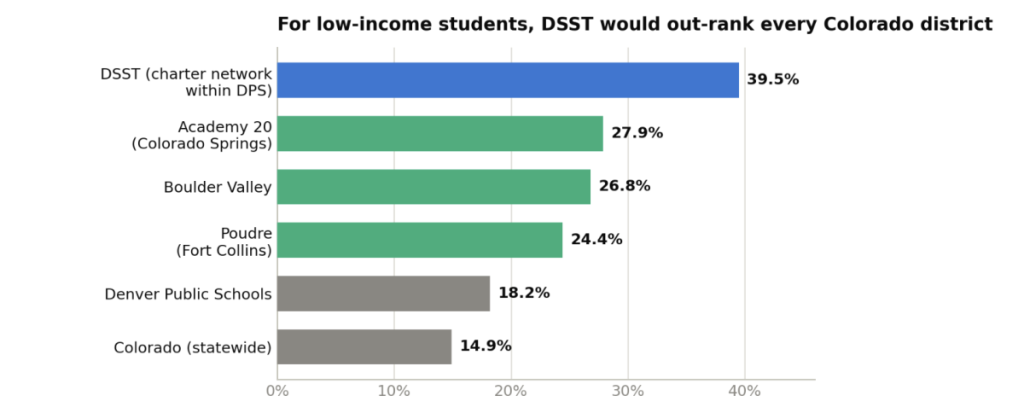
DSST isn’t the only bright spot, and low-income excellence isn’t a charter-only story. Among Colorado districts with a real low-income population (at least 100 students tested), the strongest performers in 2025 were Academy 20 in Colorado Springs (27.9%), Boulder Valley (26.8%), and Poudre in Fort Collins (24.4%), all well ahead of Denver’s 18.2% and the state’s 14.9%.
DSST, were it ranked as a district, would top the list. Traditional districts and charter schools, in very different parts of the state serving very different communities, are getting appreciably more of their low-income kids to a college-ready score. They are proof that demography is not destiny.
To be clear, DSST would be the first to say it has a lot of work left to do (all good schools do). Its edge has eroded sharply. Low-income readiness has fallen from more than 60% in 2017 to under 40% today, tracking the broader post-pandemic slide.
That erosion is its own warning: even our best models are losing ground, and no one should treat these schools as the answer. The point isn’t that DSST or Academy 20 has solved this. It’s that they are doing meaningfully better for the very students we most often fail, and neither Denver nor the state has made any real effort to understand why.
That’s the opportunity in front of the next superintendent and the next governor. Before we launch yet another districtwide initiative from scratch, we should study the schools already beating the odds.
What are DSST and the strongest districts doing in middle and early high school math, where the readiness gap first opens? How do they staff, schedule, and support the students who are behind? How do they build a culture where every student is expected to leave with a real post-high-school plan, and the preparation to pull it off?
This is the hardest work in public education. But we’ve seen schools, districts, and even entire states do it and make real change. With new leadership in both the state and my city, we have a rare chance to set a clear priority, and plenty of examples to learn from, here and throughout the country.
The only question left for our new governor and Denver’s next superintendent is whether we’re finally willing to learn from them.
A NOTE ON THE NUMBERS
College-ready is defined as meeting the SAT Math benchmark of 530, the score the College Board links to a roughly 75% chance of a C or better in a credit-bearing college course. Readiness figures for 2025 are counted directly from state benchmark data; 2017 and 2019, which report mean scores only, are modeled from each group’s score distribution (a method that matches the 2025 actuals to within about 1.5 points). Colorado’s SAT moved from paper to digital in 2024, so year-to-year changes are best read as direction rather than precise point differences. “Denver excl. DSST” removes DSST students from the district total by weighted subtraction.
SOURCES
• College Board: SAT college and career readiness benchmarks (Math 530).
• Center for American Progress: remedial education and college completion.
• Georgetown University Center on Education and the Workforce: “The College Payoff” (2021).
• Georgetown CEW: projections of jobs, education, and training requirements.
• National Center for Education Statistics: immediate college enrollment rate, by family income.
• California Department of Education: college-going rate data.
• Colorado Department of Education: grade-11 PSAT/SAT results and data (2017/2019/2025).