

A member of the DPS Budget Advisory Committee reflects on how its processes and outcomes could have been improved.

A deal cut last week between Denver Public Schools and the Denver Classroom Teachers Association blew a big hole through the plan to give the biggest raises to the lowest-paid workers.
A powerful column excerpted here places the debate about neighborhood schools within the context of the Black Lives Matter movement. A provocative read, especially for progressives.

Gather your allies and your strength now while our minds and hearts truly feel the injustices borne by our students every day. Plan bold steps that go beyond addressing symptoms and that finally cut to the heart of what we know is unjust with our system.

Let’s, for argument’s sake, give these individuals and groups that want to eliminate accountability and measurement their way. Let’s stop measuring anything and just trust that teachers will get it right. Then let’s come back together in five years and see what our graduation, dropout, and remediation rates look like, not to mention our achievement gaps.

DPS employee associations are pushing for budget cuts that don’t touch negotiated teacher pay raises. That’s a tough case to make, given the $61 million in cuts that are looming.

Two school leaders who served on the Reimagine SPF committee for Denver Public Schools offer a counterpoint to a recent column that was critical of some of the committee’s recommendations

I implore you to watch the first 15 minutes of last night’s school board meeting, and to hear the words of the board’s two African American directors.

In the wake of the murder of George Floyd — say his name — if the response is business as usual: More excuse making. More complaints and resistance. More scapegoating of COVID-19, then the bold action that we must take is EXODUS.
Note: This post has been updated with more detail about when the threshold for school board approval for purchases was raised to $1 million. It also puts into perspective how far below past limits the current proposal to lower the threshold to $100,000 would be.

Denver voters have approved mill levy overrides before. DPS collected $369.6 million last year from seven voter-approved overrides dating to 1988. That history is exactly why voters deserve specifics. A district that has been trusted this many times should be able to say what the next dollars will do.

Three eventful years into his tenure on the Denver Public Schools Board of Education, board member John Youngquist discusses where the board’s focus should be as it emerges (we hope) from a period of tumult, in-fighting and dysfunction.
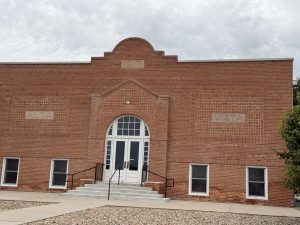
A rural school outside of Lamar converted to a charter almost 30 years ago. Alta Vista’s conversion history may be bordering on ancient, but it now holds potential relevance for communities across Colorado.

We asked Denver Classroom Teachers Association President Rob Gould, and Vernon Jones, a community advocate and executive director of FaithBridge, onto the show to discuss the mill levy, reasons voters should approve it, and to answer some questions about why maybe some voters should be skeptical that it’s a good idea. We also discussed board and district leadership and whether there need to be changes.
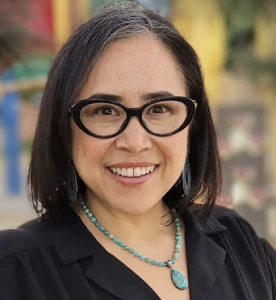
It is time for the board to call for new leadership of the body. A new officer election would give members an opportunity to reconsider that leadership and publicly articulate the expectations they have of those serving as president, vice president, and other offices.

Recently, I’ve heard people question whether Denver should make another investment in our schools because of the disagreements and challenges happening among adults in the district. As a student, that is hard for me to understand. Whatever concerns adults have about leadership, governance, or accountability, taking investment away from students because of adult behavior feels like punishing us for decisions we did not make.
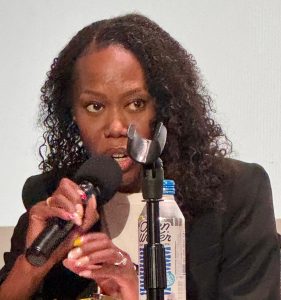
The Denver school board on Thursday, October 8, censured Director Monica Hunter for allegedly making anti-Semitic statements about a fellow board member. The censure followed a quick investigation by an outside party, and while the findings of the investigation were inconclusive, the board decided on a 4-2 vote that there was enough evidence to merit the censure. Potential conflicts of interest with Hunter’s employment also contributed to the decision to censure her. In this episode, co-hosts Alexis Menocal Harrigan and Alan Gottlieb discuss the fallout.
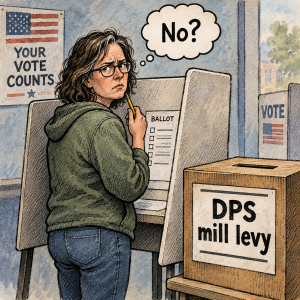
Maybe it is time for all of us to say NO to the board’s request for a $44 million mill levy tax increase. I am torn. Denver’s teachers need to be paid more. But I do not see how Denver will ever do better by most of its students without a clear plan, transparency, honest discussion of progress, and real accountability for student success — none of which this board has offered.

News broke midday Thursday that DJ Torres, who has served on the Denver Public Schools Board of Education, had resigned, effective immediately. So what happens now? And how will this affect the problematic board dynamics? We invited to the podcast to discuss this Parker Baxter, Scholar in Residence and Director of the Center for Education Policy Analysis at the School of Pubic Affairs at the University of Colorado Denver. Baxter is also a lawyer, and spent 20 years working on education policy, including a stint in the central office of Denver Public Schools during the Tom Boasberg era.

Alleged antisemitic statements by Denver school board member Monica Hunter aimed at her colleague Amy Klein Molk are problematic. Equally troubling, however, is why the superintendent and board president sat on them for nine months until it became politically expedient to release them. In this episode, co-hosts Alexis Menocal Harrigan and Alan Gottlieb discuss whether board relationships and trust in board President Xóchitl Gaytán and Superintendent Alex Marrero are irreparably damaged, and if so, what should happen as a result.



Before voters approve a $44 million DPS tax hike, tell us what will change
Denver voters have approved mill levy overrides before. DPS collected $369.6 million last year from seven voter-approved overrides dating to 1988. That history is exactly why voters deserve specifics. A district that has been trusted this many times should be able to say what the next dollars will do.