
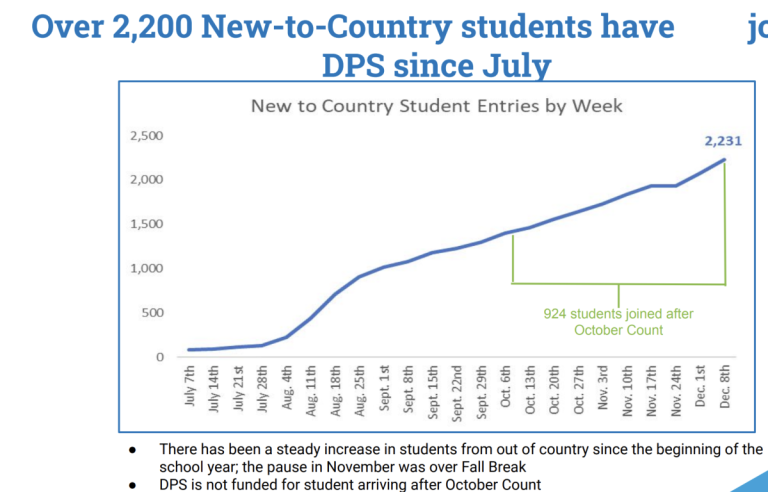
More than 2,200 new students have arrived since the start of the school year. DPS has been planning for slow, steady enrollment declines for the foreseeable future, and this throws planning into disarray. There’s no way to know how long the influx will continue, how many of the new arrivals will stay, or for how long.
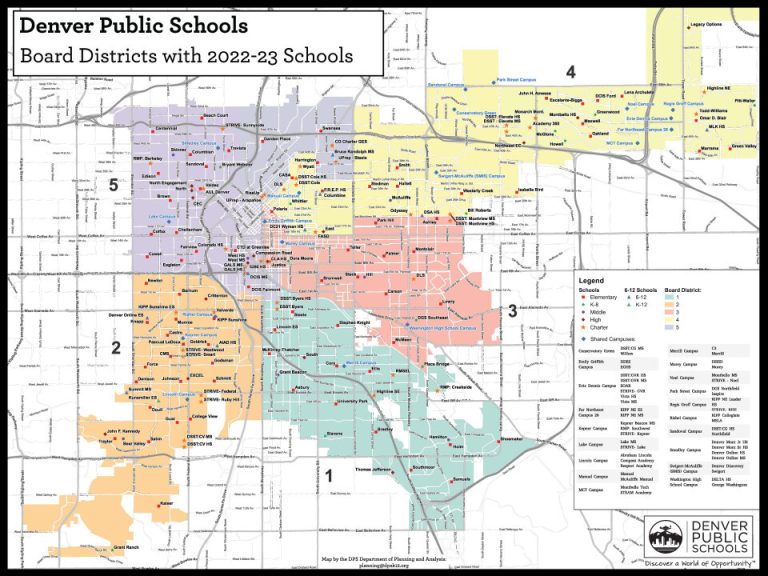
In this inaugural piece by new Boardhawk columnist Alexis Menocal Harrigan, she argues that the Denver school board’s foot-dragging on drawing new director district essentially disenfranchises some voters.
Last Thursday’s unfortunate action by the holdover board members delays the return of meaningful accountability to the leadership of DPS. And, as usual, it is the city’s children who will pay the price.
What does Denver Public Schools tell us, in light of the achievement scores from year one? Has any district leader involved in the design and implementation come forth to acknowledge the bad news?

While it’s not unusual for newly elected officials to want to make a mark, in this case doing so is essential to begin restoring confidence in a school district that has lost the trust of its community.

“Mental health” counselors intend to alleviate the “trauma” students encounter in their daily lives. While the intention is noble, the practice is varied, with most students quickly realizing the power of victimhood in our society.

Educators should come together to solve issues for students. Currently, DPS leans on investigation rather than collaboration. This is not good for our students.

While the new board may remain deeply divided with the new board members in the minority, the momentum towards having a new board majority and agenda is strong and growing. The magnitude and pace of the board’s new agenda will depend entirely on who leads the board.

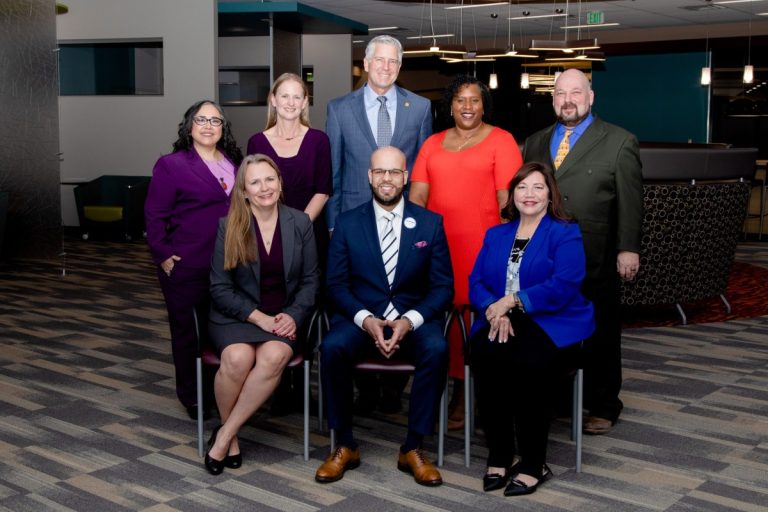
It has been a rough two years for DPS, led by an inept and dysfunctional school board that could not get out of its own way. The three new members who will be joining the board later this month – Kimberlee Sia, Marlene De La Rosa, and John Youngquist – bring a wealth of relevant experience and steady hands to a thankless job.
These two evaluations are starkly different for an obvious reason: The majority of the 2020 board was eager to nudge Cordova out the door. The current board seems desperate to hang onto Marrero, twice bestowing raises and contract extensions upon him for no apparent reason.
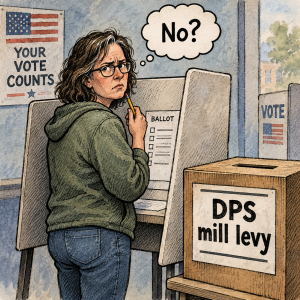
Maybe it is time for all of us to say NO to the board’s request for a $44 million mill levy tax increase. I am torn. Denver’s teachers need to be paid more. But I do not see how Denver will ever do better by most of its students without a clear plan, transparency, honest discussion of progress, and real accountability for student success — none of which this board has offered.

News broke midday Thursday that DJ Torres, who has served on the Denver Public Schools Board of Education, had resigned, effective immediately. So what happens now? And how will this affect the problematic board dynamics? We invited to the podcast to discuss this Parker Baxter, Scholar in Residence and Director of the Center for Education Policy Analysis at the School of Pubic Affairs at the University of Colorado Denver. Baxter is also a lawyer, and spent 20 years working on education policy, including a stint in the central office of Denver Public Schools during the Tom Boasberg era.

Alleged antisemitic statements by Denver school board member Monica Hunter aimed at her colleague Amy Klein Molk are problematic. Equally troubling, however, is why the superintendent and board president sat on them for nine months until it became politically expedient to release them. In this episode, co-hosts Alexis Menocal Harrigan and Alan Gottlieb discuss whether board relationships and trust in board President Xóchitl Gaytán and Superintendent Alex Marrero are irreparably damaged, and if so, what should happen as a result.
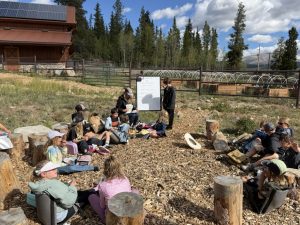
This is High Rockies Community School, a K-8 public charter school located at Sacramento Creek Ranch outside Fairplay. The four-day-a-week school is most notable for holding almost all of its instruction outdoors.

The Denver school board on Thursday, Sept. 17 voted unanimously to launch an investigation into allegations that board Director Monica Hunter made anti-semitic comments about fellow board member Amy Klein Molk, who is Jewish. In this episode, co-hosts Alexis Menocal Harrigan and Alan Gottlieb discuss the meeting’s bizarre twists and turns, and impacts on Denver Public Schools students, with Nicholas Hernández, executive director of the advocacy group Transform Education Now.

At the September 17 Denver Public Schools Board of Education public comment session, 14 people addressed the board and community about allegations leveled against two board members by the board President Xóchitl Gaytán, with an assist from Superintendent Alex Marrero. Two comments stood out, so we are publishing them here.

In its 2024–25 State of Charter Schools Report, the Colorado Department of Education concluded that charter schools had lower chronic absenteeism rates than non-charter schools in each of the previous three years.

In this episode, cohosts Alexis Menocal Harrigan and Alan Gottlieb discuss the latest Denver school board imbroglio, including potentially serious allegations, and its implications for Colorado’s largest school district.

Last week, Boardhawk published a detailed analysis of Denver Public Schools’ 2026 state test score (CMAS) data, as well as an evaluation of the state school performance framework rating of DPS. We invited the author of the piece, Cody Ostenson, on the podcast to discuss the findings.
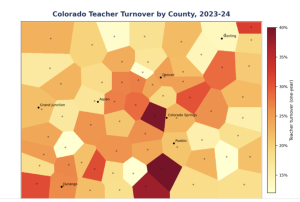
Students across rural Colorado have been back in school for a few weeks now. In far too many of their classrooms, they were greeted by a brand-new teacher. In some, they’ll find a rotating substitute, a class merged into one down the hall, or simply no permanent teacher at all, because the position was never filled. While not a perfect proxy for teacher effectiveness, the data that is available on turnover, vacancies, and certifications are the best available proxies we have in Colorado.

Should Denver voters say no to DPS mill levy?
Maybe it is time for all of us to say NO to the board’s request for a $44 million mill levy tax increase. I am torn. Denver’s teachers need to be paid more. But I do not see how Denver will ever do better by most of its students without a clear plan, transparency, honest discussion of progress, and real accountability for student success — none of which this board has offered.